Stone Industry trends in large-format tile
When it comes to today’s residential and commercial applications, larger tile sizes are all the rage — making for unique stylish designs
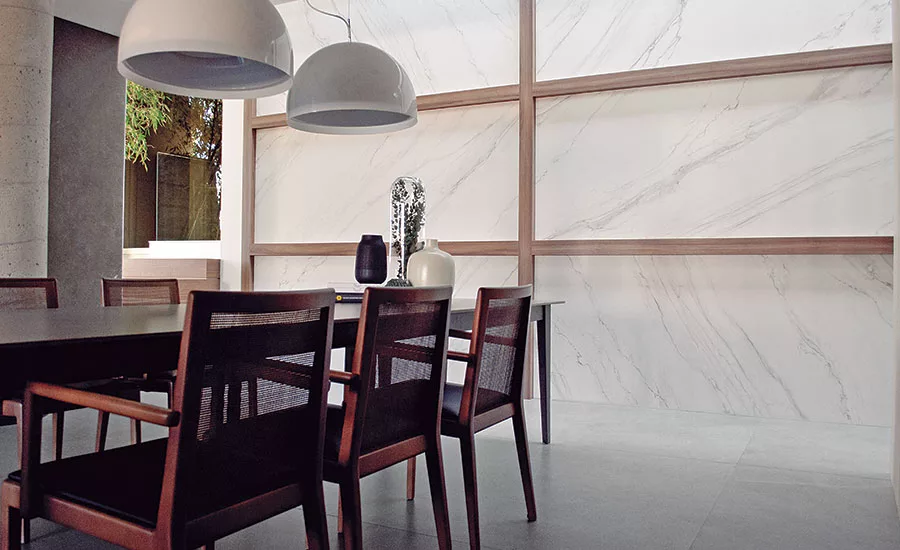
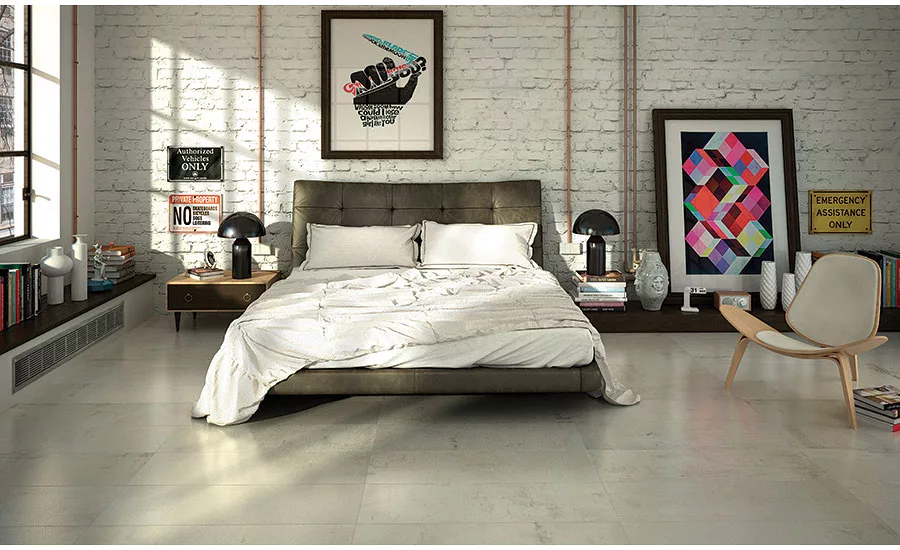
Today's tile collections are embracing natural-inspired looks such as stone, wood and concrete, such as the Regeneration series by Soci.
Photo courtesy of Sogi
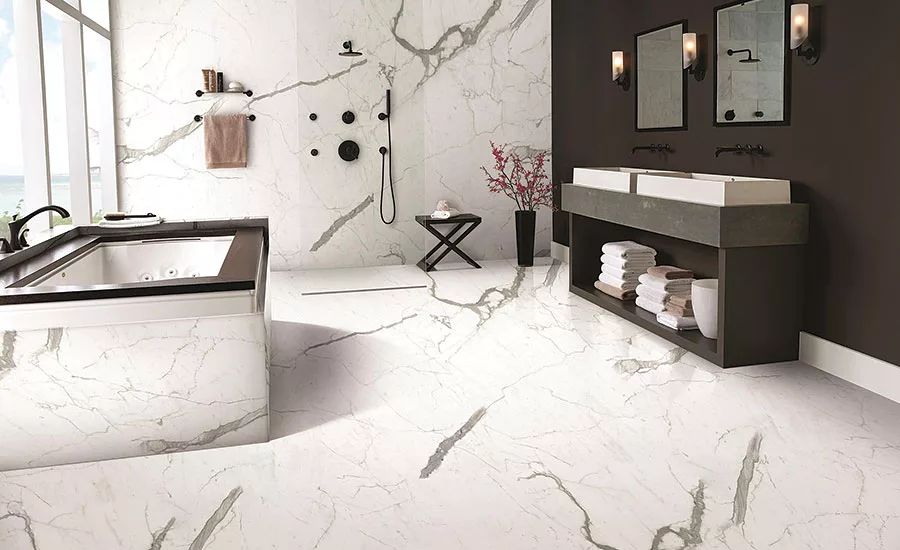
Large thin porcelain panels, such as those in M S International, Inc.'s Stile series, are being employed for both floor and wall applications.
Photo courtesy of M S International, Inc.
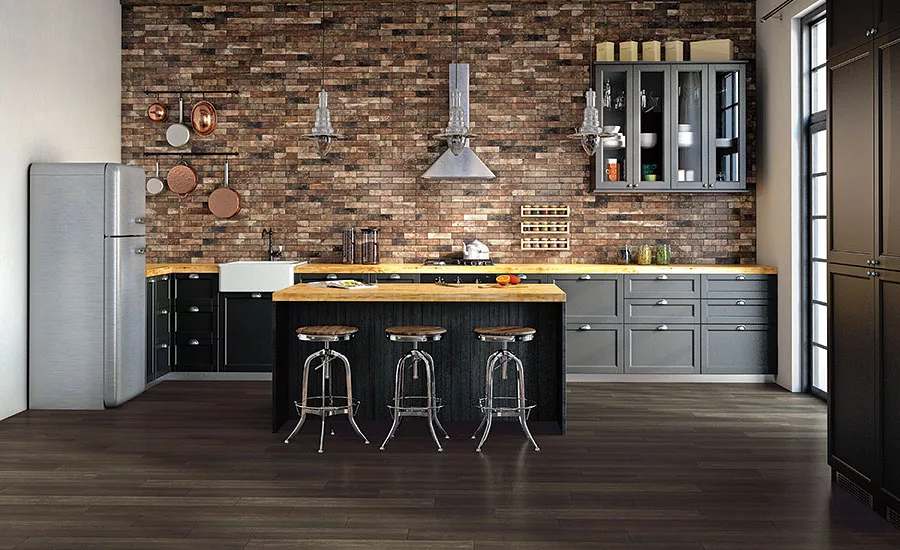

Available in various textures, large-format tiles, such as those in the GA by GIUGIARO line from Del Conca, offer diverse options to make unique designs with a three-dimensional effect.
Photo courtesy of Del Conca
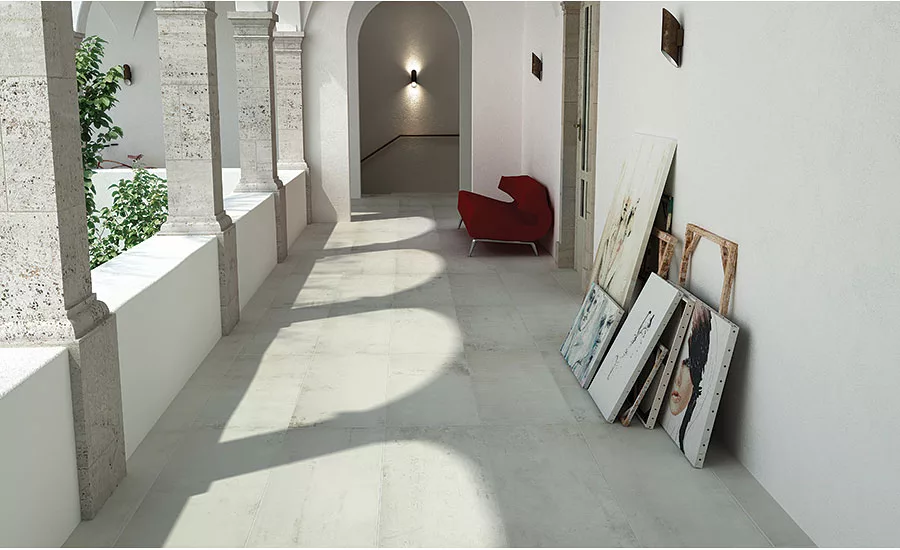
Oversized tiles are ideal for outdoor applications such as walkways.
Photo courtesy of Soci
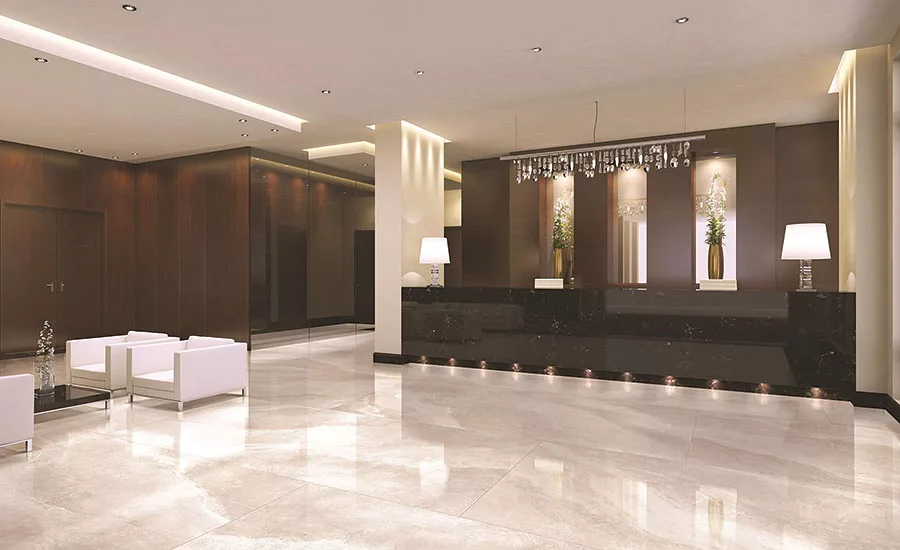
Porcelain slabs, such as those available in the Quantum Stone collection by Mediterranea, can create a seamless and grand floor design in spaces such as commercial lobbies.
Photo courtesy of Mediterranea
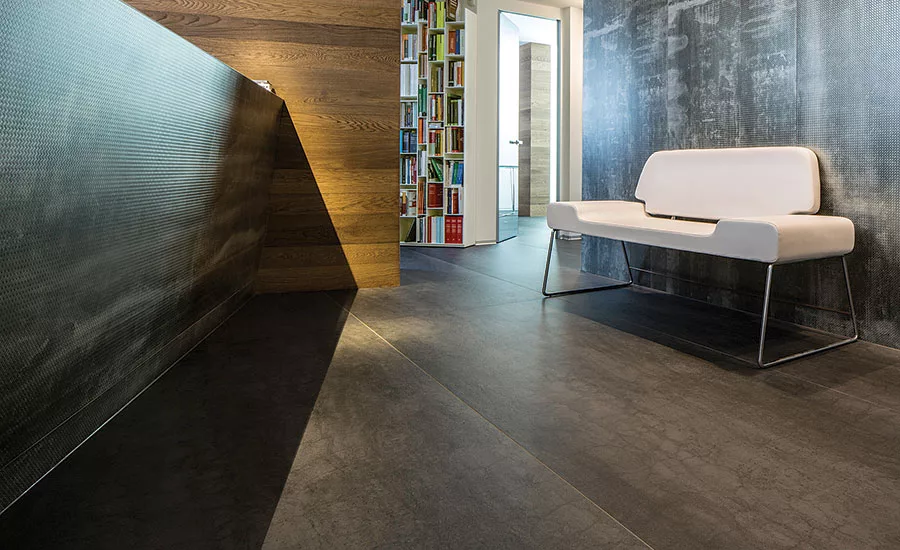
According to some designers, large-format tiles and slabs are preferred options when it comes to developing an open space.
Photo courtesy of Laminam
Large-format tiles are constantly evolving. When they were first introduced to the indus-
try, “large-format” encompassed tiles that measured one or two feet in width and length. Now, after roughly a decade of development, “large-format” has been defined as any tiles ranging from 12 x 24 inches to 40 x 120 inches, and in some cases, even larger.
When these types of tiles first began picking up momentum in the industry, the term “thin porcelain tile” was coined, since the majority of the tiles being produced in larger formats were made of porcelain. Widely referred to as “TPT,” these types of tiles became increasingly popular for designers and fabricators alike. As a result, various manufacturers began producing larger sizes in different materials such as ceramic, glass and even sintered stone. As the sector began to grow, so did the thicknesses that were offered — pushing the limits of how thin and thick these pieces could be.
To keep up with the ever-changing trend, the Tile Council of North America (TCNA) — an international trade association dedicated to expanding the market for ceramic tile manufactured in North America — is continuously developing different standards. The organization recently focused its efforts on properly defining this realm of tiles, which now incorporates all types of materials and sizes. When unveiling this year’s edition of the TCNA Handbook at the recent edition of Coverings, the international tile and stone exhibition held annually in the U.S., association members explained how “TPT” will no longer exist in the world of tile. Given the wide range of sizes and thicknesses created over the last 10 years, the TCNA has now defined “TPT” as “gauged porcelain tiles,” and designated any products under one square meter as “tiles” and any products exceeding one square meter as “tile panels/slabs.”
To get an inside look at how these large-format materials have transformed the market since their inception, Contemporary Stone & Tile Design (CSTD)spoke with a handful of industry professionals. The panelists, who provided us with an in-depth look from several different perspectives, included Michele Alfano, interior architect and founder of MODmadeNY Studio in Rockland County, NY; Massimo Ballucchi, director of product design for Daltile Corp. in Dallas, TX; Gloria Graham-Sollecito, AKBD in Lake Worth, FL; Paolo Mularoni, president of Del Conca USA in Loudon, TN; and Devrim Tas, general manager of Ege Seramik America Inc. in Norcross, GA, and Ege Seramik Foreign Trade Co. in Istanbul, Turkey.
From an architectural and design standpoint, large-format tiles are commonly employed in residential areas with high traffic such as kitchens and bathrooms, according to Alfano and Graham-Sollecito. “Lately, I am also seeing opportunities for tile ‘feature walls’ and a lot of great dimensional tile options for that application,” said Graham-Sollecito.
Both designers said they’re drawn to using these larger formats when creating an open space. “They make a space feel bigger,” said Alfano. “There are less grout lines and large slabs or large-format tiles also give a high-end look.”
“As contemporary design continues to gain in popularity, simplification is the goal even in more traditional settings,” added Graham-Sollecito. “I love large-format tiles for the cleaner look they provide, fewer grout lines and less visual interruption.
“As far as size goes, I am drawn to rectangular shapes,” she went on to say. “I think they’re more interesting than squares. Size is determined by the dimensions of the room. For example, 24 by 48 inches is easy to use most places, but 30 by 60 inches is very popular. It’s definitely a newer fresher look, and more contemporary.”
Since Alfano and Graham-Sollecito mainly work on residential spaces, they noted how floors and walls are the main areas where they’re observing larger tiles being used. However, with the introduction of new sizes and thicknesses, other options are being considered now as well. “Although I concentrate on kitchens and bathrooms, tile is always a great option for literally any room in the house because it is versatile and so easy to care for,” explained Graham-Sollecito. “The ¼-inch-thick tile installed over existing flooring is a convenient option for remodels.”
“On walls, they appear as accent walls, almost wallpaper-like and are a nice alternative to paint,” added Alfano.
Despite the newer shapes and patterns being created, Graham-Sollecito has noticed how the “standard-sized” large-format tiles — 12 x 12 and 12 x 24 inches, etc. — are becoming less popular. “I rarely see 12- by 12-inch tiles anymore,” she said. “I’d say the smallest square option would be 18 by 18 inches. The 40- by 40-inch format is a popular, current, go-to size (if a square shape is preferred) and 30 by 60 inches is very popular, too. The biggest size I have seen is 118 by 40 inches. I have used porcelain for kitchen counters, too, not only for the look, but because they are not porous. This makes for a counter that is sanitary and won’t stain.”
Design versus manufacturing
When talking with some well-known manufacturers, who produce tile nationally and internationally, they told CSTD that they’re seeing these large-format tiles and panels/slabs utilized in both commercial and residential settings, given their durability and ease of maintenance. “Larger tiles are currently used for commercial projects more than residential projects,” explained Tas. “However, in southern states where the climate allows tiles to be installed in living rooms and larger spaces as an alternative floor covering material to carpet and wood, we believe larger tiles will also become more popular for residential projects as well.”
“Customers are seeing impressive large-format installations in hospitality settings, malls, restaurants, etc., and are becoming inspired to replicate the look in their own home,” added Ballucchi. “They like the clean look with less grout joints and a more high-end designer feel. Right now, we are seeing installations in high-end residential settings, but it will likely become more mainstream. The Southwest, California, Texas and Florida are early adopters and are highly influenced by Asian and European imports, so we have also seen an increase in installations of large-format in those regions.”
“In Europe, we’re seeing them used for both settings,” said Mularoni. “Probably in the U.S., they’re used more for commercial projects, but the gap is shrinking.”
Being tile trends differ from continent to continent, manufacturers take different aspects into consideration when developing new products for certain regions of the world. “Europe and Asia have been early adopters of the large-format tile trend and design trends in general, so we get a lot of inspiration from overseas,” said Ballucchi. “When we go to develop new products and decide on sizing and shapes, we have to consider the material we are trying to replicate. Will a marble look best on larger pieces or a wood-grain more accentuated on a longer plank? In some instances, the same visual can look entirely different on a large rectangle versus a linear plank or even a smaller mosaic.”
“Every region in the world has its own taste in terms of sizes, colors and design,” added Tas. “We do see a similar variation — even within the U.S. North America has always been a market where people tend to use natural colors and earthy tones in their living spaces. Therefore, when developing products specifically for this market, our main inspiration comes from nature. We cooperate with a few top European design houses to develop the popular looks and create cutting-edge products for our partners in the marketplace.
“In addition, Turkey is one of the best places where you have access to countless different types of natural stones, which definitely inspires us while developing products for the U.S. market,” he went on to say. “But regardless of the design, consumers in the marketplace are expecting the most natural outcome. In order to achieve that, Ege Seramik continuously invests in its digital printing technologies, keeps its machinery up-to-date and focuses on the fine tuning of our products.”
“The process is similar for all markets, but each area of the world has a different taste and perks,” added Mularoni. “For instance, in North America the pink color is a ‘no-no,’ and in Germany, only subtle color variations work. The classic source of inspiration is always nature, with stone and wood being the evergreens that always get updated. Now, technology gives us more opportunities so we are able to incorporate inspirations that come up from the collaboration with architects like Giugiaro Architettura or artists like Manara and Monkey Punch (a Japanese cartoonist) or let us experiment blending looks together. Another source of inspiration is the vast landscape of design furniture that is present in Italy; that always helps set the trends of interior decor.”
Although inspiration is drawn from all different areas, this trio of manufacturers agreed that natural materials are the most popular source nowadays. “Organic materials — anything that resembles the look of natural marble, slate, wood, brick, etc., are really popular right now,” said Ballucchi. “You can see that in Marazzi’s Urban District collection with brick-look and wood plank variations. Also, Daltile’s Marble Attache is a beautiful example of how we have taken an actual scan of rare marble and replicated it on tile.”
“Nicely defined natural stone looks like travertines, marbles and mono-color slates are still considered safe for everyday sale,” added Tas. “Our Arya, Jupiter and Mirage series [which replicate these looks] received a great amount of attention at Coverings. Wood planks with almost limitless designs in sizes 6 by 24, 6 by 36 and now 8 by 48 inches are among the most popular collections.”
“Inspiration comes from the natural elements — not just copying them — and it is then essential to bring the design one step further,” explained Mularoni. “At Coverings, we launched a new collection by Del Conca USA that combines a wood, concrete and fabric look called Allegria, and it was very well received. The same happened with Artelegno by Ceramica del Conca (Del Conca), a wood look we reinterpreted adding a ‘watercolor’ look to it that makes it very unique, edgy, but still reminiscent of wood, the natural material that gives us a warm and cozy feeling.”
Although Daltile, Del Conca and Ege Seramik have been successful with reinterpreting natural materials, they’re beginning to focus on a newer trend that’s emerging, as well as newer sizes. “On the horizon, we will be seeing a lot of inspiration from woven textiles as customers continue to look for warmth and texture in their spaces,” said Ballucchi. “We will see these in classic muted tones, but with some bold multi-color and accent options to complement and really make a space unique.”
“It is a reality that sizes are becoming larger, but we should not get carried away — regular sizes are still making up for most of the quantity,” added Mularoni.
Tas and Ballucchi believe 12- x 24- and 24- x 24-inch formats are still popular, but larger sizes will soon supplant the need for smaller sizes. “Our best-selling size in the U.S. market is still 12 by 24 inches,” said Tas. “The U.S. is a traditional market where things do not change as fast as they do in other parts of the world. However, we expect 18- by 36-inch tiles to replace the 12- by 24-inch size within the next few years. On the commercial side, we are very hopeful that the 24- by 48-inch size will do great. As far as the planks are concerned, our best-selling size is 6 by 36 inches.”
“We are not only seeing 24- by 48- and 18- by 36-inch sizes becoming more standard offerings alongside the already popular 12- by 24- and 24- by 24-inch formats, but we are seeing unique sizes and shapes coming to market,” added Ballucchi.
Other uncommon sizes are also emerging with great success, according to Mularoni. “Among larger sizes, we are having very good results with 32 by 32 inches, 16 by 32 inches and the 40- by 48-inch planks,” he said. “They are larger than the common sizes used now, they enhance the look of the product and of the room, but they are still ‘manageable’ in terms of transportation, handling and installation. Bigger slabs are beautiful objects, but so far the market is such a small niche that it is not interesting.”
Looking toward the future, it’s assumed that sizes will continue to grow, with technology playing a major factor. “Thanks to developing production technologies, like many other products, floor covering products have gotten better over the years in terms of design, definition, size, texture, finish and durability,” said Tas. “All of these variables combined add an incredible value to the final product. The reason behind the popularity of large-format tile is very simple: it allows you to see a piece of art without having your perception interrupted with grout lines.”
“The product in a larger-sized tile is much more eye catching,” added Mularoni. “You’re able to see the graphic much better and bigger tiles are new things that have recently become available, since technology was not so advanced in the past.”
Additionally, the ability to produce a product within the U.S. is a huge game changer for the industry, in terms of product availability and access, since a good portion of manufacturers are internationally based. “With Daltile Corp.’s new plant in Dickson, TN, our manufacturing capabilities are becoming incredibly sophisticated,” said Ballucchi. “We are able to bring larger sizes to the market domestically that were previously only available overseas or as imports, and that is really exciting.”
Looking for a reprint of this article?
From high-res PDFs to custom plaques, order your copy today!