Care And Maintenance Of Slate Flooring
Care and maintenance of slate flooring is not complicated, for the main reason for slate flooring problems can be blamed on neglect.
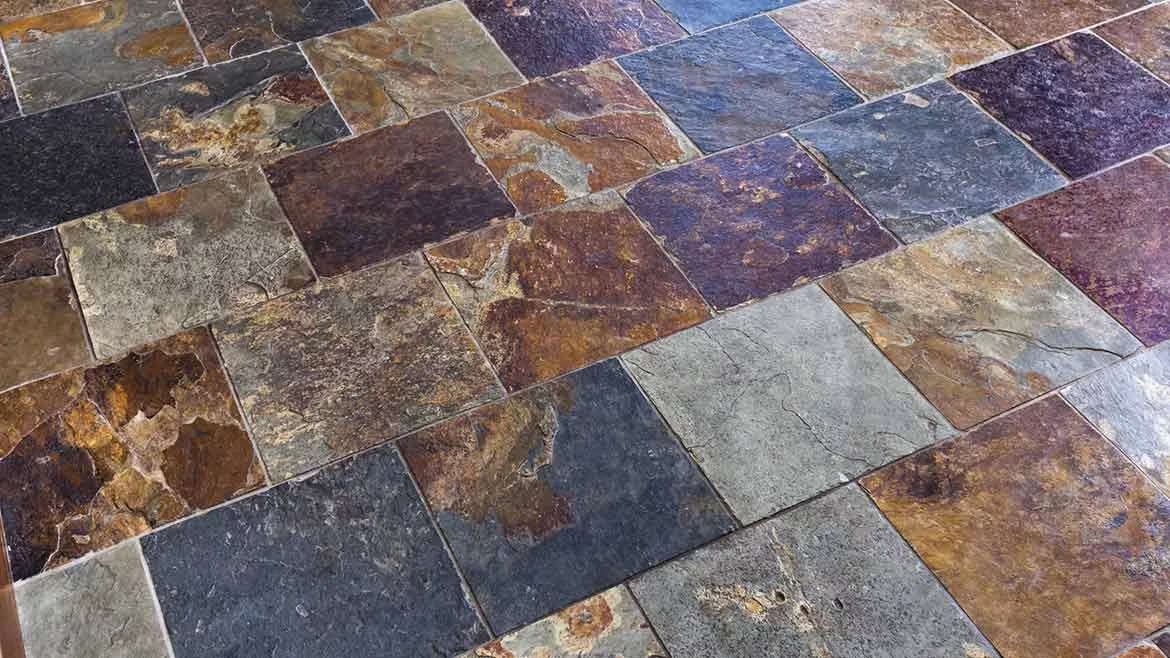
Image courtesy of: JamesBrey /iStock / Getty Images Plus / via Getty Images
What is slate?
Slate is a stone which has been metamorphosed from shale -- that is, it consists of clay-like materials that have undergone change under heat and pressure. In other words, slate can be recognized by its sheet-like structure. The material is usually thin, and if broken in half, will flake off into sheets. Slate is seldom highly reflective unless a coating is placed on it, and its surface is usually uneven unless machine-sanded.
Slate is made up of minerals of quartz and illite. You will also find minor amounts of mica, calcite and other minerals. Red-colored slates contain hematite, which gives them their red color. Greens contain chlorite and blacks and grays contain carbon and/or graphite. The reddish tans are the result of iron oxides. Although slate can be purchased in 12- x 12-inch tiles, random patterns of varying shapes are very popular as well.
Basic slate floor cleaning
The actual care and maintenance of slate flooring is not a complicated subject. In fact, the main reason slate flooring gets dirty or ruined can be traced to simple neglect.
Let's suppose you've just purchased a brand-new car -- and you never wash it. Soon enough the paint will fade, the body will rust, and the car will cost you a small fortune to restore. On the other hand, if you make the effort to wash it on a regular basis and throw a coat of wax on it every now and then, it will look as good as new for years. This is exactly what you need to do for slate flooring. Keep it clean and protected, and it will last until the kids move out -- and may even be around when they move back in. To keep your slate flooring in tip-top condition, a few simple maintenance procedures are necessary. For best results, they should be followed very closely.
Dust-mopping -- Of all the procedures used to maintain slate flooring, dust mopping is probably the most important. Dust, dirt and grit are what cause most surfaces to scratch and mar. If we could somehow eliminate them, this would cease to be a problem. Several studies have indicated that floors, which are dust-mopped often, stay cleaner and shinier longer. Dust mop your floor daily. If traffic is heavy, or the floor is located in a commercial building, do it several times a day. Remember, do not use oil-treated dust mops on slate flooring.
When dust mopping, be sure to run the dust mop in one direction only. Do not move it back and forth. Think of it as pushing the dirt in only one direction. When you have accumulated enough dirt and debris, pick it up with a dustpan and brush and take the dust mop outside to shake any remaining dust. When storing the dust mop, be sure to keep its head off the ground. Hardware stores sell various hangers, which are excellent for storing mops and brooms.
Designate only one dust mop for each type of surface. For example, you should use one dust mop for your slate flooring and a separate one for other tile or wood floors. Do not get the dust mop wet; if the floor is wet, be sure to dry it before dust mopping. Purchase a good-quality machine-washable mop and keep it clean. Wash it in cold water with laundry detergent and machine-dry.
Welcome mats, rugs and walk-off mats -- Another important tool necessary for keeping dirt and debris off your slate floors is some type of mat, rug or what is commonly called a walk-off mat. A good-quality mat will capture dirt before someone walks on the floor. If it is placed outside your door, it is only human nature and common courtesy for people to wipe their feet before entering the house. Studies have shown that it takes approximately seven steps to remove most loose dirt from one's shoes. For this reason, I would recommend placing mats both inside and outside.
There are hundreds of mats and rugs on the market today. Be sure to purchase one of good quality. Be careful about using rubber- or jute-backed mats or rugs on slate flooring; either kind of backing can bleed into the slate, causing a stain that may be difficult or impossible to remove. A mat should be at least as wide as the doorway it serves.
Clean your mats often, daily if possible. Take them up and clean under them when you dust mop. Be sure the floor is dry before returning them to the floor. Never place a mat down on a wet surface or put a wet mat on any surface.
Damp or wet mopping -- All slate flooring needs to be cleaned. How often you will need to damp or wet mop will depend on the amount of traffic and the finish (honed, coated, textured). The following frequencies are recommended:
- Residential: Once a week
- Light commercial: Twice a week
- Heavy commercial: Daily
These are only recommendations; you will need to adjust the frequencies to suit your own conditions. For example, during a heavy rainstorm, dirt is tracked onto the floor more frequently and should be mopped up as quickly as possible.
Removing old wax
Suppose your slate floor has been covered with a wax or some other type of coating. How do you remove this coating, and what chemicals should be used? The procedure used to strip a slate floor is relatively simple, and is outlined below. But before you run out and buy a chemical floor stripper, it is important, as always, to find out what type of coating is actually on the floor.
What's on my floor? -- Today's technology has delivered hundreds of different types of floor coatings -- natural and synthetic waxes, acrylics, thermoplastics, polyurethanes, epoxies, etc. To choose the proper chemical for removing them, we must know what type of coating we are dealing with. I suggest the following procedure:
- If you already know what coating is on the floor, contact the product's manufacturer for removal instructions.
- If you have no idea what is on the floor, perform the following test. Mix one cup of household ammonia in 1 gallon of warm water; pour a small amount of this mixture on the floor and agitate with a soft scrub brush. Pick up the solution with a wet vacuum or a dry rag. Examine the area; if you have removed the coating, you will need to use a commercial wax stripper to remove the remaining wax. These coatings are water-based and are easily removed with commercial strippers. Visit your local janitorial supply house and ask for an alkaline acrylic finish stripper. If the coating has not been removed with the ammonia, there is a good possibility that the finish is urethane- or epoxy-based. What this means is that some very strong solvents will be needed to remove the finish. At this point, it might be wise to call in a professional. It is common to find urethane-based coating on slate flooring. They can be very difficult to remove. The removal process may be so aggressive that the surface may become damaged. Always test a small area first to make sure you get the desired results.
Stripping Procedure (acrylics)
To strip a slate floor with commercial alkaline strippers, use the following procedure. A janitorial floor-buffing machine and a wet vacuum are highly recommended. Before setting up to strip the slate, be sure to remove all furniture and protect painted surfaces such as baseboards with a plastic drape.
- Mix the stripper solution in a separate bucket, following the instructions on the label.
- Apply the mixed solution with a string mop to one small section at a time. Do not apply more than can be scrubbed effectively. Let the stripper sit for several minutes; this will allow the chemicals to break up the coating. If the stripper begins to dry, add more of the solution to keep it wet.
- Scrub the floor using a 175-rpm standard buffing machine equipped with a black stripping pad or stripping brush (pads and brushes are available at most janitorial and rental supply houses). Continue scrubbing until the coating breaks up. Some slate may be scratched by stripping pads and brushes; always test a small area first before proceeding with the entire project. If the pad scratches, your janitorial supply house can recommend a softer pad or brush.
- Pick up the solution with a wet vacuum and rinse immediately. Use a separate string mop, bucket and wringer for your rinse water.
- Examine the area thoroughly. If any of the coating is still present, re-strip.
When you're through, be sure to rinse the floor thoroughly; most alkaline strippers have a tendency to leave a film. Adding several ounces of a good neutral cleaner or stone soap to the rinse water will help neutralize the stripping solution.
If a coating is to be applied, re-apply according to manufacturers instructions. If a penetrating sealer is to be used, make sure the floor is thoroughly dry. Allow at least 24 hours before sealer application.
Stripping procedure (urethanes)
Before setting up to strip the floor, be sure to remove all furniture and protect painted surfaces such as baseboards with a plastic drape. (Caution: Some of the strippers for removing urethane contains solvents such as methylene chloride that is extremely dangerous to work with. Make sure to wear protective clothing and goggles and to ventilate the room to avoid being overcome with fumes.)
Many of these strippers also require you to wear a respirator. These strippers will damage all surfaces, so make sure everything is protected. If you do not feel comfortable with these procedures, contact a professional.
There are also what are known as “safe strippers� available that do not pose as much as a danger, but they take a very long time to react. Some of these strippers require as much as a 24-hour dwell time to remove urethane effectively.
To strip a slate floor that has a urethane coating, use the following procedure.
- Apply the stripper with a paintbrush or roller. Apply liberally, and try not to reapply once you have placed the stripper down. Most of these strippers are in a form of a thick paste.
- Let the stripper sit for several minutes to several hours; this will allow the chemicals to break up the coating. Do not scrub the floor with brushes or a floor machine. These strippers are flammable, and machinery should not be used. You can tell when the stripper is working by a bubbling or softening of the coating. Take a metal putty knife and try scraping the coating. If it is soft and easily comes off, then it is ready to be removed.
- Scrape the coating with a putty knife, and place the softened coating into a metal bucket. These materials will need to be disposed of in an approved hazardous waste container and will need to be picked up by a hazardous waste company. Refer to your Yellow Pages under hazardous waste. Some counties and cities also have authorized facilities that will take these containers. Call your local county government and ask how to dispose of these materials.
- Once all the coating has been removed, re-strip the slate as outlined above using a commercial floor stripper for acrylics.
- Examine the area thoroughly. If any of the coating is still present, re-strip.
When you're through, be sure to rinse the floor thoroughly; most alkaline strippers have a tendency to leave a film. Adding several ounces of a good neutral cleaner or stone soap to the rinse water will help neutralize the stripping solution. If a coating is to be applied, re-apply according to manufacturers instructions. If a penetrating sealer is to be used, make sure the floor is thoroughly dry. Allow at least 24 hours before sealer application. (Important: It is very important that the slate is thoroughly dry before applying any finish. Placing a coating on wet slate will cause the coating to turn a milky white color.)
Looking for a reprint of this article?
From high-res PDFs to custom plaques, order your copy today!