Investing and caring for a historic asset
or the second time in its history, the limestone exterior of the historic main Post Office building in Fort Worth, TX, was meticulously cleaned and restored by a team of experts, including PROSOCO
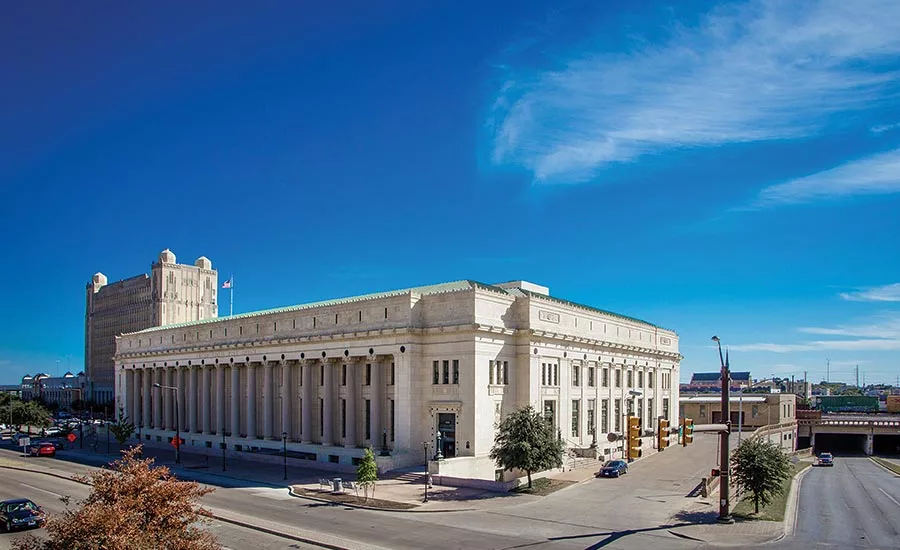
Occupying a 1 1/5-acre city block, the Fort Worth Post Office was originally built in the 1930s and overtime its Cordova Cream limestone exterior has been affected by outdoor elements, which has resulted in its cleaning twice in the past few decades.
Photo courtesy of Ashley Tullis Photography
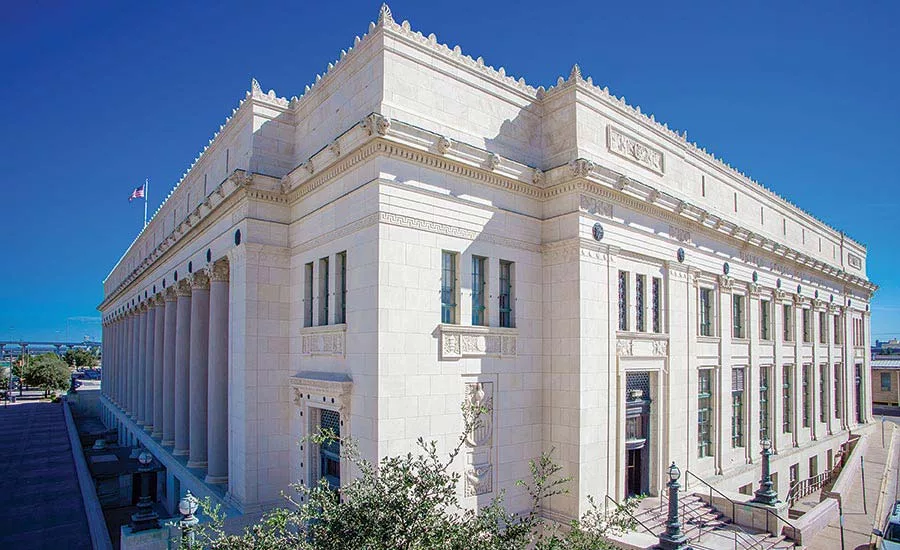
The most recent cleaning was performed with PROSOCO products in 2015.
Photo courtesy of Ashley Tullis Photography
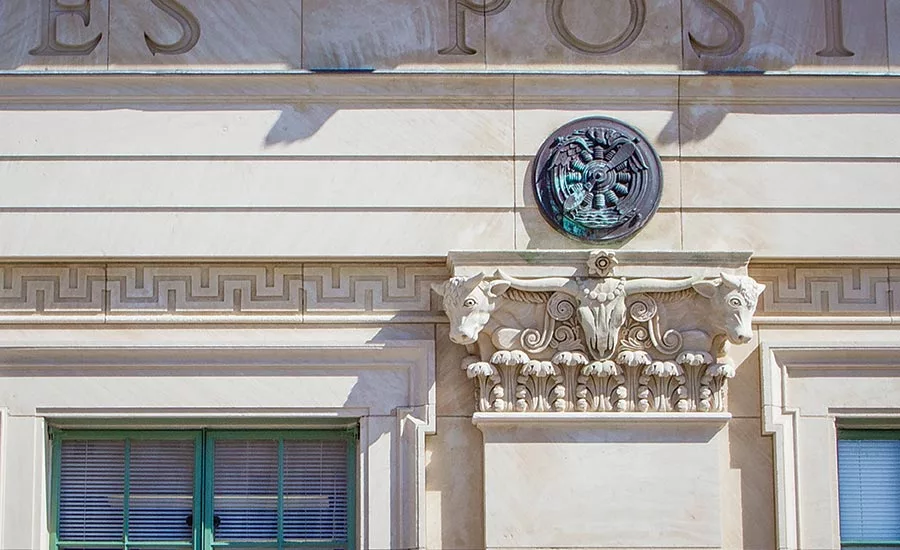
The building’s regionally influenced Corinthian capitals consist of shorthorn cattle, acanthus leaves and longhorn Bucrania — a nod to the importance of the cattle industry and its economic impact on Fort Worth.
Photo courtesy of Ashley Tullis Photography

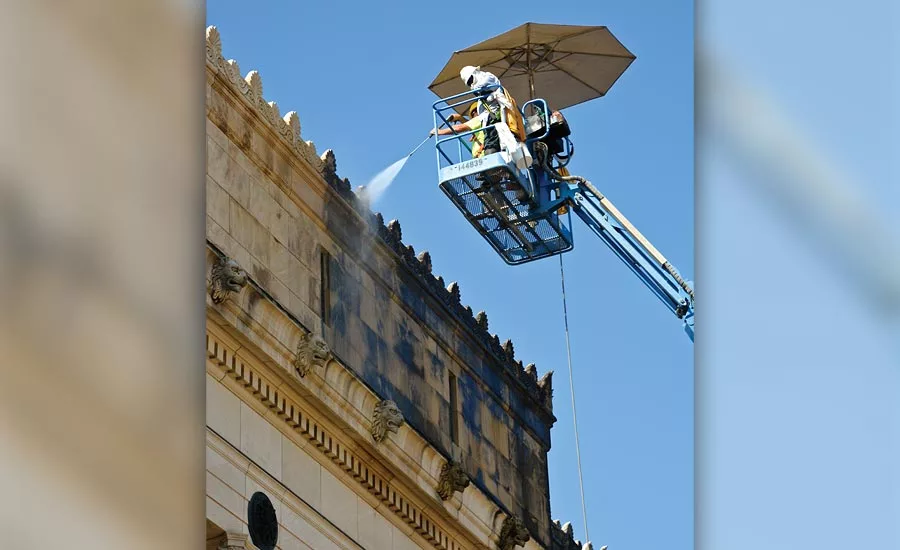
The latest stone restoration included a low-pressure spray cleaning of all exterior surfaces (steps and walls), abatement, re-cleaning and new paint for all exterior windows.
Photo courtesy of PROSOCO
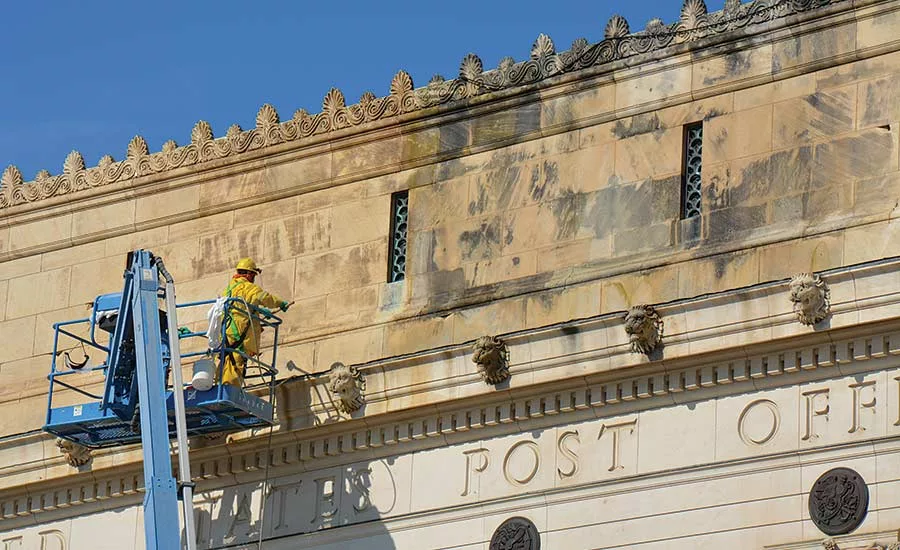
PROSOCO’s Sure Klean products were used to restore the surface’s beauty and maintain the older masonry of the Fort Worth Post Office.
Photo courtesy of PROSOCO
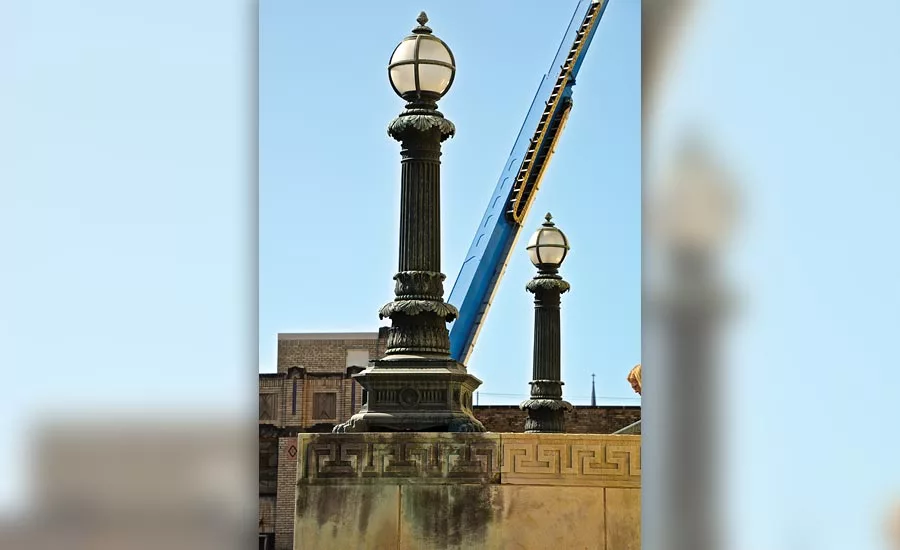
Carbon staining, usually dark brown, gray or black, is a typical result of repeated exposure to automobile traffic and burning of fossil fuels (coal, oil, gasoline, etc.). These pollutants leave a sticky water-resistant film over the face of the substrate. Airborne pollutants adhere to the film and progressively accumulate on the surface.
Photo courtesy of PROSOCO
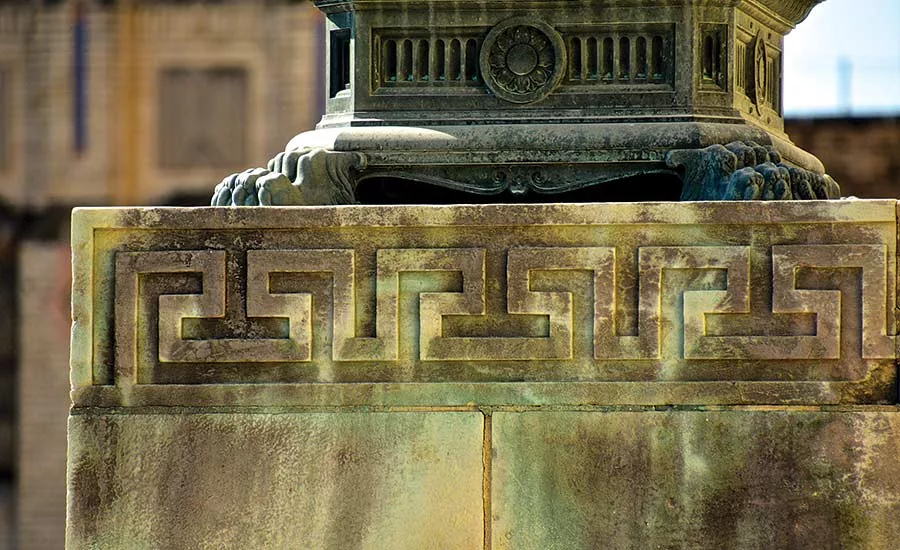
On acid-sensitive carbonate surfaces, like the Fort Worth office’s Cordova Cream limestone, acid rain further erodes carbon accumulation from projecting elements, resulting in pronounced streaking. Carbon stains also accumulate in carved recesses that are not exposed to rain washing. When exposed to heavy pollution, many of these substrates can develop carbon stains that obscure the entire surface.
Photo courtesy of PROSOCO
By any definition, the main Post Office building in Fort Worth, TX, is a commanding presence. Located on the southern edge of the city’s central business district, the massive, three-story, rectangular structure occupies an entire 1 1/5-acre city block and is bounded by two key throughways, Lancaster and Jennings avenues. The reinforced concrete structure was constructed in the early 1930s, and its cut limestone exterior was a uniquely regional interpretation of Beaux Arts/Classical Revival architecture by the American master Wyatt C. Hedrick. A recent exterior restoration and cleaning has brought renewed public attention, as well as rekindled devotion, to the historic structure’s many special attributes. PROSOCO cleaned the intricate exterior of the Postal Service’s main Fort Worth office on two separate occasions, in 1982 and again in 2015. Both efforts were integral to restoration initiatives at these important junctures in the historic building’s existence.
The Downtown Station (U.S. Post Office Fort Worth) possesses a flat roof balanced above the second floor and surrounded by a narrow U-shaped third floor. Clad in Cordova Cream limestone quarried near Austin, TX, the building features a foundation perimeter wall and steps made of Texas granite. With a stately and prominent public face, the north facade boasts a 17-bay central block containing 16 colossal-order unfluted columns of limestone. The regionally influenced Corinthian capitals consist of shorthorn cattle, acanthus leaves and longhorn Bucrania — a nod to the importance of the cattle industry and its economic impact on Fort Worth.
Additional embellishments include bronze medallions on the entablature, a pattern of lion’s heads on the architrave around the building and ornamental bas-relief panels on the main frontage. Multi-pane metal casement windows perforate the facade. Each corner pavilion includes large doors at ground level and three eight-pane windows. The main Post Office is one of the most significant Beaux Arts and Classical Revival building in the Dallas/Fort Worth/Arlington metropolitan area. Restoring and preserving its ornate public face pays tribute to local master craftsmen and artisans.
Not your run-of-the-mill Post Office
Although Wyatt C. Hedrick’s monumental civic building was built adjacent to the Texas and Pacific Railway complex, the architect diverged from the Art Deco design of the nearby passenger terminal and warehouse. The Fort Worth Post Office opened on February 22, 1933, the anniversary of George Washington’s birthday and two years after the Texas and Pacific buildings were completed. In size, aesthetics and continuous use, it stands out both among its peers and neighboring architecture. Although the general expectation during this time was to make the Post Office the most significant classical building in a small town, this premise did not typically hold true for large cities, like Fort Worth.
In the first half of the last century, the construction of massive public buildings became commonplace in the urban landscape. Neo-Classical architecture was typically favored for federal buildings. The Fort Worth U.S. Post Office is not unusual in this respect, but the ornate, classically inspired Texan motifs are singular in their fineness and in their charm. Who can resist smiling at the carved heads of the longhorns and shorthorn cattle?
No small achievement, the Fort Worth Post Office has provided postal services to the surrounding community since its 1933 opening. All earlier Post Offices have been demolished, leaving this building with the special distinction of having the longest continuous association with mail delivery in the county. Furthermore, there have been no major changes to the structure at any time; “its integrity remains intact,” as per the National Register of Historic Places.
Helping historic buildings weather modern times
For several decades, the Fort Worth Post Office was subjected to an elevated portion of Interstate Highway I-30 constructed parallel to the building’s Lancaster Street frontage. This portion of the highway was eventually demolished and relocated to an area one block south of the site. By then, the damage to the Post Office was already done — and was extensive.
Carbon staining, usually dark brown, gray or black, is a typical result of repeated exposure to automobile traffic and burning of fossil fuels (coal, oil, gasoline, etc.). These pollutants leave a sticky water-resistant film over the face of the substrate. Airborne pollutants adhere to the film and progressively accumulate on the surface. On acid-sensitive carbonate surfaces, like the Fort Worth office’s Cordova Cream limestone, acid rain further erodes carbon accumulation from projecting elements, resulting in pronounced streaking. Carbon stains also accumulate in carved recesses that are not exposed to rain washing. When exposed to heavy pollution, many of these substrates can develop carbon stains that obscure the entire surface.
Environmental elements can also affect metals, such as copper, brass and bronze. Specifically, a black, green or greenish-blue stain may appear on surfaces near these metals. This staining is caused by exposure to atmospheric elements causing oxidation of the architectural metals containing copper. Water mobilizes the staining from adjacent metals and transfers it to the substrate. The Fort Worth Post Office’s copper and bronze embellishments experienced residue staining resulting from this exact scenario.
Helping buildings withstand the test of time is a central mission for PROSOCO and for the talented preservation and restoration specialists with whom the company collaborates. With each project, PROSOCO builds on a foundation of experience, innovation and expertise developed over time.
Recent restoration work in 2015 at the Fort Worth Post Office included a low-pressure spray cleaning of all exterior surfaces (steps and walls), abatement, re-cleaning and new paint for all exterior windows. Dallas-based Brown Reynolds Watford Architects (BRW) teamed with PROSOCO representatives to identify the most appropriate and effective cleaning methods to address the Post Office’s specific challenges. BRW Architects and the team at RK Holmes Company (a long-time representative of PROSOCO products) decided on a multi-step process involving Sure Klean products containing alkaline agents capable of a precise targeted application.
Other restoration work conducted by BRW included crack repair to the exterior limestone cladding, replacement and replication of numerous historical medallions, replacement of glazing for the original globe light fixtures, repair of damaged brick and painting of all miscellaneous metal surfaces. The exterior steel windows also required cleaning, preparation, re-glazing and re-painting.
Righting a past wrong: sandblasting
Since the 1960s, many cities have banned the use of abrasive grit-blasting for cleaning purposes on historic and aged buildings. This move recognizes that the practice can be incredibly damaging to masonry. Sandblasting significantly expands the surface area, exposing malleable stone to further erosion and dusting. In addition to causing physical damage, sandblasting ultimately creates an ideal environment for biological organisms to multiply and thrive in dark moist surface crevices. “The stain can go deeper, down into the pore structure,” said Sarah Holder, preservation specialist at PROSOCO. Perversely, this “cleaning” strategy results in staining that becomes more prominent with increased water retention.
In the 1960s, well-meaning caretakers used sandblasting to clean the Fort Worth Post Office’s delicate Cordova Cream limestone, which had the unintentional effect of causing irreversible damage to the building’s facades. That, combined with the construction of an interstate adjacent to the main Post Office, facilitated a significant increase in the building’s general capacity to attract dirt and grime, resulting in both biological and atmospheric staining.
Specialized knowledge = customized solutions
A deep knowledge base in specific regional materials and staining patterns has proven a valuable resource for trouble-shooting deep-seated stains like those on the Fort Worth project. In the last few decades, PROSOCO has cleaned many notable historic buildings in Texas made with the same Texas-quarried Cordova Cream limestone on the Fort Worth Post Office. Projects also benefit from PROSOCO staff’s technical proficiency with historic masonry and ability to address the kind of damage associated with sandblasting and other cleaning practices.
PROSOCO’s response, in 1982 and again in 2015, involved specialized alkaline cleaners, an effective strategy for working with relatively pure calcium carbonate materials, such as the porous limestone used to construct the post office. The ongoing deterioration resulting from the 1960s sandblasting further reinforced the need to find a cleaning method that limited the potential for any additional adverse effects.
In 2015, PROSOCO’s cleaning approach involved a two-step process, a prewash followed by an afterwash. Sure Klean 766 Limestone & Masonry Prewash is a non-acidic, alkaline gel that’s highly effective at dissolving heavy carbon crusts, but capable of precise application for spot-cleaning. When used properly, the prewash dissolves and assists in removing heavy carbon encrustations from most masonry, including brick, terra-cotta, sandstone and limestone.
After using the prewash, the team determined the masonry needed to be neutralized with Sure Klean Limestone & Masonry Afterwash. This process ensures that cleaning residues are completely removed and that the masonry retails its natural color and appearance. The afterwash is a very mild, organic, acid-cleaning compound that will not damage or alter masonry, and it also works well in humid environments, making it ideal for Fort Worth’s climate.
In the case of the Post Office project, it was important to minimize any potential for additional water-related deterioration resulting from the sandblasting. “You want to be sensitive to particularly vulnerable, acid-sensitive surfaces, which means considering appropriate dwell times and dilution rates,” said Holder. For example, the prewash can be diluted or used in concentrate with a dwell time of 30 minutes to two hours. This flexibility allows for the user to test various dilution rates at different contact times to determine the best fit for this job. The goal is to affect change in different ways and in response to different challenges, because, according to Holder, “Each product is specially formulated to target a specific staining mechanism on a particular substrate. Its performance can be impacted by dilution rates, dwell times, condition of the substrate and environmental factors.”
This system was a particularly effective strategy, as the Fort Worth Post Office is in a high-pollution area and, as a result, had experienced significant blackening by deep-seated carbon and biological stains. Many of these stains could have been targeted with acid-based cleaning compounds, but the selected system was the best choice for the staining, masonry and its condition.
The power of testing
An extensive testing process leads to a more substantive understanding of how to treat specific kinds of stains on each type of masonry. Each product has a different purpose and use, which lends itself to a systematic approach like changing the dilution rate in small increments to evaluate the impact to the masonry.
And no two jobsites are identical. Jobsite testing accounts for all the real-life circumstances and specific needs of the project – phasing, equipment staging, access to water, coordination with municipalities and environmental factors like site protection, temperature, humidity and so on.
The objective is to identify the right solution for the right space at the right time. Testing gives designers and contractors the advantage of being able to select the product or products best suited for a substrate and associated conditions. Weather conditions, especially humidity and temperature volatility, can affect product performance. Therefore, data derived from test performance panels that are tested under actual field conditions are the best bet for accurate and comprehensive findings.
The Fort Worth team started with small test panels and then progressed to larger panels capable of accurately predicting the stain removal process under varied conditions. “The team started with the mildest products and then trouble-shooted square foot by square foot until the desired results were achieved,” said Weston Sherrill of RK Holmes Company, the PROSOCO representative familiar with this project.
Another bonus: PROSOCO representatives were already familiar with this particular Texas-quarried limestone. Throughout the testing process, they used their understanding of the substrate to target the staining and predict the performance.
Significantly, PROSOCO’s cleaning solutions for the Fort Worth Post Office, both in 1982 and again in 2015, were custom-designed to address the substrate, conditions and staining mechanisms. The building didn’t require one solution but many, depending on which substrate (and which aspect of the deep-seated staining) needed attention. The response, both times, was demonstrative of a company-wide commitment to identifying a series of strategies responsive to the aspects of a project — specific solutions for specific problems.
First impressions count: rethinking value and use
The perceived value of a masonry surface declines with every drop of grease, grime, food, oil, smoke or other contaminant. The Sure Klean products used in 2015 in Fort Worth restored the surface’s beauty and maintained the older masonry, but the cleaning’s value went far deeper.
Increased visibility benefits a historic asset. A refreshed revitalized presence for the Fort Worth Post Office raised more awareness among direct stakeholders, such as architectural, preservation and municipal/federal organizations active with the cause to keep historically and culturally important built assets intact and valued by their communities. Several years ago, the property was listed among 3,700 other post offices being studied for closure because of “excess capacity” and falling revenue. After the building was placed on the “most endangered places” list in 2014 by Historic Fort Worth Inc., acts of investing in and caring for this historic asset became rallying cries for the preservation community.
When a historic building receives care, the local community’s perception of what they have is changed for the better. In turn, the building’s owner and potential investors are encouraged to rethink use strategies. When the public sees renewed activity and a refreshed appearance for an underutilized, uncared for property, they project value.
Since 2004, the city of Fort Worth has contemplated buying the Post Office building as a potential City Hall, according to NBC Dallas-Fort Worth reporting. Spending to study potential uses for the massive historic structure has been estimated at around $200,000. In December 2013, Fort Worth Mayor Betsy Price said to the Star-Telegram, “I think there is some interest, certainly that is a very historic building and we want it to be put to good use and promote development along Lancaster.”
Post Offices from this era are typically underutilized both in terms of utility and square footage. Because of urban flight/suburban sprawl and infrastructure development in the 1960s, small communities have rallied behind small, local Post Office branches that are often nimbler and better equipped to adapt to contemporary needs.
“The scale of historic Post Offices can vary, and the reconfiguration of space is not easily accomplished,” said PROSOCO’s Holder. “There isn’t an easy solution of adaptively re-using the structure for mixed-use while keeping the historic finishes intact.”
Often, a refresh is the first step in advocating for a building’s potential. “Cleaning a building shows people that you care,” Holder said. Both the actual and perceived value of the building is raised. Hidden gems are exposed, as the architecture’s best assets are revealed in a better light. And, significantly, it is the exterior that is the first to impress, the first to send the message that a property is worth the investment. Holder attributes this heightened perceived value as the positive impact of a “clean smiling face.”
Cleaning the Fort Worth Post Office’s facade was a game changer in several ways. Such a high-profile refresh increased public visibility — and concern — for the Post Office building, which in turn increased the property’s marketability. As important, the modernization of the building was accomplished while preserving the local materials and the expert craftsmanship of local artisans. Because all aspects of the restoration were “done properly,” from neighborhood relations to the preservation tactics to the cleaning, said Steve Elliott of BRW Architects, we have a “fresh new building.”
The U.S. Postal Service ultimately decided to remain in the building, retaining the facility for postal operations and for new and improved expanded customer retail services. Today, the Post Office has re-established its importance to the Fort Worth community, which has embraced the facility as an important resource for expanded social services, including a retail center and passport office.
|
Fort Worth Post Office Building Fort Worth, TXOriginal Architect: Wyatt C. Hedrick Restoration Architect: Brown Reynolds Watford (BRW) Architects, Dallas, TX Cleaning Products Manufacturer: PROSOCO, Lawrence, KS Cleaning Products Distributor: RK Holmes Company, Maypearl, TX |
Looking for a reprint of this article?
From high-res PDFs to custom plaques, order your copy today!