The value of recycling your process water
Some food for thought when it comes to the importance of evaluating your water treatment process

For stone fabricators, water is a tool. Just as you wouldn’t be likely to throw away your knife as it dulls, water can be easily rejuvenated to work for you as it did when it first entered the fabrication shop.
Water in stone fabrication facilities is one of those items often easily taken for granted. That is, until one of four things happen: a pump fails, a well runs dry, local ordinance prohibits use or the utility bill imposes shock. When the value of an easily accessible, dependable and inexpensive water supply is realized, stone fabricators will often take a second look at their ability and need to reuse their process water. If you’re able to realize the significant benefits of recycling your water, you’ve taken the first critical step in addressing an underlying issue often overlooked in both your bottom line and your company’s “green” image.
I’ve made it a priority to visit customer sites that have incurred the pains inefficient water supplies can induce. In doing so, I’ve witnessed customers infuriated by their water supplies which were previously deemed trivial. Water is a necessity, but what happens when the cost of supplying it is in jeopardy? The simple answer is to create your own controlled supply of the precious resource. Instead of discarding the process water after each use, you can recycle it.
Cutting costs
I was recently in the southern states seated at the desk of a stone shop owner that had recognized his water use was in dire need of attention. He placed a utility bill on the desk and pointed to the water portion of it. The number read $14,233.00. That number has stuck in my head to this day. This was a glaring example of how one stone fabricator let his shop grow without consideration of water. Fortunately, today, the same line on this bill has been reduced by about 85%. This was done by incorporating one clarification system which paid for itself in the first quarter of his fiscal year.
Needless to say, reusing process water saves money. Water becomes more precious every day, and unlike other commodities, its value will only increase. The average American household consumes and discards 400 gallons of water per day, while the average stone shop uses 40,000 gallons per day. I estimate that one finished square foot of stone requires 27 gallons of process water. Implementing a simple clarification system can reduce otherwise discarded water by up to 90%.
The Eco-friendly advantage
Operating as a green company not only allows for sleeping better; it allows consumers to cement their decision in choosing your company as their stone resource. While this may seem obvious at first glance, most consumers are unaware of stone fabrication process water consumption. I believe it is important consumers are made aware so they can recognize your company’s water reuse as a benefit to all. It is the “green” differentiator of the stone industry.
Compliance
Local codes and current EPA restrictions are also factors that play a critical role in how process water is discarded. These regulations must be understood. However, those facilities that are recycling their process water generally avoid any issue with local codes or environmental regulation.
How it works
Mother Nature, with little help from us, provides the simplest most efficient means to clarify water for reuse. Gravity. It costs nothing, is extremely powerful, never fails and we as humans know just how to take advantage of it. Municipal water treatment operations rely on Sir Isaac Newton’s revelation on a large scale through use of sedimentation basins and inclined plate settling. It is one of the first operations after pretreatment and is performed by using gravity to settle suspended solids in the waste slurry. Most appealing of this settling process is that gravity does the work for free.
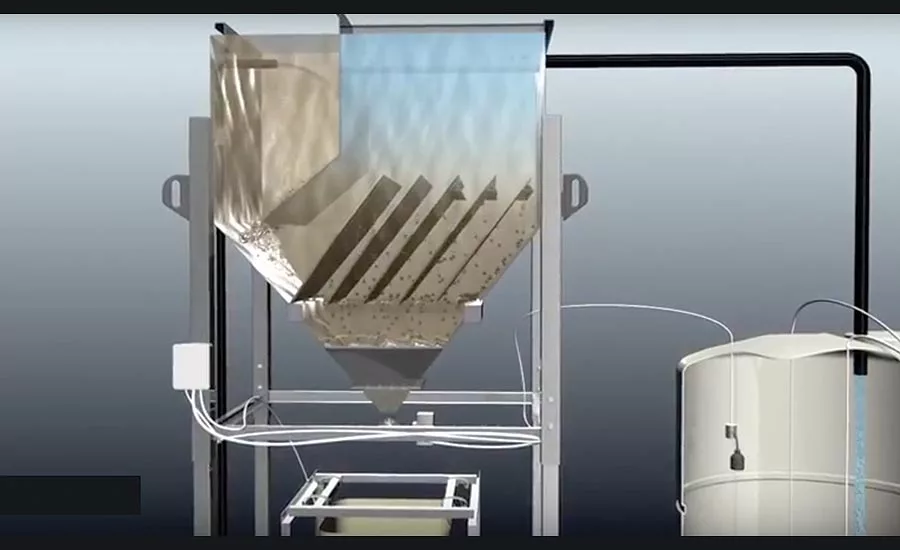
Of course, gravity alone is not enough as some suspended solids in slurry water remain suspended. This is where we humans help. Coagulant is added to neutralize the mostly negatively charged particles which keep the particles from contacting each other. These repelling forces also contribute to keeping the particles in suspension. By neutralizing the particles, they can now come into contact with each other and some may join together in a “floc,” which makes one heavier particle. Now that the particles can contact one another we desire to make them stick together in large flocs that will settle. This is done by adding flocculant chemistry. The flocculant will form bonds keeping the particle flocs together while gravity sinks them further — eventually settling to the bottom forming dense sludge.
This simple concept is applied at various scales across many industries requiring water to be clarified. However, most applications do not have settling ponds or basins at their disposable. They simply take up too much space and are expensive. However, one process mentioned previously used at the municipal scale can also be used on a smaller scale. That process is inclined settling.
Water recycling systems
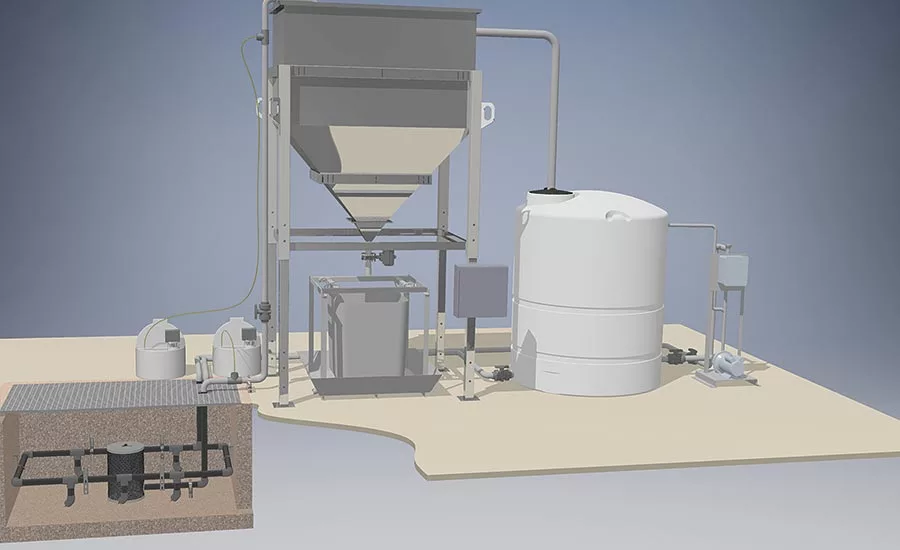
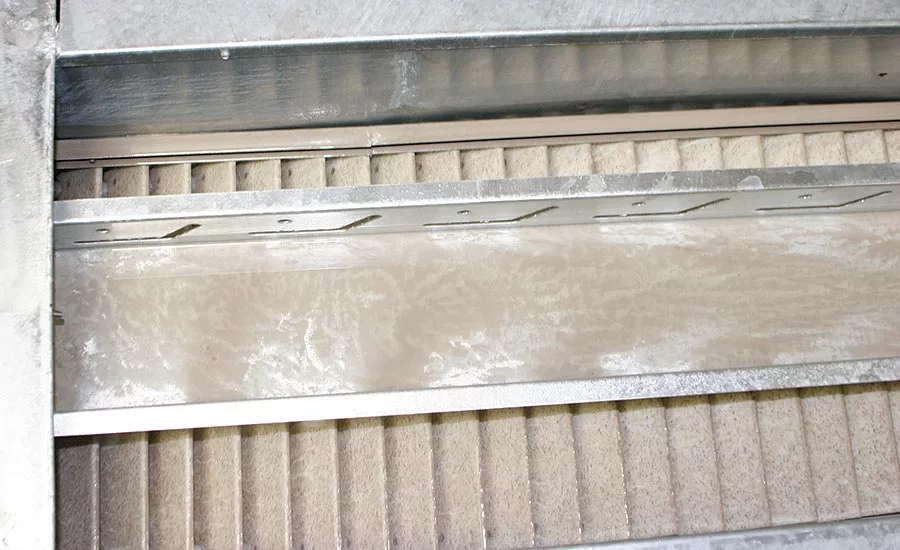
Inclined settling systems happen in a fraction of the space consumed at a municipal waste water treatment facility. These systems settle suspended solids in the same manner as those found in municipal facilities by passing slurry water through a pack of inclined plates. This allows a floc to only need to settle several inches before contacting a plate surface and sliding down into a collection chamber to be purged after condensing. Coagulant and flocculant chemistries are added in the same manner, promoting rapid settling.
Rather than processing millions of gallons per day as treatment facilities do, the inclined settling systems are sized to fit stone fabrication shops processing between 40 to 200 gallons per minute. Systems are fully automated to process stone slurry water and require very little maintenance or attention. The coagulant and flocculant chemistries offered with these systems are formulated for stone slurries, yet use the same elements found in municipal waste water coagulants and flocculants. The coagulant and flocculant chemistries always have safety data sheets provided and are safe to work with. All industrial processes come with a safety risk and protocols that need to be followed.
Inclined plate clarification, although not a filter, is the simplest and most cost-effective solution to remove sludge from slurry water. Other systems are a good solution for creating small amounts of filtered process water, but the maintenance and operating costs are substantial. Other systems utilize pre-coating which is time consuming and the actual pre-coat chemical contains silica dust. Incline systems have uptimes in the 95 to 98% range. This is due to the simple nature of the system’s operation.
Invest in your water
Water is the resource that is often forgotten, until it becomes a screaming issue. The cost of water is on the rise and stone fabricators need a large supply. As your shop grows, the investment in a water clarification system becomes a necessity. Make the choice to recycle process water before you are shocked with a utility bill that is well over-budget. Evaluate the growth of your shop and consider when you should make the investment.
Looking for a reprint of this article?
From high-res PDFs to custom plaques, order your copy today!