Levantina's large-scale operation provides an easy and safe process for its employees
Extracting more than 2.2 million cubic meters of material annually from over a dozen quarries, Levantina of Alicante, Novelda, Spain, is an immense stone producer with locations worldwide. While the company has numerous moving parts, the secret to its success is to maintain a basic structure and to be open with its employees.
Among the many quarries owned by Levantina is the Crema Marfil Coto site, which is one of the largest in the world. The base of the quarry rises 300 meters above sea level, while the very top is 800 meters above sea level. In total, roughly 200,000 cubic meters of material is extracted per year and it employs over 220 workers.
“One of the most important things for us is safety,” said Francisco Javier De Garnica, business operation manager for the Crema Marfil quarry. “We have an internal department that drives around making sure everyone is safe. We also get audited by external authorities. They come around all year. Because of this, we have never had a serious injury.”
Approximately 200 to 250 blocks are extracted per day at the Crema Marfil quarry. To keep up with the demand, five double diamond wire cutting stations are set up to square off the blocks. Each of the five stations holds eight to 10 blocks, and takes three to four hours to cut through them. Besides its look, one of the biggest selling points of the stone is the size of the quarry. “We can offer a guaranteed volume of blocks for each client,” said Garnica. “That’s very important to them. Our competition is smaller, and they don’t have the level of extraction we do.”
Once the blocks are squared off, they are sent to the Crema Marfil factory, which is fully automated and equipped with 19 Simec gangsaws to cut the blocks into slabs with 2 cm and 3 cm thicknesses. From the moment slabs enter the plant until they are loaded on the truck for shipment, the entire process is automatic. The facility runs two resin lines simultaneously, averaging 52 slabs an hour. When a slab has a chip or slight damage, it is inspected and then it is decided if the slab can be repaired.
In addition to Crema Marfil, Levantina also operates five Marrón Emperador marble quarries. One of the largest currently spans 27,000 square meters with 90,000 square meters of exploration area for blocks. “There are a lot of browns out there in the market, but none of them have veins like the Marrón Emperador,” said Javier Gomez-Ceballos, quarry engineer for the company’s Marrón Emperador quarry. “This stone is extremely appreciated by clients. No other quarry has a stone quite like this one.”
While the quarry still has over 60,000 square meters of exploration area left, they are currently still looking for a similar type of stone in the area. “Trying to find the same quality and quantity for a new quarry is hard,” said Gomez-Ceballos. “Each of the five quarries offers a slightly different veining of the stone, but they are all pretty close to each other.”
Levantina features dozens of marble coming in white, cream, pink, red, green, yellow, brown and black. In each of those colors come a wide range of marble offers, such as in the white marble category, Levantina features the Blanco Ibiza, Blanco Carrara and the Blanco Venato. The extensive collection of Levantina’s marble collection can be viewed online.
New discoveries
While Crema Marfil may be one of Levantina’s most well-known stones, it is not the company’s only impressive one. In Porriño, Spain, Levantina quarries some extremely unique varieties of granite. One of the newest materials that will hit the U.S. market soon is “Wild Honey.”, “It’s a hard quarry,” said Javier González, block purchasing manager for Levantina. “With the experience and enough patience, we know it will do well. Now that we are getting a good stock pile of it, we are ready for a larger market. The market is so demanding that things must be perfect. Any and every flaw in the stone is going to be pointed out so we have to produce specifically for every expected market to ensure high standard supply.”
Levantina also gets its supply of Rosa Porriño stone from nearby quarries, producing on average per month 2,500 to 3,000 cubic meters. “The way they cut these stones is in huge sections,” said González. “That makes these great for huge projects because of the size of the stone. There is also very little variation in grain and color.”
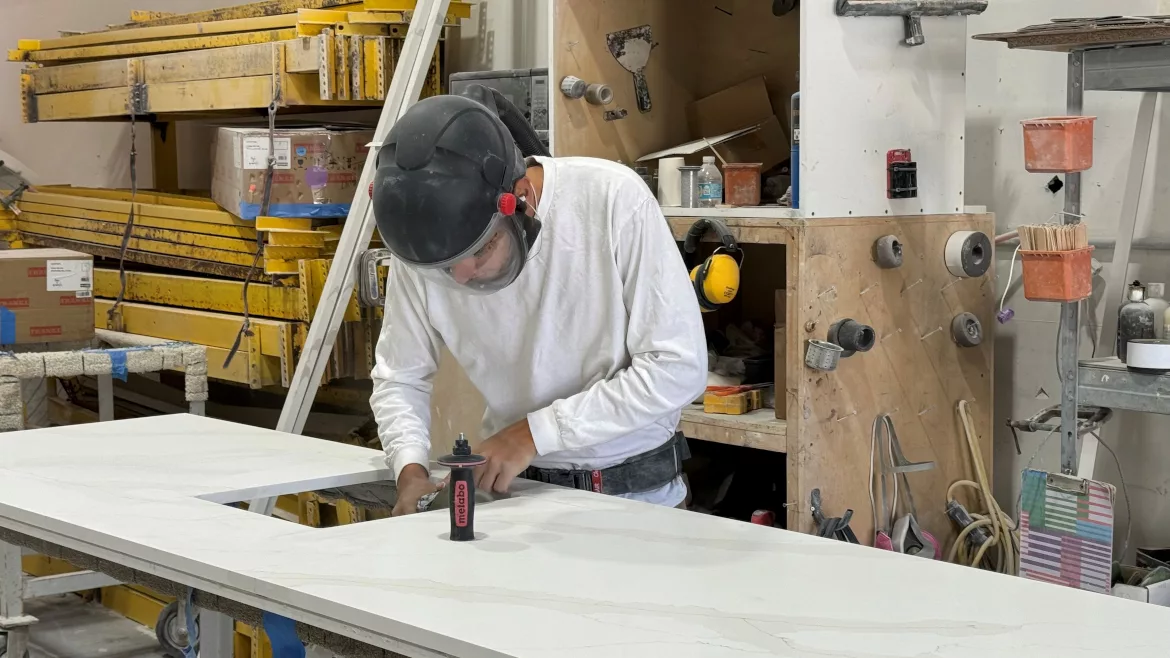
When it comes to granite and quartzite fabrication, Levantina has three different factories, one focused in domestic materials, imported materials from worldwide locations including classic and exotic stone, a cut-to-size factory and also a granite center that highlights its main granites. Levantina believes it is important to have a strong level of communication between its factory workers and management staff. As a result, throughout the factories, each group of workers, or team, is assigned a Lean Panel board. This board easily allows and quickly shares open communication between managers and workers. It features the skills of each worker, equipment that can be used by each worker, comments and concerns among other things.
In the cut-to-size facility, Levantina can apply several different finishes to its stone, including flaming, polish and leather. “Every slab has its own label, block number and slab number — everything that tells us when and where it was selected, we know the whole timetable for it,” said Manuel Perez, sales area manager for Levantina. “We sent about seven to 10 trucks and containers a day, and through the individual label system we can completely trace every single slab.”
In the exotic and semi-exotic collections, blocks are gathered from all around the world at quarry sites by Levinatina’s own inspectors and are squared off and reviewed to ensure that it is good material for the line. Levantina has in the exotic and semiexotic production facilities eight jumbo gangsaws and a 65-wire saw, as well as three single wire saws in place to complete the process. The granite center features a showroom of the highest quality of granites from around the world, all of the material ready to be sold. “We do a lot of research on the materials,” said Perez. “The materials keep evolving based off different patterns and markets. Stones will have certain patterns, and we can make them as per the veining or color shade lighter or darker, to different markets.” Between all three facilities, Levantina produces more than 1 million square feet of material every month.
Levantina’s top granite is the Lennon quarry, a quarry exclusively owned and quarried by Levantina out of Brazil. The site produces around 4,000 cubic meters of material per year. The granite itself is white and gray with characteristic bluish quartzes.
Techlam
Going beyond marble and granite, Levantina is also the producer of Techlam. Created in 2006, Techlam is one of the original Porcelain Ultra Compact Surfaces to come onto the market. The product comes in a maximum size of 1 x 3 meters and in a thickness of 3 and 5 mm. The product also comes in 150 x 100 and 100 x 100 cm.
The entire process of making a Techlam piece, which takes 50 minutes, is done on one fully automatic line. There are dozens of different types and colors of Techlam panels. “The panels are all very light, easy to move and easy to clad,” said Francisco Herrera, product manager for Techlam. “Because it is so thin and light, a container can hold a lot of these panels, helping a customer to save money.”
The process starts off at an entirely different location. The chemicals that Techlam is made of are mixed in another facility and then shipped to Levantina’s factory in Alicante, Spain. In the manufacturing plant there are 24 silos that store the chemicals — all feeding down to a measuring system that puts the exact amount of the chemical needed on a conveyor belt. From the belt, it is dumped out by a machine that levels the chemical powder into the slab shape. The material is then pressed to harden the product and then is painted before finally being put in an oven for 45 minutes. Over 3,000 sheets are produced a day.
“What also makes this product unique is that it can be used on an old surface,” said Herrera. “The product is so thin that you can just glue it right on an old countertop — no need to rip the old one off.” The product also has a Green Building certificate, and Levantina looks to expand the product to hospitals and schools.
The Levantina Foundation
While Levantina focuses a great deal on its products, they also give back to the community. A year and a half ago, the company started the Levantina Foundation, a way to give back to the community that has helped support the company for so long. “It’s something we believe that a company has to do,” said Yolanda Llinares, director of the Levantina Foundation. “If you want to be a great company, you have to care about people and the environment.”
The foundation built a museum in Pinoso, Spain, to show the history of Levantina and the town from the point of view of the workers. It shows the machinery used and the stone that has been extracted. “We made it very simple to understand and not technical so the entire community can easily understand it,” said Llinares. “We also feature a lot of pictures of people who worked for Levantina back in the 60s and 70s, who are still alive and can take their families to see the museum.”
As of last December the museum had over 2,500 visitors, 12% of them being international. The museum features English, Spanish and Braille as well as different programs to help the community such as an internship program for young unemployed and grants for master’s degrees. “We want to help the local community as much as possible, and this is why we have a program like this,” said Llinares. “Some of the graduates work with us, and some don’t, but it’s all about helping people.”
Looking for a reprint of this article?
From high-res PDFs to custom plaques, order your copy today!

Jason Kamery is the Managing Editor and Group Digital Editor of Stone World. With more than a decade of experience covering the stone and countertop industry, he has conducted hundreds of interviews with fabricators, manufacturers, and industry leaders, and hosts the Stone World. podcast. He reports from events worldwide, including TISE, Coverings, and Marmomac, and his coverage extends to worker safety and silicosis, trade policy and tariffs, and fabrication technology. Kamery has also served as a speaker and panel moderator at The International Surface Event (TISE). He graduated from Purdue University with a B.A. in Mass Communication.
email: kameryj@bnpmedia.com | office: (248) 833-7356