Stone World logo
search
cart
facebook twitter linkedin youtube
  • Sign In
  • Create Account
  • Sign Out
  • My Account
Stone World logo
  • NEWS
  • PRODUCTS
    • Machinery
    • Digital Technology
    • Tooling & Accessories
  • MATERIALS
    • Alternative Surfaces
    • Stone
    • Tile
    • Imports & Exports Data
  • FABRICATORS
    • Fabricator How-to
    • Fabricator Case Studies
    • Fabricator of the Year
  • A&D
    • Installation & Technical Tips
    • Outdoor Design
    • Interior Design
    • Hospitality | Commercial Design
    • Mosaics & Decorative Tile
    • Kitchen & Bath
    • Residential
    • Renovation | Restoration
  • MEDIA
    • Videos
    • Podcasts
    • EBOOK
  • EVENTS
    • STONE INDUSTRY EDUCATION
    • Industry Calendar
  • MORE
    • NEWSLETTERS
    • WOMEN SPOTLIGHT
    • MARKET RESEARCH
    • STONE WORLD STORE
  • DIRECTORY
    • TRADE ASSOCIATIONS
    • Stone Suppliers
    • GET LISTED
  • EMAG
    • eMagazines
    • Archives
    • Contact
    • Advertise
  • SIGN UP!
Industry Insights

Air and Water Filtration: What do you really need?
By John Fallon
May 30, 2007
With stone fabrication shops using 15,000 to over 200,000 gallons of water per day, an effective water treatment system can offer a significant savings for a business.

There are many choices that face the owner of a stone fabrication shop, and water filtration can seem to be the most complicated, as there are so many options to choose from. Especially with OSHA, EPA and state regulations, you want to be sure that your choice is the best one for you and your specific fabrication process.

Concerning water treatment or recycling, you must first determine how much capital you are willing to invest, as solutions can range in price from less than $10,000 to $100,000 and more. The answer ranges from “some recycling” (with a permitted discharge for use of city water for critical applications), or a totally closed loop, zero-discharge system that requires no permitted discharge.

All fabrication equipment requires varied levels of water clarity. For a bridge saw, all that is needed is cooling water - “gray water” is usually acceptable. The same is generally true for the cooling ring or halo of a CNC. But a waterjet, the spindle of a CNC and most polishing equipment (including hand polishers) require a much higher water quality specification. Often, people use city water for these applications, although acceptable recycling solutions are available that do not require you to discharge excess water. Flow rates and pressure requirements for your equipment are key pieces of information that you will need to know as well.

The infrastructure of your facility, such as plumbing, electrical supply and available compressed air, should all be understood in order to properly evaluate any proposal. Who will be handling the installation? Who will pay for freight and related installation charges? Are delivery pumps required, and who will provide service for any system component that requires service?

It’s important to factor the “extras” into the budget and also to make a decision based on what you do and do not have time for. Ask yourself, “What it the best use of my time? Installing a new system that I am not familiar with - like a child’s bike or a new BBQ grill - or allowing the equipment professionals to do that for me?”

As you narrow down your selection, be sure to check references. This is your best source of information about any water recycling system that you are looking to purchase. When contacting these references, inquire about the warranty and what experience this individual has had with service or warranty issues.

In most cases, it is wise to avoid trying to make a recycling or filtration system on your own, but instead look for one that meets a balance between your budget and equipment needs - all while keeping you in compliance with state and federal regulations. One day of non-compliance fines for an illegal discharge can make an air or water recycling system seem cheap in comparison.

Focus on the business of stone fabrication, and let the air and water professionals help you by doing their job. By turning to these industry professionals for advice on water and air filtration, you need to be sure to ask for a guarantee that the equipment will perform as you require.


Air filtration considerations

The key to effective air filtration is placement, which will ensure proper and complete treatment. If the filter is not located near the source of the dust, the contaminated air will be pulled across the shop, exposing more people to the dust.

In a stone shop, contaminated air is also minimized by incorporating a wet fabrication process as much as humanly or economically possible. A wet cutting and polishing process will greatly minimize what is airborne in the first place. However, in many markets, this is easier said than done.

If the water filtration system is removing the majority of the sediment and providing clear water, then the concern about silica dust will almost be eliminated. You could also use this same clear, recycled water to rinse the floors at night, providing additional removal of any sediment that can become airborne when the water evaporates.

If the sediment is not properly removed, there is the potential for silica to keep going back into the air. This was the case for one stone fabricator in the Western U.S. The amount of the silica dust in the air was documented by state tests, which had standards higher than the federally mandated OSHA requirements.

Water filtration and recycling systems

There are many water recycling systems available to the stone shop, and a range of benefits and attributes that each type of recycling process brings to the fabrication shop.

Tiered settling pits
Originally, many stone shops began with the age-old tiered settling pits. These worked well when production was slow, and the need for a high volume of water was not as important - and when fresh water supply was plentiful. The benefits of this type of water recycling system is that it is fairly easy to construct with a minimal investment. Be alert to the possibility that you will have to apply for a discharge permit if you are unable to recycle 100% of your water. Generally these systems will produce a “gray” water quality and will require you to clean the pits.

Filtration bags

Filtration bags are designed to hold solids while allowing water to drain out and back in to the fabrication process. These provide a gray water source, and a means to dispose of the solids collected, but need to be supplemented with a fresh water supply for your polishing applications. The bags are a consumable, and that cost will need to be factored into your budget. The filter bags can require some agitation to prevent the stone sediment from forming a layer on the inside of the bag, slowing down the drainage process.

Centrifugal systems

Centrifugal systems separate the liquids from the solids and produce gray water. However, some manufacturers offer point-of-use filtration cartridges, which increase the water quality to meet the needs of a shop’s particular equipment. It is important to inquire about how to prevent the stone sediment from inhibiting water flow and about the frequency of cleaning and the cost of replacing point-of-use filtration cartridges.

General settling systems

Settling with or without an inclined plate clarifier usually requires a rather large aboveground collection area into which your pit wastewater is pumped. These systems are ideal for separating and concentrating high levels of solids. They produce gray water but are often sold with point-of-use filtration cartridges to improve water quality. Some require a flocculent to be added to their filtration process. Be sure to read the MSDS sheet and see if there will be any impact on your equipment or personnel if a flocculent is used.

Filter press systems

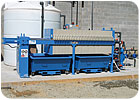
Filter presses are designed to squeeze the water out of the waste - in this case the stone sediment. A quality system, based around a filter press, can be the answer to supplying both the water clarity and volume of water required. If the system is engineered correctly, the water quality is safe to feed to all equipment in your facility; and it provides a 100% closed-loop, zero-discharge system.


Why all this effort?

Simply stated, the Clean Water Act passed by Congress in 1972 makes it illegal to discharge the wastewater that comes from your fabrication process without a permit. Permitting fees can be costly and unnecessary if the correct system is in place to recycle your fabrication water.

Being “green” in your operations is perhaps the most important reason to have a water recycling system. Show your community that you care and are doing something to preserve this precious commodity. It is also a great advertising and marketing edge for your business. Remember, the average shop can use 15,000 to over 200,000 gallons of water per day, and these systems can offer a great savings for your business, your town and for future generations.

The fabrication of stone is one business that cannot be exported, and it requires those of us in the industry to lead by example and to take care of our environment and community - as they are what sustains our industry.

Share This Story

Looking for a reprint of this article?
From high-res PDFs to custom plaques, order your copy today!


John Fallon is the National Sales Manager for Water Treatment Technologies.

Recommended Content

JOIN TODAY
to unlock your recommendations.

Already have an account? Sign In

  • customer doing research online

    3 Reasons Why Quick Response Time Results in a Successful Fabrication Shop

    Your fabrication shop can have the best website. The best...
    Fabricator How-to
    By: Anthony Milia
  • Silica

    Renewed National Attention Ignites Over Silicosis Epidemic

    A major investigative report published on March 12, 2026...
    Industry Insights
    By: Jason Kamery
  • shipping containers

    U.S. Countertop Material Imports: February 2026

    U.S. countertop material imports collapsed in February...
    Stone
    By: Jason Kamery
Manage My Account
  • eMagazine
  • Newsletters
  • Online Registration
  • Manage My Preferences
  • Subscription Customer Service

More Videos

Popular Stories

shipping containers

U.S. Countertop Material Imports: February 2026

Save Quartz Jobs Coalition Logo

ITC Moves Towards New Quartz Import Tariffs

cal osha

Cal/OSHA Standards Board to Vote May 21 on Engineered Stone Ban Petition

Fabricator Focus

From profiles to roundtable discussions, Q&As to best business practices, we're turning a focus on topics and challenges impacting fabricators.

AI Talk Is Everywhere -- Where Does a Countertop Fabricator Begin?

Fabricators Discuss Pros and Cons of Chip Repair

How to Grow a Countertop Fabrication Shop

Events

June 25, 2026

North Carolina Stone Summit

You’ve probably heard a lot lately about how to calculate the profit for each job you produce. You likely have production benchmarks based on square footage since it’s the most common production metric in the industry. Come learn how focusing on these metrics can hurt your profitability and what to do about it.

July 16, 2026

Washington Stone Summit

Join us for "Taking Your Organization to the Next Level," a session dedicated to transforming your business practices. Discover strategies for setting clear agendas, encouraging participation, and driving actionable outcomes. Learn how to foster collaboration and communication, ensuring that every meeting enhances productivity and contributes to your business goals.

View All Submit An Event

Poll

Tariffs and Quartz Imports

If high tariffs are placed on U.S. quartz imports, how will this affect your business?
View Results Poll Archive

Products

Restoration & Maintenance Technical Module

Restoration & Maintenance Technical Module

See More Products
	
3 Reasons Why Quick Response Time Results in a Successful Fabrication Shop

Related Articles

  • motm

    Machine of the month: Matec Water Filtration System from Taurus Craco

    See More
  • Matec Water Filtration System Taurus Craco

    Machine of the Month: Matec Water Filtration System

    See More
  • Do you have a winning design?

    See More

Related Products

See More Products
  • Glass Tile Inspirations for Kitchens And Baths

See More Products

Related Directories

  • Water Treatment Solutions

    Water Treatment Solutions custom designs and installs CHEMICAL FREE, closed loop, filter press based water filtration and recycling systems developed exclusively for the stone fabricator. Producing both gray and crystal-clear water – safe for equipment and your employees. And Introducing ECO Clean Nature’s Settling Technology.
  • Web Granite Supplies

    We strive to be the best at what we do – to provide you with value. Combining quality and price will make you a happy customer and enhance the competitiveness of your business. Concrete & Stone, Equipment's, Granite Supplies, CNC Tools, Floor Restoration, Porcelain & Tile.
  • Full Circle Water

    Full Circle Water develops simple-to-use, turnkey wastewater solutions that make recycling water easier, less time-consuming and more cost-effective. Our American-made products are manufactured using years of experience and the feedback of hundreds of customers. We continually evaluate our products to ensure they exceed customer expectations and deliver the most value for their cost.
×

Our Newsletters are a rock solid source of industry insights!

Stay in the know on the international stone and tile industry trends.

JOIN TODAY!
  • RESOURCES
    • Advertise
    • Contact Us
    • Directories
    • Store
    • Want More
  • SIGN UP TODAY
    • Create Account
    • eMagazine
    • Newsletter
    • Customer Service
    • Manage Preferences
  • SERVICES
    • Marketing Services
    • Reprints
    • Market Research
    • List Rental
    • Survey/Respondent Access
  • STAY CONNECTED
    • LinkedIn
    • Facebook
    • YouTube
    • X (Twitter)
  • PRIVACY
    • PRIVACY POLICY
    • TERMS & CONDITIONS
    • DO NOT SELL MY PERSONAL INFORMATION
    • PRIVACY REQUEST
    • ACCESSIBILITY

Copyright ©2026. All Rights Reserved BNP Media, Inc. and BNP Media II, LLC.

Design, CMS, Hosting & Web Development :: ePublishing