Targeting the U.S. market with Italian travertine
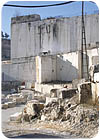
Among the three travertine quarries owned by Fratelli Poggi, a company that began quarrying Roman travertine in Tivoli, Italy, in 1923, is a site that was opened in 1963. Currently, the quarry is about 50 meters deep, and it is estimated that it will be fruitful for another 12 to 15 years.


As a leading supplier of Italian travertine, Fratelli Poggi runs an impressive operation at its base in Tivoli, Italy. The company, which has been in business since 1923 and is now under a third-generation ownership, owns and operates three quarries. And to further secure its place in the global market, it recently opened Poggi Brothers, Inc. USA in Tampa, FL, which is already showing encouraging signs of growth.

With a total of 70 employees in its quarries, fabrication facility and office in Italy, the company has established itself as a leading supplier of travertine for the worldwide market.

“We want to be the biggest supplier of travertine,” said Denis Colledani, president of Poggi Brothers, Inc. USA, explaining that the U.S. office opened in August 2005. “With the global market, we need to be present and someone that architects and designers can go to.”

Presently, the primary markets for the U.S. office are Florida and Georgia, and a total of 50% of its sales is travertine. In addition to its own material, Poggi Brothers, Inc. USA is importing travertine from regions such as Mexico and Peru.
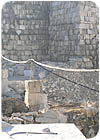
At the quarry, blocks are split with drills.

Quarrying in Tivoli

And because travertine comprises half of the company's business in the U.S., Fratelli Poggi is diligently working to meet market demand. One of the company's premium materials is Roman Classic travertine, which is used extensively in the U.S., according to Mauro Poggi, adding that one prominent project is the Ronald Reagan Federal Reserve Building.

Among Fratelli Poggi's travertine quarries is one that was opened in 1963. This quarry, which is currently about 50 meters deep, has about 12 to 15 years worth of material left, according to the company. Additionally, the original quarry that was purchased by Fratelli Poggi in 1923 was reopened three years ago, and it is about 40 meters deep.
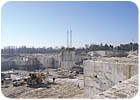
Three years ago, Fratelli Poggi reopened the original quarry that was purchased in 1923.

At the time of Stone World's visit, quarry workers were taking down a bench at the original site. “We don't use explosives because it will damage the stone and cause fractures,” said Poggi. “It is costly [not to use dynamite], but pays off in the end.”

To tilt the bank, a deep hole is first drilled with high-pressured hydraulic jacks. A steel wire with diamond studs is then inserted in the hole to cut the bank, which can weigh as much as 1,000 metric tons. The cutting is performed with a Fantini chainsaw.
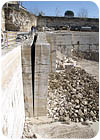
At the time of Stone World's visit, quarry workers were taking down a bench at the original site. To tilt the bank, a deep hole is first drilled with high-pressured hydraulic jacks.
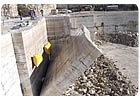
After the bank of travertine has been tilted onto the ground, a careful technical evaluation of potential blocks is done using selection criteria based on structure and color, according to the company. Areas that break in the bench are not as good of a quality, because they are not as strong, explained Colledani, who added that benches come down at least once a week to open up different areas in the quarry.

A steel wire with diamond studs is then inserted in the hole to cut the bank, which can weigh as much as 1,000 metric tons. The cutting is performed with a Fantini chainsaw.

The average size of a block measures approximately 11 x 6 feet. Each block of travertine can be cut in two ways - with the vein or against the vein, which is referred to as “crosscut.” “In Italy, everything was [originally] cut with the vein,” said Colledani. “Crosscut travertine became popular in the U.S. in the late '80s and early '90s.”

In addition to its quarries, Fratelli Poggi runs a saw mill for cutting blocks as well as a full-scale fabrication facility. In total, it employs approximately 70 workers in Italy. Additionally, Poggi Brothers, Inc. USA currently has 12 workers. “It is growing by the minute,” said Colledani, about the U.S. operation.
You must register or login in order to post comments.

Multimedia

Videos

Image Galleries

Coverings 2011 in Pictures

Once again, Coverings served as a platform for exhibitors to showcase the very latest in natural stone and quartz surfacing options. The event made a shift to Las Vegas, NV, this year after alternating between Orlando, FL, and Chicago for the past few years. The following is just a sample of the many materials that were on display in Las Vegas.

THE MAGAZINE

Stone World Magazine

February 2012 cover

2012 February

Check out Stone World's newest edition!

TABLE OF CONTENTS SUBSCRIBE

Contemporary Stone & Tile Design Magazine

cover

2012 Winter

Installation Case Studies, Interior Design. Revival in St. Louis

TABLE OF CONTENTS SUBSCRIBE

Social Media Tools

What is your feeling on Social Media as a business tool?
See Poll Results Poll Archive

The Stone World Store

Tile_Style_for_the_Home.gif
Tile Style for the Home

This book illustrates almost 500 contemporary tile projects, with thousands of ideas for illuminating a home with the beauty of tile.

More Products

Stone Industry Education

Stone Industry Education

From fabrication...to installation...to marketing and much more!  We provide natural stone professionals with stone knowledge and education they can count on, as well as great networking opportunities. Click here to go to Stone Industry Education.

Contemporary Stone and Tile Design

cover


The Winter 2012 issue of Contemporary Stone & Tile Design takes a look at some innovative uses of stone and tile in interior design. Additionally, it includes two installation case studies of high-profile projects. The issue rounds out with a feature showcasing large-format Italian travertine at the Aston-Martin luxury showroom in Troy, MI, and the restoration of two classic buildings in Downtown St. Louis, MO.  Check out the new issue here!


STAY CONNECTED

Facebook logo