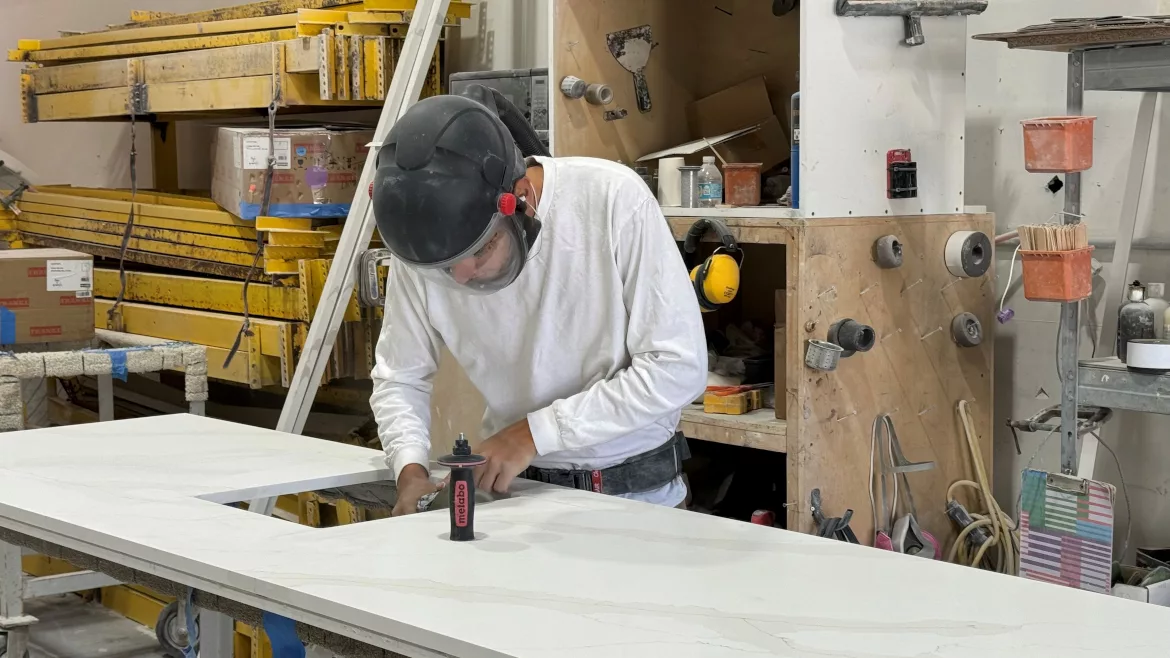
Merging timeless material and modern technology

Driving through the hills of the Brescia region in Northern Italy, a little over an hour from Verona, visitors can see the evidence of Botticino quarry operations from decades ago as well as activity that continues today. And while time-honored methods are being used to extract materials such as Botticino Classico, workshops such as the one run by Cooperativa Operai Cavatori del Botticino are using state-of-the-art technology to transform raw blocks into high-quality finished products.
The organization, which started in 1932, is broken into two sectors - quarrying and fabrication. On the fabrication end, it processes items such as 12- x 12-inch tiles as well as slabs and cut-to-size pieces.
The current slab factory, which is located in the town of Botticino Mattina, was established in 1998 and upgraded in 2003. It produces resin-treated slabs of Botticino Classico in sizes of 2 cm and 3 cm. From the beginning, the plant was equipped with machinery from Breton S.p.A., and this technology is continually being updated to represent the latest generation of stoneworking equipment.
Blocks are processed into raw slabs on one of two Breton gangsaws - one for 2-cm slabs and one for 3-cm slabs. After being cut into slabs, the material is calibrated using a Breton calibrating line, and then it is filled and polished. By applying resin, which is manufactured by Tenax S.p.A., the company can produce large-format slabs of Botticino Classico marble and maintain a high degree of durability.
A range of large-scale machinery from Breton facilitates the resin-application procedure, including massive driers capable of holding 40 slabs at once. These are used to optimize the resin-application process and ensure maximum penetration of the resin. The slabs also pass through a vacuum chamber, which ensures there will be no “air fissures†in the finished product. Slabs with large cracks receive a second resin coating, and fiberglass netting is also applied to the back of the slabs as needed. After the resin is applied and cured, the slabs receive their final polish on a 14-head Breton polishing line.
As dictated by the material quality and consistency, some material is cut to size on a Breton bridge saw into smaller slabs and panels. The bridge saw is also used for architectural pieces.
The facility can process 90 slabs in one eight-hour shift, and there are currently two shifts at work. Five workers are necessary for each shift, with the most manpower necessary for the polishing units. A broad range of automated material-handling equipment from Breton is in operation, thus lowering overall manpower requirements.
At the plants and in the quarries, new workers learn their craft while working alongside more experienced workers. There are also courses for accident prevention and safety on the job. The organization also participates in various social, cultural and recreation initiatives within the community.
A total of 60% of Cooperativa Operai Cavatori del Botticino's production is shipped outside of Italy, and export customers include major stone distributors in the U.S. In addition to an English/Italian Web site at www.coop-cavatori-botticino.it, the organization promotes itself at trade shows around the world. Working in collaboration with Consorzio Produttori Marmo Botticino Classico, it exhibits at CarraraMarmotec in Carrara, Italy; Marmomacc in Verona, Italy; and Stone+tec in Nuremberg, Germany.
A total of 500,000 tons of Botticino Classico is quarried each year, and the company has a geologist on staff to oversee that the very best material is being extracted. The organization's directors point out that Botticino Classico's neutral color fits many types of applications, including interiors and staircases. Additionally, it has less magnesium than Fiorito, making it physically stronger. In fact, the material is used for kitchen counters in the local Italian market.
Looking for a reprint of this article?
From high-res PDFs to custom plaques, order your copy today!