Laterite forms a nature-friendly environment
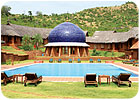
At the SwaSwara resort, situated on Om Beach near Gokarna, India, the design incorporates laterite, which was taken from areas near the resort as well as the jobsite itself.


Our firm, Inspiration, has 18 years of experience in the field of creating nature-friendly built environments, and it has designed and realized over 100 crafted buildings in South India. Natural materials are used as much as possible in the construction process. Around 50 of Inspiration’s constructions involved crafted stone work, completed thanks to a team combining architects, infrastructure engineers and trained craftsmen.
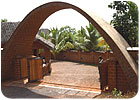
The entrance to the resort features a majestic laterite catenary vault.

One unique experience - where laterite was employed as a building material - can be found at the SwaSwara resort in Gokarna, India. Completed for M/s Cgh Earth Group, which has set the standard for luxury eco-resorts and spas in South India, SwaSwara at Gokarna combines years of experience in the industry to create what is expected to be the best yoga beach resort in India.

Primarily catering to the discerning international traveler who seeks to discover one’s “inner vibrations,” SwaSwara, situated on Om Beach, 6 km (3.6 miles) away from Gokarna, Karnataka, accommodates 24 luxurious courtyard villas, the Ayurvedic Spa, a restaurant, library bar, music room, craft center, swimming pool, art gallery, exhibition hall, yoga space and related accommodation facilities for a staff of 60.
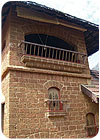
The laterite stonework takes on a range of forms and shapes as part of the design.

The site

The resort is located on approximately 29 acres of land. Entering from the north, the land slopes down to the beach on the southern side. The upper stretch is relatively gently sloping with scrub vegetation. The middle stretch has a patch of dense vegetation, and the lower stretch has a strip of paddy fields and coconut groves, which open out into the pristine Om beach.

The southern boundary of site is a stretch of Arabian Sea. The highest location at the site is approximately 30 meters (100 feet) above sea level.
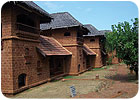
SwaSwara accommodates 24 courtyard villas, all of which include laterite in the design.
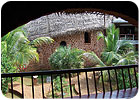
The soil profile of the site is mainly lateritic, which is reddish brown in color, having a lateritic clay soil texture. The top layers are soft laterite with small boulders, but below depths of 3 meters (10 feet), hard laterite rock formations prevail.

In addition to cut, rectangular formats, random shapes of laterite were used at SwaSwara.

Ecology sensitive features

Almost 65% of the site falls under Coastal Regulation Zone (CRZ), which is a stipulated “No Development Zone.” The design of SwaSwara fully respects these stipulations. Buildings are all held back more than 200 meters (650 feet) from the high tide level.
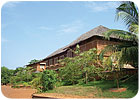
Laterite can be found in areas with heavy rainfall for two to three months, followed by very dry months. This is true for the western coast of India, where laterite can be found almost everywhere.
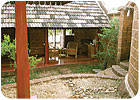
The architecture of SwaSwara respects the local tradition and culture and is quite in keeping with the same. A total of 24 spacious konkan villas form the guest living quarters. On opening the front door of each of these villas, a visitor gets perhaps the most memorable of the several surprises that SwaSwara has to offer. Inward looking and arranged around an inner courtyard, each of these villas has separate bedroom space, dressing areas, a luxurious bathroom which can neither said to be inside nor outside and study spaces and dining spaces on the ground floor. A balcony can double as a yoga and meditation space at the personal level, offering a panoramic view of the sea and hills around on the upper floor.

The stone was used for both flat and curved walls at SwaSwara

Predominant use of laterite as building material is what strikes one’s eye everywhere. The entrance is a majestic laterite catenary vault. The compound wall and retaining walls rising and falling with the ground levels, jalis shading glare, cutting off vision yet allowing ventilation, arches of various shapes and sizes, even twisted arches, vaults and chajjas all can be seen of laterite. Signage, lamp masts, pavements, pathways and water stand posts further celebrate versatile uses of the local laterite. Approximately close to 1 million pieces of laterite - with an average size of 12 x 9 x 6 inches - have been used on site, necessitating around 15,000 man-days of work in shaping, crafting and laying of laterite in various applications. Approximately, 10% of the laterite was extracted from the premises itself, in the process of creation of an artificial rainwater harvesting lake. 

Laterite can be found in areas with heavy rainfall for two to three months, followed by very dry months. This is true for the western coast of India, where laterite can be found almost everywhere. The color ranges from pale yellow to black, and its properties are similar to that of brick. The pieces used at SwaSwara were 1-inch in thickness, and they were used in cut, rectangular formats as well as random shapes.
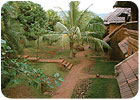
Lateriate can also be found along pathways that wind throughout the resort.

In terms of other crafted aesthetics, there is a brick masonry dome that was completed with hand-made blue ceramic tile cladding - assuming the position of “sanctum sanctorum.” Terracotta tile flooring, red-oxide crafted columns, seats, niches and flowing terracotta murals bring texture variations. Cane furniture, crafted wooden columns, handrails, trellis works and other accessories complete the design scheme. 

In treating the landscape too, attention to detail has been given priority. The buildings rise and fall with the contours of the land, minimizing disturbance of the natural terrain.
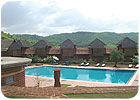
Approximately close to 1 million pieces of laterite - with an average size of 12 x 9 x 6 inches - have been used on site.

Environmental measures

In addition to using local stone materials, roofing in most spaces is of timber and renewable local thatch, tied at joints with copper bolts and copper wires. A combination of timber and tile is used where chances of catching fire is higher. In places where a clean interior ceiling is needed, such as in bedrooms, baths and kitchens, there is a thin shell of RCC (reinforced cement concrete) or filler slab.
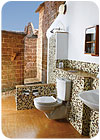
The bathroom areas at SwaSwara - described by the architect as neither “outside nor inside” - are of particular interest, and they include laterite as a key component of the design.
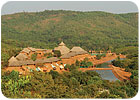
The bio-climatic design at SwaSwara ensures that less than 10% of the total built area requires air conditioning. It was an important criterion for the management that maximum thermal comfort be achieved without artificial means of ventilation and cooling - to the point that guests can have a reasonably comfortable stay without air conditioning even on a hot sunny day.

The buildings rise and fall with the contours of the land, minimizing disturbance of the natural terrain.

The design also ensures that all spaces have natural light during daytime, and all lamps used are CFLs (compact fluorescent lamps). The embodied energy of the building is also dramatically reduced by cutting down the use of cement, steel, paints and chemicals.

Did you enjoy this article? Click here to subscribe to Stone World 

You must login or register in order to post a comment.

Multimedia

Videos

Image Galleries

Surfaces 2013 preview

Surfaces 2013 -- to be held in conjunction with StonExpo/Marmomacc Americas -- is slated for January 29 to 31 at the Mandalay Bay Convention Center in Las Vegas, NV. The show, which also includes an extensive educational program that will be held from January 28 to 31, provides a place for thousands of floor covering retailers, distributors, installers, architects, designers and builders from around the world to gather and view the latest products, get vital education, network with other floor covering professionals and conduct business.

More than 600 of the largest manufacturers and suppliers representing products in every major category, including carpet, tile, hardwood, rugs, laminate, resilient and stone, are expected to exhibit at the trade show. Hanley Wood, owner and operator of the exhibition, reports that they have many new exhibiting companies and returning ones who have expanded their booth size. Additionally, Surfaces 2013 will host more than 40 workshops, seminars and mini sessions led by industry experts in the fields of business, sales, marketing, installation and design. Attendees can earn AIA, NKBA, AIBD, IICRC and AIA/CES industry designation. Here is just a small sampling of some of the displays that will be present at Surfaces 2013.

THE MAGAZINE

Stone World Magazine

SW May 2013 cover

May 2013

Stone World's new issue includes a feature on the restoration of St. Joseph Cathedral in Sioux Falls, SD as well as an inside look at the Artisan Group’s annual fabrication event in Austin, TX.

Table Of Contents Subscribe

Contemporary Stone & Tile Design Magazine

CSTD Spring 2013 cover

2013 Spring

CSTD's Spring issue features a special on Kitchen and Bath renovation. This edition also takes a look at the continuing popularity of quartz surfacing.

Table Of Contents Subscribe

Business Staff

How is your business currently staffed?
View Results Poll Archive

The Stone World Store

How_To_Polish_&_Restore_Mar.gif
How to Polish & Restore Marble Flooring

This video will show you step-by-step how to resurface and polish marble flooring from grinding and removing lippage and scratches to achieving a highly reflective polish.

More Products

Stone Guide

cover

The directory for Stone, Equipment and Supplies - the single information resource readers turn to.

Visit Stone Guide today!


Stone Industry Education

stone industry educationStone Industry Education is sponsored by Stone World Magazine and Marble Institute of America. The SIE events will help you: strengthen your skills, build your business, and  increase profit in your shop.  Check out stoneindustryeducation.com to register for upcoming fabricator and installer seminars.

STAY CONNECTED

facebook logo Twitter  YouTube