Historic basilica maintains ties with Quebec stone supplier
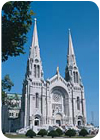
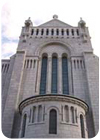

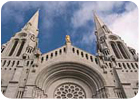
Drawing a remarkable 1.8 million pilgrims a year, the Cathedral Saint-Anne-de-Beaupre projects a majestic presence - with massive granite steeples and intricate stone detailing. The cathedral, which is located 18 miles from Quebec City, Quebec, was inaugurated in 1934, and maintains an association with the family and associates of the people responsible for quarrying and fabricating the original San Sebastian granite.

The history of this holy shrine dates back over 350 years to 1652, when three sailors traveling the St. Lawrence River shipwrecked just off the coast of Cap Tourmente, a stormy passage east of Quebec City. Stranded with no help in sight, they spent the next 24 hours on top of their capsized vessel. Sometime in the night, the three made a pact that if they were fortunate enough to survive, they would erect a chapel right on the very sight.
They kept their promise after they survived, and by 1663, a modest chapel was completed on the site of a small shrine that had been dedicated to Saint Anne, mother of the Virgin Mary, and as such, the grandmother of God. For the next 200 years, the chapel was honored by passing sailors with a mighty blast of the cannon.

However, the struggle for control of the St. Lawrence Seaway between the English, French and Americans brought devastation and fire to the shores of Quebec, destroying the chapel dedicated to Saint Anne on three different occasions. In 1911, Amede Bussiere and his son Ronald, well-known granite fabricators from nearby Saint Henry, were summoned by the parish priest to begin building the exterior walls of a new basilica.

The Bussiere family, joined years later by Ronald's son Marc, ultimately obtained the bid to provide all the granite and fabrication for this enormous project in October of 1923. With the architect's plan in hand, the Bussieres set about the task of quarrying the granite and delivering it to the site to begin piece-by-piece fabrication.
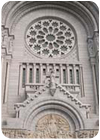
Building the original chapel took 11 years to complete, and the basilica was officially inaugurated by His Eminence Cardinal Rodrige Villeneuve on July 26, 1934. The Basilica of Sainte-Anne-de-Beaupre was finally finished, in all of its intricate detail, in May of 1977. Following an old tradition in church design, the general floor plan of the basilica is in the shape of a Latin cross, with the transepts acting as the arms. The church is best described as “neo-Romanesque,” meaning that it was built with modern construction techniques, but decorated in the traditional manner of Roman cathedrals.

Two magnificent steeples wrapped in San Sebastian granite pierce the Quebec sky, and finely crafted arches and stained-glass windows chronicle the years of labor needed to realize this ambitious project.

“My family came to Saint Sebastian in 1911, and we still play an important role in the construction industry today,” said Marc Bussiere. “I'm proud of my grandfather, my father, my brother and everybody else who played a role in the success of this incredible project.”

The Bussiere family is still active in the stone industry at Polycor Granite Bussiere Inc., a subsidiary of Polycor, Inc., which operates the San Sebastian quarry. They are also involved in renovations on the cathedral, and their knowledge of its history is invaluable when replacement stone is needed.

Jean-Nil Bouchard, geologist/historian at Polycor, is another resident “expert” on the basilica, and he has an intimate knowledge of the building and its history. “[The basilica] is so impressive, especially the sound,” he said. “You can speak normally from the main altar and still be heard perfectly all the way across the chapel.” To this end, representatives from New York's Carnegie Hall regularly visit the basilica to study its acoustics.

Polycor's products are also used in two of the cathedral's eight chapels - one with Missisquoi marble and another in Caledonia granite.

In addition to appreciating the grandeur of cathedral itself, those who are associated with it everyday enjoy the benefit of seeing the positive reactions of those seeing it for the first time. “I have seen so many [testimonials], I can't imagine one more powerful than the other,” said a priest at the basilica. “These scenes have been my every day for 30 years.”

You must register or login in order to post comments.

Multimedia

Videos

Image Galleries

Vitoria 2011

Over the course of the past decade, the Vitoria Stone Fair in Brazil has made a name for itself as a major international event. The country's vast natural stone resources -- centered in the State of Espirito Santo, where the fair takes place -- have made it a draw for attendees around the world.

THE MAGAZINE

Stone World Magazine

may 2012 cover

2012 May

Check out Stone World's May issue!

TABLE OF CONTENTS SUBSCRIBE

Contemporary Stone & Tile Design Magazine

spring 2012 cover

2012 Spring

CSTD's Spring issue is now available. Check it out!

TABLE OF CONTENTS SUBSCRIBE

Stone Industry Education

How much education is necessary in today's stone industry?
See Poll Results Poll Archive

The Stone World Store

Tile_Style_for_the_Home.gif
Tile Style for the Home

This book illustrates almost 500 contemporary tile projects, with thousands of ideas for illuminating a home with the beauty of tile.

More Products

Marmomacc AIA Continuing Education Contest

marmomacc contestMarmomacc, in partnership with Stone World, is sponsoring a contest  for licensed, U.S.-based architects to win a FREE Trip to Italy to attend the Marmomacc exhibition. CLICK HERE for more information.


Contemporary Stone and Tile Design

spring 2012 cover

The Spring 2012 issue of Contemporary Stone & Tile Design showcases the use of stone and tile in Kitchen and Bath design. Additionally, it includes a focus on sustainability and green design as well as highlighting some of the latest tile innovations that were on display at Cevisama this year, which was held in Valencia, Spain. Check out the new issue here!

STAY CONNECTED

Facebook logo  YouTube