Granite Distributor Sponsors Radon/Granite Testing Project

Recently, there has been heightened concern regarding the release of radon from granite finishes. This has created some anxiety for homeowners and other users of granite finishes, including developers that are deciding whether to include granite in their projects. Granite wholesalers want to be able to assure their clients that their product is safe, and testing has begun to evaluate materials. This article describes one of the approaches being taken in this endeavor as well as some of the initial results.
The potential for granite to emit radon at low levels has been known for some time. However, there have been some reports of granite emitting what could be considered unacceptable levels of radon. These tests, combined with recent media attention, have begun to raise concern among homeowners, developers and wholesalers.
In order to understand the potential risk of radon in granite countertops, we must first understand what radon is and how it is produced. Radon occurs naturally all around us, and it is a product of the radioactive decay of uranium. Uranium is naturally occurring in the soil, rock and water of the earth’s crust. Radon gas produced from the breakdown of uranium in the earth’s crust is found throughout the U.S., and it can seep into homes through air and water - posing a health risk. The largest source of radon gas into a home is from the rock it is built upon and soil beneath it. Other sources of radon in the home include building materials that are mined from the earth’s crust such as bricks, cement, sheetrock, floor and wall tiles, as well as granite. Some areas of the country have higher naturally occurring radon levels from soil than others. Areas on the East Coast of the U.S. generally have higher levels of radon. It is important to note that many homes will contain some radon levels from items discussed above and that this would be considered the “baseline level” of radon for a home.
Given the growing concern and public attention, Partner Engineering and Science (Partner) teamed with a local wholesale granite distributor, MS International Inc. (MSI), to undertake a full-scale sampling of all of their granite types for sale - some 250 different types of granite imported from quarries located all around the world. MSI wanted to determine if any of the types of granite they were offering for sale were potentially unsafe for their customers. They also wanted to give their customers the added comfort in knowing that they had tested their granite and to be able to provide the customer with written results of those tests should they have any concerns about the product.
“When the granite and radon issue became highlighted in the press, it became clear to MSI that we needed to quickly get an independent third party science and engineering firm to test our granites to prove to our valued clients that our granite countertops are safe,” said Rupesh Shah, the Executive Vice President of MSI. “Given the lack of industry testing standards and the lack of commonality of colors/granite types across the industry, we worked quickly with Partner Engineering and Science to develop a scientifically sound and practical testing protocol.”
For this project, Partner developed a sampling protocol based on the methods of studies conducted by Akron University as well as what is typical of field-testing in homes. In addition, what was logistically feasible for the facility in which the testing was to occur was also taken into consideration.
Initially, two methods were developed; one with smaller pieces of granite in a small confined air space, typical of the Akron University study; and another method to recreate an “in-home” scenario with average kitchen airspace and average granite countertop size. Once it was confirmed that these two methods yielded similar results, the more feasible, smaller-scale method was used for the remainder of the tests.
Given that radon is naturally occurring all around us, it is important to consider background levels in the study. For each round of testing conducted, several duplicate background samples (or air samples not exposed to granite) were also taken. All background levels tested were below laboratory detection limits.
All samples were tested using approved devices from the Environmental Protection Agency (EPA), and tests were performed by a National Environmental Health Association (NEHA) certified radon specialist, with all results analyzed by a NEHA Certified laboratory.
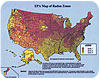
• Non-detect. No radon was measured to the laboratory detection limit of 0.4 piC/L (picocuries per liter). Same granite type from the same quarry is safe.
• Non-significant detect. Radon levels measured were at a level that, when extrapolated, did not have a significant effect on the natural levels of the home. Granite type from the same quarry is safe.
• Significant detect. Radon levels measured were at a level that, when extrapolated, did have a material effect on the natural levels of the home. Depending on the baseline level of the home, this granite type could cause unsafe radon levels in the home.
The objective of the testing provided was to determine if the extra radon from the installation of granite countertops into a home was significant enough to be a health concern. As discussed above, many homes will have a baseline level of radon present from the other sources already there (mainly the soil and rock beneath the home). The EPA suggests remediation for radon concentrations exceeding 2.0 pCi/L, and strongly recommends remediation for concentrations exceeding 4.0 pCi/L. Given the starting safe baseline levels, understanding if the addition of radon from the granite presented a danger was the goal.
Approximately 100 different types of granite have been tested so far with sampling currently ongoing. To date, the majority of the samples (approximately 90%) had a result of non-detect, or levels below the laboratory detection limit of 0.4 piC/L (category 1). The remaining 10% of samples tested fall into the category of non-significant detect (category 2).
Although there has been a great amount of buzz around this topic that has even created some fear, perhaps the risk is manageable simply by conducting a few simple tests. Although more tests need to be conducted, it is certainly a good start.
Editor’s Note: This independent study has no direct relation to the MIA-funded granite/radon study that was completed in mid-November and is covered on page 119 of this issue.
Looking for a reprint of this article?
From high-res PDFs to custom plaques, order your copy today!