Georgia marble continues to be a mainstay on college campus

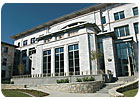
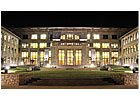
With an exterior of several Georgia marble varieties, the new Emory School of Medicine building at Emory University in Atlanta, GA, is a monument to refined classic style. Etowah Fleuri marble trim - consisting of pinkish hues - lines the building at regular intervals, contrasting beautifully with the Cherokee White and Pearl Grey blocks of stone that form the facade. The deep red tile roof further sets off the radiant tones of the marble, which was quarried by Polycor Georgia Marble of Tate, GA.
The use of Georgia marble for the School of Medicine building is in keeping with a long-standing tradition on campus. The new structure seamlessly connects the identical Anatomy and Physiology buildings that date back to 1917, two years after Emory University was founded. Their marble exteriors, designed in a calico pattern, gleam and show no signs of weathering after 90 years.
After Emory was founded in 1915, architect Henry Hornbostel of New York set out to create a “natural garden” campus that would complement the surrounding landscape of Druid Hills. The neighborhood reminded Hornbostel of an Italian hill town, and he designed the buildings with this thought in mind.
Hornbostel succeeded in turning his vision into a reality. The architect’s contribution to the Emory University District is listed on the National Register of Historic Places. The affiliated Web site states that, “the use of the block form buildings with wide eaves and arched windows in combination with pink and gray Georgia marble in a random ‘quilt-like’ pattern suggests the forms of Italian villas and buildings characteristic of Renaissance Tuscany.”
Jen Fabrick, University Architect, explained how Georgia marble came to define the campus. In 1916, Hornbostel visited the Georgia Marble quarries in Tate, GA, and noticed that there was a lot of residual marble around the quarries that was not being used. In a shrewd investment decision, he bought all the residual marble slabs from the Tate quarry and had them sent to the campus. He used the multi-color marbles ingeniously, creating the assemblage that resembles calico quilted patterns.
“You don’t see this anywhere else in the country,” said Fabrick. “Not this patterning. That was [Hornbostel’s] architectural statement.”
Emory’s Georgia marble buildings gave the campus of the new University glamour and distinction. Indeed, Georgia marble had already been used in such prestigious projects as the Lincoln Monument, the U.S. Capitol and the New York Stock Exchange.
Deciding on building material
When it came time to design the new building for the School of Medicine, it seemed only natural that it would be constructed with marble, so as to continue Hornbostel’s legacy. However, due to cost concerns, it was not originally considered feasible to construct the building with a full marble exterior.According to J. William Eley, MD, MPH, Executive Associate Dean for Medical Education and Student Affairs, school administrators thought that the exterior would have to be stucco with marble trim. However, the Board of Trustees was quick to intervene. “They said, ‘We want this building to be an Emory building in marble,’ “ he said.
Eley explained that in the early stages of the project, the architects lined up marble and other types of stone from all over the world next to the old buildings. “We looked at it, and everybody said, ‘We want the same stuff,’ ” he said. “ ‘There’s nothing as pretty as what is already on those buildings.’ “
The decision to use Georgia marble was made for technical as well as aesthetic reasons. “Most marbles are softer than limestone or granite, but Georgia marble is very hard, and therefore, capable of being used on the exterior of buildings,” explained Fabrick. “There aren’t any other marbles that would match the existing buildings and have the same coloration. We felt that the only way to go with a marble facade was to use Georgia marble.”
The installation
Garcia and Sons, an installation firm based in Georgia, purchased the marble from Georgia Marble’s parent company, Polycor, and installed it on the building. “It’s unique, that’s for sure,” said Brad Shull, who works at Garcia and Sons and was involved in the project. “You can’t get anything like that anywhere else.”In total, 25,000 square feet of varying types of Georgia marble with a honed finish were utilized for the new School of Medicine building. White and gray marble are used on the new building because repeating the calico pattern would have been too costly, according to Fabrick, who describes this as somewhat ironic as the Calico pattern was originally the more economical choice.
The School of Medicine has been a work in progress for quite some time. In the late 1960s, a connector building with very limited classroom space was built in between the two historic wings. The connector had few amenities, and the stucco exterior never quite fit in. In July 2005, construction began on the new building and, in the meantime, students and staff attended classes in the nearby Robert W. Woodruff Health Sciences Center.
When the School of Medicine building was completed in July 2007 and the school year commenced in August, students and staff delighted in their new home. “It’s been a great transition,” said Erica Black, Associate Director of Admissions, who added that the students are truly making the space their own, and that the different classes have been intermingling both academically and socially. “As for staff, we’ve definitely noticed that we’re more energized. Before, we had no windows in the old building, and now we’ve really noticed that sunlight makes a difference. People are excited to come here every day.”
Emory’s architectural heritage is an integral part of its identity, and the School of Medicine building is an important continuation of the Georgia marble lineage on campus. The elegant, striking building will continue to inspire awe and facilitate valuable learning experiences for many years to come.
“The Tate marble is one of the best available marbles in the world because of its density, its lack of porosity, its coloration and its strength,” said Fabrick. “That marble will last a long, long time - I have no doubts about that.”
Looking for a reprint of this article?
From high-res PDFs to custom plaques, order your copy today!