Focus on Indian Stone: Indian heritage reflected in a modern context
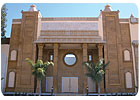
The Jain Center in Buena Park, CA, features an exterior made of Jaisalmir Yellow limestone from India. The pieces, which range in thickness from 2 to 12 inches, are secured with a T-9 mechanical anchoring system.
While the new Jain Center in Buena Park, CA, was intended to reflect the traditional design of Indian temples, the building materials also had to withstand the building codes and outdoor environment of Southern California. To meet all requirements, several varieties of stone from India were selected for the building's design.
“This is a small community center with about 2,000 to 3,000 members,†said Manu Shah of MS International, Inc. (MSI) of Orange, CA, the stone supplier and installer for the project. “In India, all Jain Temple work is usually intricately carved in marble. Some temples are as old as 1,600 years old. Ranakpur and Abu Jain temples are known for the most intricate detailed carvings in marble. The most famous, the Taj Mahal, is the world's biggest Mausoluem in marble with lots of inlay work with semi-precious stones.â€
The recently built 45,000-square-foot structure that is now being used for services is actually going to be a recreational hall for community use, explained Shah. Construction on an adjoining temple will begin next year.
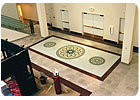
Creating a point of interest in the interior floor design are large mosaic medallions, consisting of different shades of stone, which were designed, supplied and installed by MS International, Inc. of Orange, CA.
“We wanted to do as much carving as possible for the temple as well as keep the look that goes with the city,†he said, adding that limestone was chosen for the exterior of the building instead of marble. “With my experience, Southern California has a lot of traffic and [the center is on a] very busy street.†Shah and the building committee worried that white marble would stain as a result of gas fumes and exhaust.
“The Taj Mahal is in white marble, but it doesn't have 10 million automobiles running around it,†he said. “Instead of white marble, we chose Jaisalmir Yellow limestone, which is pretty hard.â€
Shah went on to say that the limestone is named after the city of Jaisalmir in India, which is built of the material. “Some carvings are so intricate in that city,†he said. “We thought that [the stone] should reflect Jaisalmir.â€

Steps within the center are fabricated from Imperial Red granite.
According to Shah, some of the limestone pieces weighed as much as 1,500 pounds. The building and support system were comprised of steel to carry the weight of the stone.
“If not for California zoning laws, we would have done traditional building [as in India] without the mechanical anchors,†explained Shah. This traditional method is known as Shilpashastras, which is an ancient Hindu architectural science that does not require the use of steel reinforcement.
Trivedi Craft Private Ltd. of Ahmedbad, India, was responsible for the quarrying and fabrication of the limestone pieces. An employee of MSI in India visited the quarry and factory to inspect the finished stone before shipment.
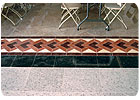
Decorative stone borders add further detail to the interior floor design.
Interior stonework
Inside, the Jain Center features an assortment of Indian stone as flooring throughout the various spaces, which was supplied by MSI. Imperial Red granite 18- x 18-inch tiles were employed in the lobby, entryway, dining area and main assembly hall. This material was also used for steps. Additionally, Dark Green marble 12- x 12-inch tiles were also used in the assembly hall and White Galaxy granite 18- x 18-inch tiles were employed in the main dining hall.Creating a point of interest in the interior floor design are large mosaic medallions, consisting of different shades of stone. The decorative floor elements, which were designed by MSI, bring a vibrant touch to the interior space.
Other stones used for the project were Opal Brown 18- x 18-inch tiles from Oman and Almond Mauve 18- x 18-inch tiles from China. According to Shah, the color palette was also modified for the center. While temples in India traditionally use darker hues, the Jain Center includes a lighter and warmer color scheme. “[Also], we had to choose a much smoother [floor] design,†he said, explaining that the floor material needed to be durable and safe for the high traffic volume that the cultural hall will receive.
Jain Center
Buena Park, CA
Overall Design Architect: LTI, Inc., Tustin, CA
Exterior Design Architect: Virendra Trivedi, Ahamedbad, India
Interior Design Architect: V Design, Ahamedbad, India
Stone Suppliers: Trivedi Craft Pvt Ltd, Ahmedbad, India (limestone); MS International, Inc., Orange, CA (interior stone)
Stone Installer: MS International, Inc., Orange, CA
Stone Substructure/Anchoring Design: Rama Ramdev, R & R Consulting Services
Looking for a reprint of this article?
From high-res PDFs to custom plaques, order your copy today!