Evolving into a well-established travertine operation
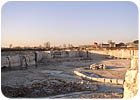
Societa del Travertino Romano's (STR) travertine quarries in Tivoli, Italy, are only 16 years old and total about 24 meters deep. The company's plan for expansion includes drilling down to 50 meters.
The beginning of Societa del Travertino Romano (STR) dates back to 1916, when the company started extracting travertine from its own 60-acre quarry in the area of Le Fosse, Italy. For years, the company concentrated on expanding its site so that it could offer a selection of stone products. To further expand upon its range of services, STR opened a facility in 1950 for processing blocks. The company continued to grow through the years by merging with other established businesses and acquiring additional quarries. Today, STR quarries travertine from all three basins - “Valle Pilella,†“Barco†and “Le Fosse†in the Tivoli and Guidonia areas, and it exports about 60% of its products to the North American market. Among the more notable projects that STR supplied material for is the Getty Center in California, which was designed by renowned architect Richard Meier.
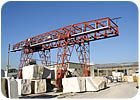
STR produces approximately 3,000 cubic meters of blocks per month.
To meet the growing demands of its flourishing business, the company acquired another quarry in 1975. This site, which is located in the Barco region, allowed STR to offer an even more extensive line of travertine products. Moreover, in the early 1980s, STR assumed the management of a quarry in the travertine basin of Valle Pilella - a site that had previously been operated by the company Filippo Cecchetti. With this new entity, the company further advanced its capacity of planning, development and processing of travertine.
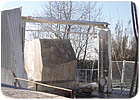
A wire saw is used to shape blocks.
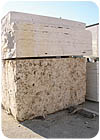
The company offers a wide selection of crosscut and vein-cut travertine products. According to Filippo Lattanzi, an owner of the company, STR's strength is in how much area the company's quarries cover. “We can get good quality material out of each,†he said.
Processing travertine
Societa del Travertino Romano offers a wide selection of crosscut and vein-cut travertine products. According to Filippo Lattanzi, an owner of the company, STR's strength is in how much area the company's quarries cover. “We can get good quality material out of each,†he said.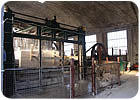
Among the equipment at the Tivoli plant are four gangsaws, which are used for cutting blocks.
Approximately 3,000 cubic meters of blocks are produced per month. In terms of finished products, the company outputs between 20,000 to 25,000 square meters of slabs and 7,000 to 8,000 square meters of tile each month. Irregular-sized blocks are used to make slabs, explained Lattanzi. “We don't want to waste blocks that can be used for slabs,†he said.
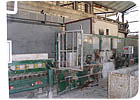
Also, the company has a Breton machine that is used for cutting thick monolithic blocks, which it has nicknamed “the Exploder.â€
Looking for a reprint of this article?
From high-res PDFs to custom plaques, order your copy today!