Detecting mild steel hairpin anchors in stone cladding

The Nuclear Regulatory Commission Headquarters is an 18-story marble- and granite-clad building located in Bethesda, MD. Cracking, displacement and emergency removal of loose marble and granite panels caused the owners to cordon off the building and install falling debris protection at the main entrance. To remedy this situation, we were asked to evaluate the condition of the stone-clad precast concrete facade, determine the cause of the failures and design repair.
As-built conditions were determined by examining the stones that had already been removed as well as additional in-place pieces. This process revealed a host of problems, including cracked stones, poorly drilled stone anchor holes, honeycombed concrete at anchor locations, unstable existing repairs, and the apparently random use of mild steel stone anchors in lieu of the specified stainless steel units. These findings caused a concern both for the immediate stability of the cladding and the long-term durability of the facade.
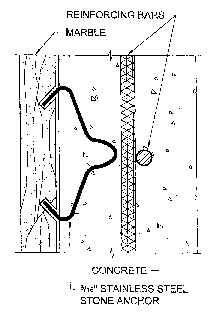
The "hairpin" stone anchors on this building are the sole attachment between the stone cladding pieces and the precast concrete facade panels (see diagram). The long-term durability of the stone anchorage system was compromised by the corrision potential of the mild steel stone anchors. While the portion of the anchor within the precast concrete enjoys passive corrosion-protection from high pH of the concrete, the remaining portion in the stone is free to corrode when wet. Moisture can reach these anchors via absorption through the stone or through leaks in failed stone-to-stone sealant joints.
With the exception of the stone cracks, the defects we identified during our initial investigation could not be directly observed with the stone cladding in place. Faced with the possibility of having to replace all of the 14,000 facade stones, or add supplemental anchors to each of them, we endeavored to find a non-destructive means of identifying only those individual stone anchors requiring repair.
In-place anchor detection
Normally, identifying metallic components within building con-struction is reasonably straightforward. Pachometers detect rebar in concrete, and other metal detectors can locate stainless steel, copper and aluminum. Armed with a half dozen commercially available metal detectors, we attempted to differentiate an in-place mild steel stone anchor from a stainless steel stone anchor. Unfortunately, the proximity of the metal hairpin anchors to the rebar in the concrete panel made it difficult for the standard metal detectors to distinguish between the rebar and anchors. After tuning out the rebar in the background, no standard metal detector was sensitive enough to pick up the small portion of the anchors engaged in the stone. Moreover, the task of differentiating between mild steel and stainless steel anchors proved to be impossible for these detectors.Developing in-hosue equipment
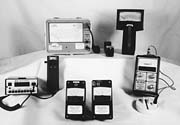
After discussing the problem with several instrument companies, we developed a pair of detectors incorporating carefully sized inductive proximity sensors. One, the Analog Anchor Detector, was sized so that its maximum range was short enough not to detect the rebar in the concrete panels. It is sensitive enough to detect mild steel anchors, yet unaffected by stainless steel anchors. This detector has a DC analog circuit and an output inversely proportional to the amount of mild steel within the first inch of the stone's surface.
The second instrument, the Digital Anchor Detector, has a detection threshold that can be adjusted to locate individual anchor legs. It indicates a positive read when the threshold is exceeded. The performance and accuracy of both instruments were verified by government representatives during blind field trials before being approved for use on this project.
Supplementing anchorage
From past experience, we knew that most stone-clad precast building panels are conservatively designed with respect to the number of anchors. Although safety factors of 4.0 are common in this type of design, we selected 2.0 as a minimum site-verified factor of safety for this project because individual stones would be addressed during the field inspection, eliminating many of the variables which are encompassed by the typical 4.0 safety factor. The minimum 2.0 factor of safety would cover any remaining unknowns.Data from laboratory tests for the marble and granite's flexural strength and modulus of elasticity were combined with anchor load test data to provide physical parameters for a series of finite element analyses for wind, gravity and outward point loads. Three-dimensional finite element computer analyses were employed to determine the minimum number of "good" anchors required, identify anchor locations critical to stone stability and predict acceptable stone deflections induced by a discreet 50-pound test load.
A two-man field crew set out to identify each stone's condition. The crew had customized recording sheets showing the stone layout for one floor's height and one bay's width, depicting the location of the original stone anchors and the planned tension load test locations.
Field use
The analog detector was first swept around each stone's perimeter and then across its entire field. When mild steel was detected, the voltage loss was recorded on the field data sheets. After each mild steel anchor was identified with the analog detector, the digital detector was then used to determine the anchor configuration. When mild steel anchors were detected away from typical anchor locations, the digital detectors were used to verify the location of the remaining anchors.Since granite thicknesses of 7¿and 1 inch were both used on this project, mild steel anchor indications required verification of the stone thickness. If the stone was 7¿inches thick, a 1¿inch-thick plastic shim was attached to the analog sensor to simulate a stone of 1-inch thickness. If the shim-equipped analog detector did not detect the previously detected anchor, that anchor was assumed to be a deeply engaged stainless-steel anchor. Mild steel anchor locations were slated for repair.
In addition to the material anchorage detection checks, each stone was subjected to a series of 50-pound discrete tensile load forces using a calibrated force meter attached to a suction cup at the predetermined critical anchor locations. Stone deflections at each test point were recorded and compared to acceptable deflection limits determined by the finite element analyses. Stones with measured deflections exceeding allowable levels were slated for repair.
After five months of stone investigation, the data from the metal detection and the tensile load tests were reviewed, and it was determined that only 600 out of the 14,000 stones required auxiliary anchor repairs. The reduced repair scope resulted in costs significantly below those associated with complete facade pinning or replacement.
Looking for a reprint of this article?
From high-res PDFs to custom plaques, order your copy today!