Creating Architectural Stonework: Providing Rosso Verona for the architectural market


Architectural stone education in Verona

The articles in our series entitled, “Creating Architectural Stonework,” are a reflection of the Veronafiere-AIA Continuing Education Seminar at Marmomacc 2005 in Verona, Italy. During the first day of this session, architects were shown all of the steps taken to create the stonework for the new Banco Popolare project in Verona (pictured on the right). The education session combined classroom seminars and site visits on the processing of stone and specific architectural applications.

The eighth edition of this educational program, which is sponsored by Stone World, will once again take place at this year's edition of Marmomacc. Industry education begins on October 3, and the show itself takes place from October 4 to 7.
Cave Bonaldi extracts Rosso Verona marble from a site nearly 2,000 feet above sea level in the Valpolicella region of Italy, just outside of Verona.
In the Valpolicella wine-making region of Italy, just outside of Verona, Cave Bonaldi extracts Rosso Verona marble nearly 2,000 feet above sea level. The vast quarry site produces 15 to 20 commercial stones, including the “Nembro” variety, which was used for the Banco Popolare project.

During the extraction process, large blocks are freed from the quarry face by drilling and blasting, and these large blocks are further worked into smaller blocks that can be transported from the site.
Because the stone has a high compressive strength, it is well suited for architectural exteriors, such as Banco Popolare, Cave Bonaldi reports.

Vertical cutting in the quarry is done using diamond wire saws from Pellegrini and Marini-Quarries Group of Italy.
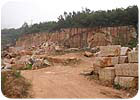
Since the site is a sedimentary quarry - it was originally formed underwater - clear fossilization can be seen in many of the stone pieces. The color of the stone is derived from its oxidation, and the different natural formation processes resulted in shades of cream, red and yellow. The combinations of these shades are classified as different varieties of Rosso Verona.

A typical block measures 4 x 8 x 4 feet in size, although Cave Bonaldi can also extract atypical shapes for specific architectural pieces, such as large columns.
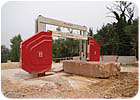
During the extraction process, Cave Bonaldi avoids blasting whenever possible. It is used only for the top layers, and for separating large blocks from the quarry face - a process that also involved drilling. Before these large blocks are freed, a bed of rubble is arranged to break their fall, thus minimizing impact and fracturing. Once the larger blocks are extracted, they are further broken into smaller blocks that can be shipped for processing.

Blocks are trimmed and squared to their final dimensions as needed on a stationary Pellegrini diamond wire saw.
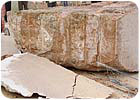
Vertical cutting in the quarry is done using diamond wire saws from Pellegrini and Marini-Quarries Group of Italy. A typical block measures 4 x 8 x 4 feet in size, and blocks are trimmed and squared to their final dimensions as needed on a stationary Pellegrini diamond wire saw. The largest blocks are used for cutting into slabs, while the smaller blocks can be used for tile and cut-to-size production. The company once produced a 44-ton block, but the size limit is not the geology of the quarry, but transportation. In addition to standard blocks, Cave Bonaldi can extract atypical shapes for specific architectural pieces, such as large columns.

The largest blocks are used for cutting into slabs, while the smaller blocks can be used for tile and cut-to-size production.
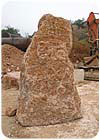
The quarry site itself is quite large, and crews work different sections depending on consumer demand for the different varieties. At the present time, the company is extracting stone from a “bench” measuring around 16 feet high that it reports to be some of the best material ever taken from the quarry. Although the bedding plane is inclined, it only presents a minimal challenge, due to the experience of the crew.

The different varieties of stone extracted by Cave Bonaldi often showcase natural fossilization (although the block pictured is quite rare).
The areas for extraction are not always adjacent to one another, and after a section of the quarry is closed to further work, it is re-claimed by filling it in with dirt, which allows agriculture to grow and preserves the beauty of the landscape for future generations.

Did you enjoy this article? Click here to subscribe to Stone World 

Column-picsmall

Michael Reis has been working for Stone World Magazine since 1993. In his role as Editor and Associate Publisher, he covers all aspects of the stone industry, from quarrying to fabrication to installation. He contributes feature articles as well as writes the Stone Column, which is a monthly commentary on industry issues and trends. Emailmichael@stoneworld.com

Recent Articles by Michael Reis

You must login or register in order to post a comment.

Multimedia

Videos

Image Galleries

Surfaces 2013 preview

Surfaces 2013 -- to be held in conjunction with StonExpo/Marmomacc Americas -- is slated for January 29 to 31 at the Mandalay Bay Convention Center in Las Vegas, NV. The show, which also includes an extensive educational program that will be held from January 28 to 31, provides a place for thousands of floor covering retailers, distributors, installers, architects, designers and builders from around the world to gather and view the latest products, get vital education, network with other floor covering professionals and conduct business.

More than 600 of the largest manufacturers and suppliers representing products in every major category, including carpet, tile, hardwood, rugs, laminate, resilient and stone, are expected to exhibit at the trade show. Hanley Wood, owner and operator of the exhibition, reports that they have many new exhibiting companies and returning ones who have expanded their booth size. Additionally, Surfaces 2013 will host more than 40 workshops, seminars and mini sessions led by industry experts in the fields of business, sales, marketing, installation and design. Attendees can earn AIA, NKBA, AIBD, IICRC and AIA/CES industry designation. Here is just a small sampling of some of the displays that will be present at Surfaces 2013.

THE MAGAZINE

Stone World Magazine

June 2013 Stone World cover

2013 June

Stone World's June issue highlights a series of stone companies and quarries such as PBA Stone, Mag Ban, Gramil and San Gabriel Black quarry. Also, check out some exclusive coverage from the annual Vitoria Stone Fair, which took place in Espírito Santo, Brazil.

Table Of Contents Subscribe

Contemporary Stone & Tile Design Magazine

CSTD Summer 2013 cover

2013 Summer

The Summer issue of Contemporary Stone & Tile Design highlights some of the top products from Coverings 2013, which took place in April. Also, read about the designing of a custom pool and spa by Rock Solid Tile.

Table Of Contents Subscribe

Green Practices

Are you promoting green practices and the life-cycle of stone in your sales and marketing efforts?
View Results Poll Archive

The Stone World Store

How_To_Polish_&_Restore_Mar.gif
How to Polish & Restore Marble Flooring

This video will show you step-by-step how to resurface and polish marble flooring from grinding and removing lippage and scratches to achieving a highly reflective polish.

More Products

Stone Guide

cover

The directory for Stone, Equipment and Supplies - the single information resource readers turn to.

Visit Stone Guide today!


Stone Industry Education

stone industry educationStone Industry Education is sponsored by Stone World Magazine and Marble Institute of America. The SIE events will help you: strengthen your skills, build your business, and  increase profit in your shop.  Check out stoneindustryeducation.com to register for upcoming fabricator and installer seminars.

STAY CONNECTED

facebook logo Twitter  YouTube