

Natural Stone Institute Educates Designers on Material Differences
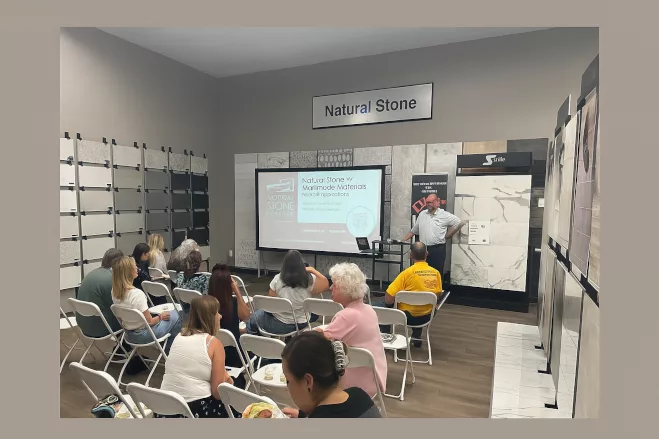
SAN DIEGO, CA -- Mark Meriaux, accreditation and technical manager of the Natural Stone Institute (NSI) led a seminar on Wednesday, October 8, 2025, for design professionals, offering a technical comparison between natural stone and manmade materials such as engineered quartz and porcelain. The continuing education course, which was hosted by MSI at its San Diego, CA, facility, focused on performance, sustainability and design considerations to help guide material selection for countertops, flooring and other applications.
The presentation addressed key performance attributes, starting with heat resistance. Meriaux explained that natural stone is generally more resistant to high temperatures and thermal shock compared to many manufactured products. He noted that the increasing popularity of high-heat kitchen appliances, such as air fryers and sous-vide ovens, has led to instances of scorching or discoloration on some resin-based countertops.
Chemical resistance was another major topic. Meriaux distinguished between two main categories of natural stone: calcareous stones like marble, which are sensitive to acids found in common food items like lemon juice and vinegar, and silicious stones like granite and quartzite, which are highly resistant to household acids. He clarified that the dull spots often seen on marble are typically etching from a chemical reaction, not a stain. While man-made materials are often marketed as impervious, Meriaux stated they can also be damaged by certain chemicals.
Addressing common misconceptions, the session explained that stain resistance is tied to a material's porosity, or absorption rate, rather than its type. Some marbles have very low absorption rates, making them less susceptible to staining than commonly believed. The role of sealers, which penetrate the stone to slow the absorption of liquids, was discussed for both natural and some engineered surfaces.
From a sustainability perspective, Meriaux highlighted natural stone's lower embodied energy. The material is quarried directly from the earth and processed, whereas manufactured surfaces like quartz and porcelain require energy-intensive processes of crushing minerals, mixing them with resins and pigments, and curing them with heat and pressure. Meriaux also emphasized natural stone's longevity, noting it can be restored and refinished multiple times over its lifespan and is fully recyclable, often crushed for use as aggregate at the end of its life.
The presentation concluded with a look at design trends and technology. Advances in fabrication with robotics and waterjets allow for intricate textures, patterns and relief carvings in stone. This versatility, combined with stone’s inherent uniqueness, supports biophilic design principles that aim to connect indoor spaces with nature.
The seminar was part of the NSI’s educational outreach, which includes a technical support team, a third-party accreditation program for fabricators and installers, and publications for the design community.
Looking for a reprint of this article?
From high-res PDFs to custom plaques, order your copy today!