The geology of building stone
An understanding of the geological background of stone can help one make informed decisions about its use, maintenance and restoration
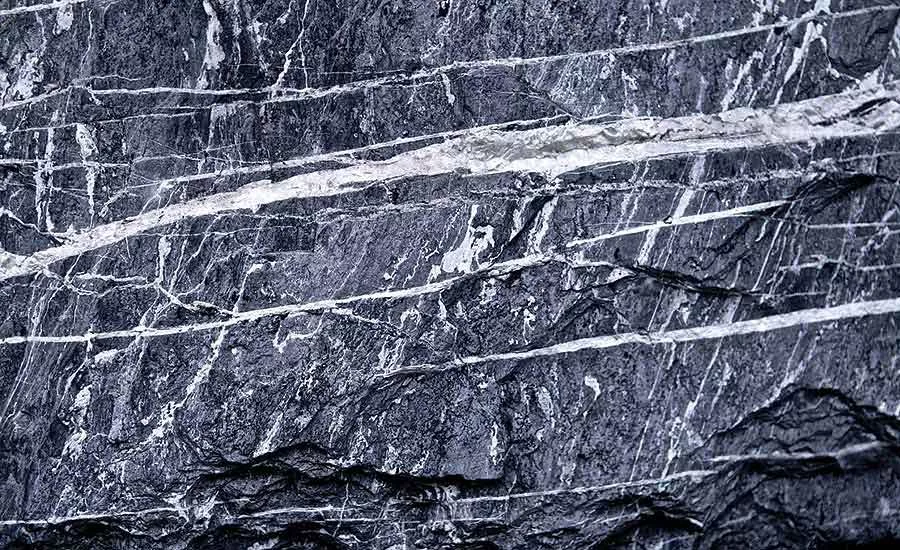
Because of its structural integrity and its diversity of color and texture, natural stone has been popular as a building material for centuries. To understand the natural attributes of stone, it is important to have some understanding of stone’s geological background. It is in understanding how stone is formed that we can see its attributes and gain some insight into each stone’s character.
All of the stones used for building are formed by three different processes. These are:
- Igneious – formed from molten rock
- Metamorphic – formed by the chemical and physical alteration of existing rock
- Sedimentary – formed by the deposition and cementation of sediment.
Each of these names gives a general indication of what a stone’s characteristics are. Within each of these three groups there are varied mineral combinations and sub-processes that can be used to identify specific types of rock, such as granite, marble and sandstone. Insight into these processes will help gain an understanding as to what makes one kind of stone different from another.
Sedimentary rocks
All sedimentary rocks begin with a parent rock that is weathered. Weathering – a vital step in the rock cycle – is the constant destruction of rock material at or near the surface of the earth. It is the weathering process that produces the raw material (sediment) of sedimentary rock. These sediments are eroded and transported by water (streams, rivers or ocean movement), wind and ice (glaciers) into an environment of deposition. After deposition, these sediments are buried and become cemented together to form rock. This process is called lithification. The end result of lithification is a sedimentary rock (limestone, sandstone and shale).
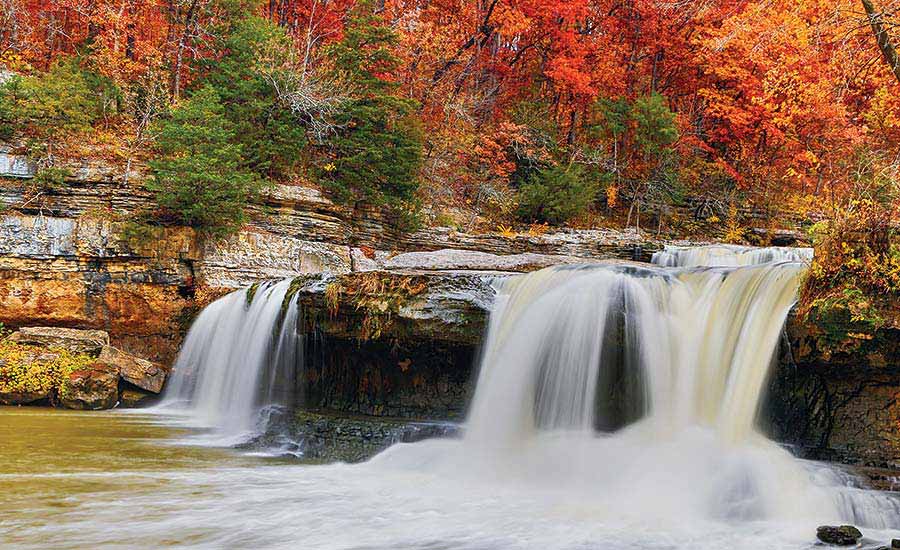
Sedimentary rocks fall into two groups. The first is the detrital rocks (from the Latin word “worn down”), which are rocks formed from sediments that are mechanically worn down. Some examples of detrital sediments are gravel, sane, silt and clay.
The second group is the chemical rocks that are formed through the evaporation and precipitation of materials that were dissolved in groundwater. These materials are the end product of chemical weathering. The most common dissolved elements are sodium, potassium, magnesium, calcium and strontium. An example of the direct process is a salty body of water that has evaporated through time, leaving salt (NaCl sodium chloride). An example of an indirect process is when an organism like coral calcite uses it as its home (skeleton). Examples of this kind of deposit are the coral reefs that surround most of the islands in the Caribbean. In this manner, the skeletons are built one on top of another and collect as a biochemical deposit, which in turn becomes a biochemical rock known as skeletal limestone.
The three processes – detrital and chemical – are not mutually exclusive. It seems Mother Nature allows both these processes to occur together and form rocks that have characteristics of both. Examples of this are sandy limestone, which is more 50% lime, but can contain up to 25% sand, and calcareous sandstone, which is 50% sandstone, but can contain up to 25% lime.
Calcium carbonate, quartz and clay triangle
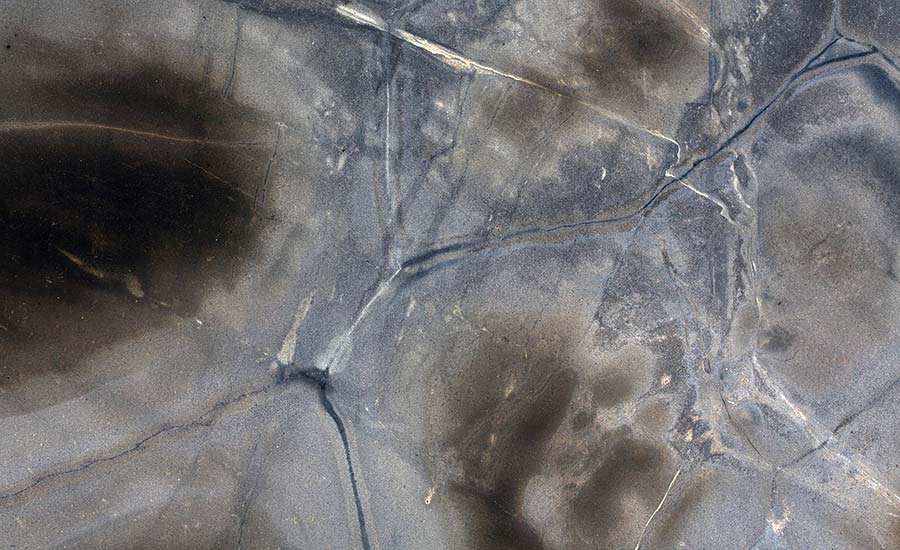
Cementation is the process that glues the loose sediments together. The most common cementing agents are calcite (CaCo3), dolomite (CaMg[CO3]2) and quartz (SiO2). Some others are iron oxide (Fe)2, chalcedony (a variety of quartz (Si2), anhydrite (CaSO4) and pyrite (FeS2). These cementing agents are carried in a solution, which percolates down through the sediment, and are deposited in the pore spaces where they act as cement.
The pH of this solution plays an important role in determining whether the cement will be quartz, calcite or dolomite. If the solution is acidic, the cement tends to be quartz. When the solution is alkaline, the cement is either calcite or dolomite. Cementation is the process that actually glues sediment together. However, this is not the only method by which rocks are lithified.
In fine-grained sediment (silts and clays), water does not percolate easily through pore spaces. In sediments like these, the process of compaction and desiccation play an important role in the lithification process.
Compaction is the reduction of pore space within the unconsolidated material in response to increasing weight of the overlying material that is continually being deposited. This reduction of pore space causes desiccation, which is the de-watering of sediment. Particularly in clays, this dewatering brings the particles in close contact with one another, allowing them to bond with each other.
The last process that aids in lithification is crystallization. This is the formation of crystals in the pore spaces from minerals in solution or the growth of existing crystals by taking minerals out of solution and bonding them to existing crystals in the sediment. This process is a specific form of cementation and has the side effect of making some rocks harder.

When all these processes are finished, we are left with sedimentary rock. Some examples of these stones that are widely used in the building industry include Indiana limestone, Delaware Valley sandstone, Mankato stone, Kasota stone and the Ohio sandstones.
Metamorphic rocks
If these rocks are buried further or are exposed to high temperatures, a process called metamorphism may occur. The two major causes of metamorphism are 1. coming in contact with molten rock bodies (contact metamorphism) and 2. heat and pressure due to depth of burial and tectonic movement (regional metamorphism).
Metamorphism is a change in sedimentary, igneous and pre-existing metamorphic rocks while in a solid state in response to changes in their environment. These changes cause modification (crystallization, recrystallization and changes in the minerals) within the rocks themselves. Changes occur below the zone of weathering and sedimentation and outside the zone of re-melting. These changes are a result of heat, pressure and chemically active fluids, with heat playing the most significant role in the process.
Heat caused by overlying pressure and the earth’s release of heat from the interior of the planet acts as the catalyst, which allows metamorphism to occur. Pressure influences the space occupied by the mineral components of a rock mass, causing closer atomic packing, recrystallization of minerals and formation of new minerals. Chemically active fluids, which are released from magma reservoirs, may cause the addition or subtraction of ions within a rock. This in turn may cause new minerals to be formed and existing minerals to grow in size. This process is called metasomatism.
Depending on the severity of metamorphism, the same parent rock might produce two different end products, which the geologist grades from low to high metamorphism in five steps called “zones.” These “zones” – from low to high – are chlorite, biotite, garnet, staurolite and sillmanite. Each of these zones is a name for the predominant mineral formed during metamorphism at its particular grade. When these rocks are buried deep enough and are heated enough, the solid rock does not immediately become molten. Instead, its internal bonds become more flexible, and the rock has a tendency to behave like plastic when heated, stretching into thin bands and bending and warping under tension and pressure. This plastic behavior is what produces the banding and veining in many stones.
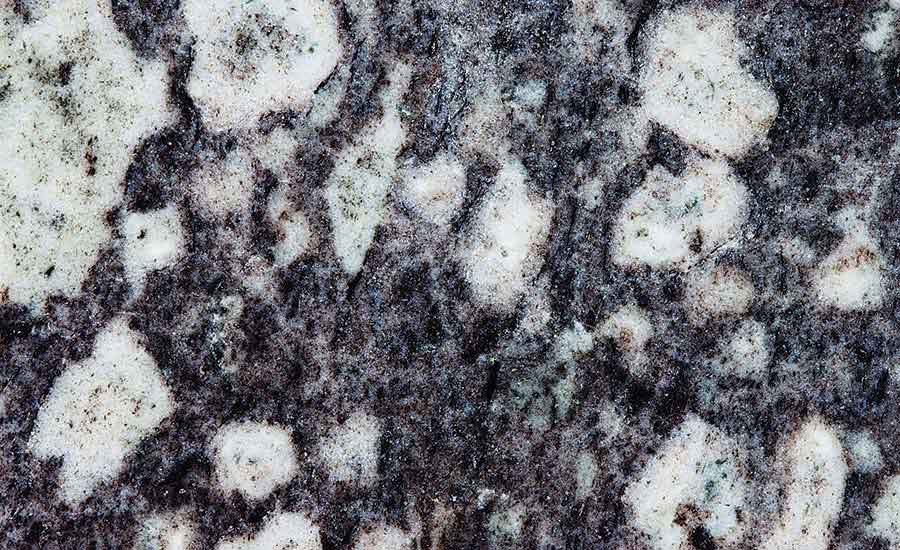
Given the variety of source rocks – both sedimentary and igneous – and the degree of metamorphism, a wide range of metamorphic rocks as end products is possible. However, some simple transitions are shale becoming slate, impure sandstone becoming schist or gneiss (depending on the grade of metamorphism), pure sandstones becoming quartzite, and limestone and dolomite becoming marble.
Products of regional metamorphism igneous rocks
The last group of rocks are the igneous rocks, which are those rocks formed by the cooling down and solidification of molten magmas lavas. It is important to realize that this group of rocks was the first to form on the planet and today make up 95% of the earth’s crust. These rocks are the parents of all other rocks that have been discussed.
These rocks originate deep in the earth’s crust, where there are molten bodies. As they cool, crystals form and grow upon one another until the entire molten body has turned to stone. If the cooling occurs slowly, larger crystals (phaneictic texture) are formed. If the cooling occurs rapidly, small crystals (aphanitic texture) will form. Sometimes, there are two stages that cause both large and small crystals (porphyritic texture) to form.
The predominant minerals in igneous rocks are orthoclase feldspars, quartz plagioclase feldspars and the ferromagnesium group. Different combinations of these minerals will produce many different rocks. Granite’s composition is two parts orthoclase feldspar + one part quartz + one part plagioclase feldspar + a pinch of ferromagnesian mineral.
Basalt, which is a dark black rock as opposed to the light-colored granite, has a mineral composition of one part plagioclase feldspar + one part ferromagnesian.
Many of the other igneous rocks fall in between these two groups — both in color and in content of predominant minerals. It should be noted that many of the granites that are sold are not true granites by definition, but are either other forms of igneous rock or high-grade metamorphic gneiss. As examples, “Nero Assoluto” would probably be categorized as basalt, “Rosa Bota” would be categorized as granite and “Paradiso” would most likely be considered a high-grade metamorphic gneiss.
General mineral composition
We can see from the formulas of basalt and granite that color can be changed dramatically by the inclusion of a different mineral. This is also true for all stones. Some of the minerals which lay a strong role in giving stone its color and shade variation are iron oxides, hematite and limonite, which produce reddish brown and yellowish brown colors, respectively; bituminous matter (organic material), which produces shades of gray and black; and minerals such as diopside, hornblende, serpentine and talc, which can give rocks a greenish appearance. These are only a few of the possible minerals that add color or lightness to a stone.
Not only do minerals affect the color of stone, but the mineral content also determines the hardness of the stone. Minerals range in hardness on a scale from 1 to 10, with 1 being the softest and 10 the hardest. Granite, which is composed of feldspars and quartz, has a hardness of 6 to 7, while marble has a hardness of 3 to 5. Calcium carbonate has a hardness of 3 in its pure form, so it is evident that impurities in marble have a tendency to make it harder.
Having an understanding of the geological background of stone helps one to make informed decisions about its use, maintenance and restoration. When choosing stone for a project, it is important to select a material which is best suited to the use of the project, the environment in which it will be installed and the use which it will receive on a daily basis.
Looking for a reprint of this article?
From high-res PDFs to custom plaques, order your copy today!