Roundtable: Architects reflect on natural stone
In this roundtable discussion, several architects share their thoughts and experiences about the use of natural stone in design
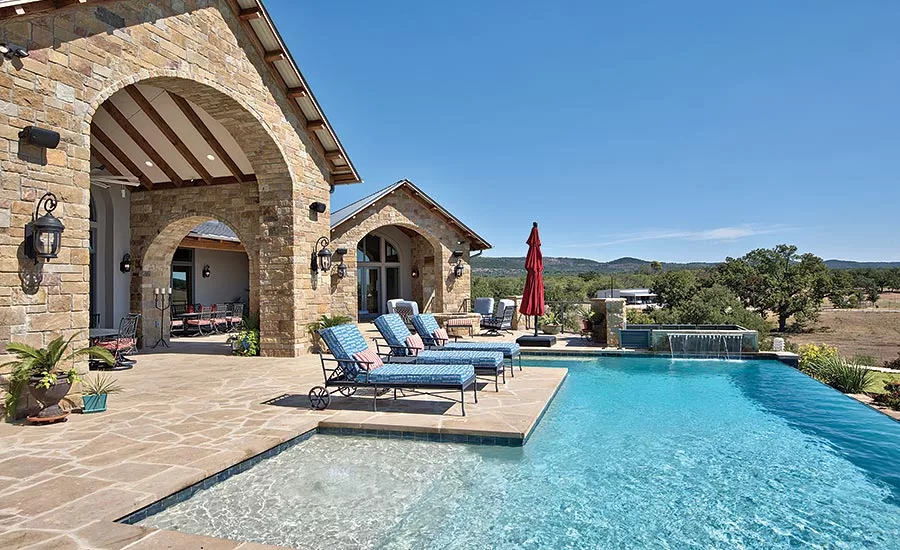
David Costea, senior project manager at Burleson Design Group in Wimberley, TX, often incorporates natural stone into his designs for its durability and longevity.
Photo ©C.L. Fry
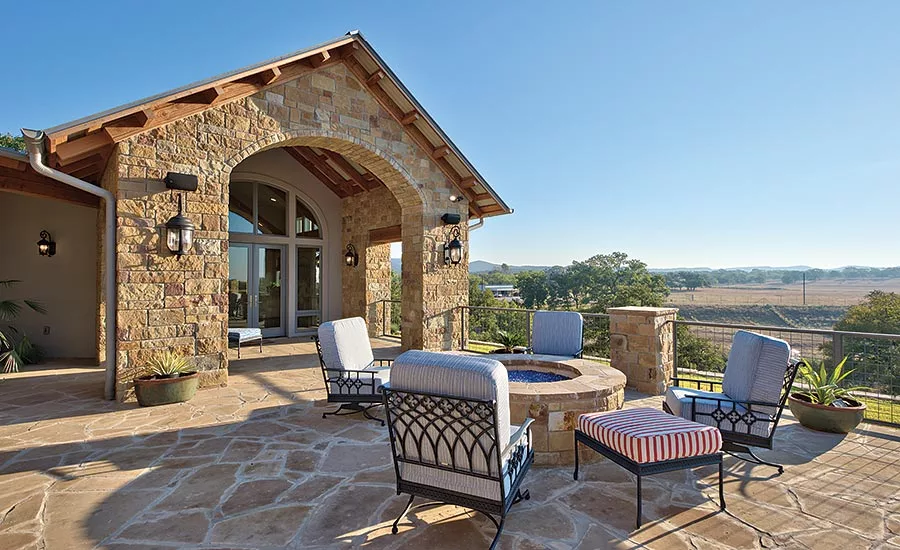
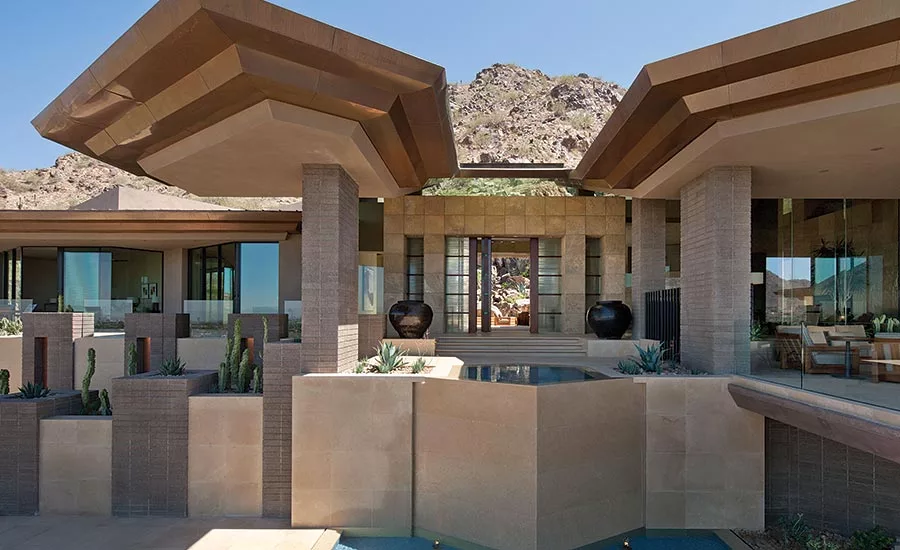
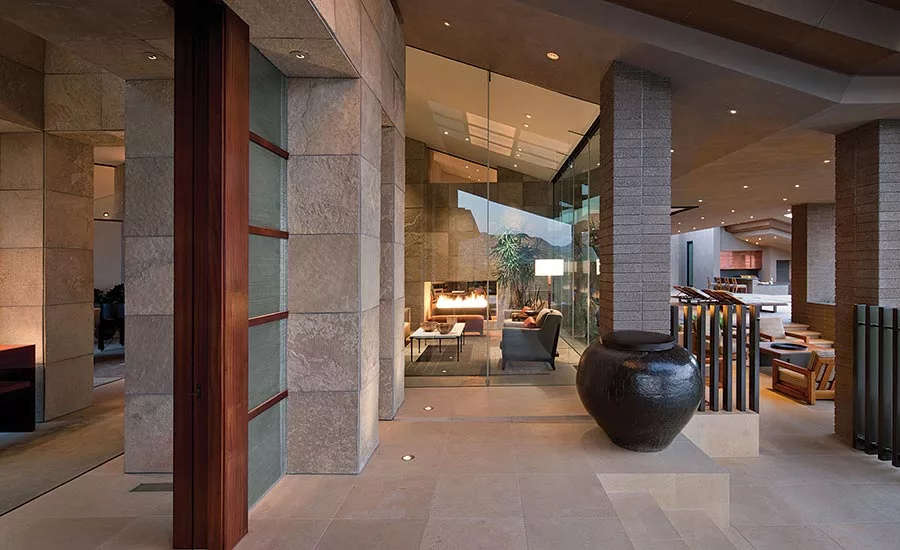
For a recent residential project, David Costea, senior project manager at Burleson Design Group, prominently showcased local Texas limestone throughout the home’s exterior and interior living spaces.
Photo ©C.L. Fry
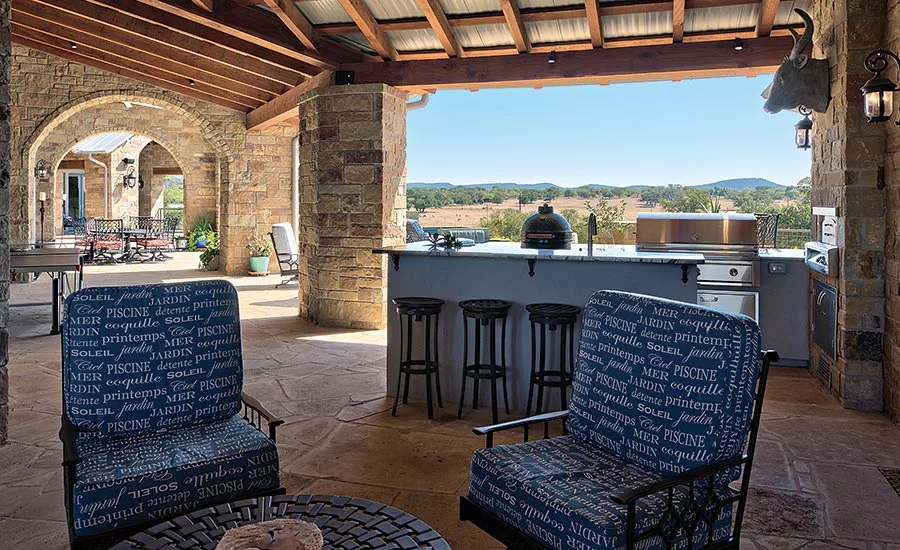
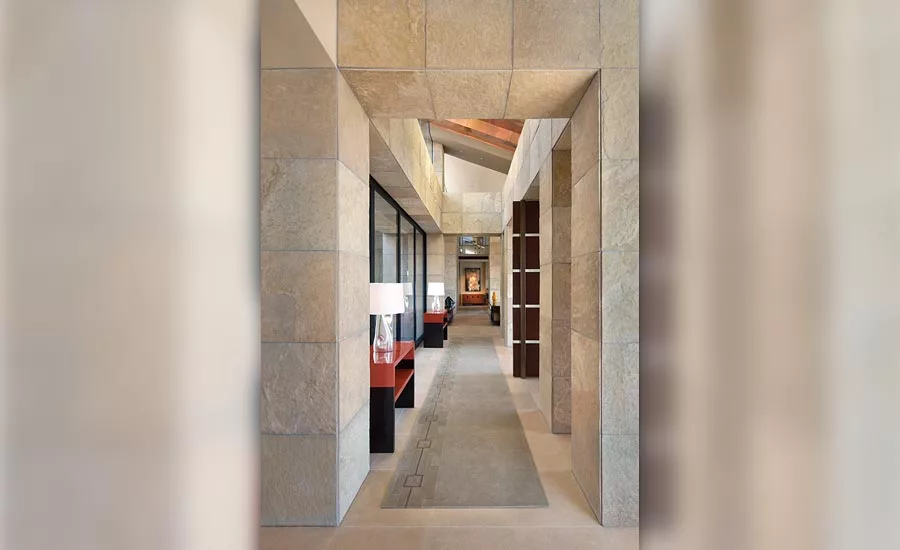
Large span stone arches were incorporated into the residential design to capture the home’s hilltop view.
Photo ©C.L. Fry
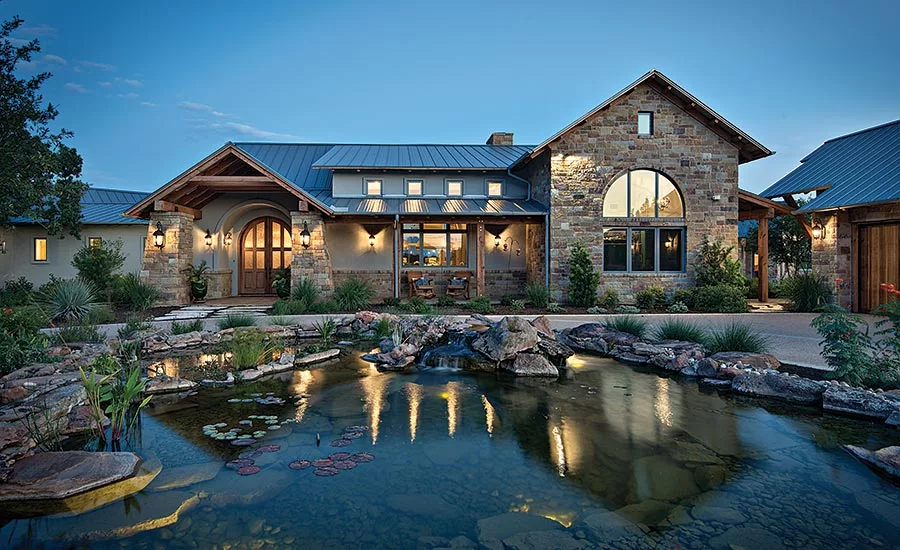
Natural stone often has the ability to complement its surrounding environment — tying a structure to the ground.
Photo ©C.L. Fry
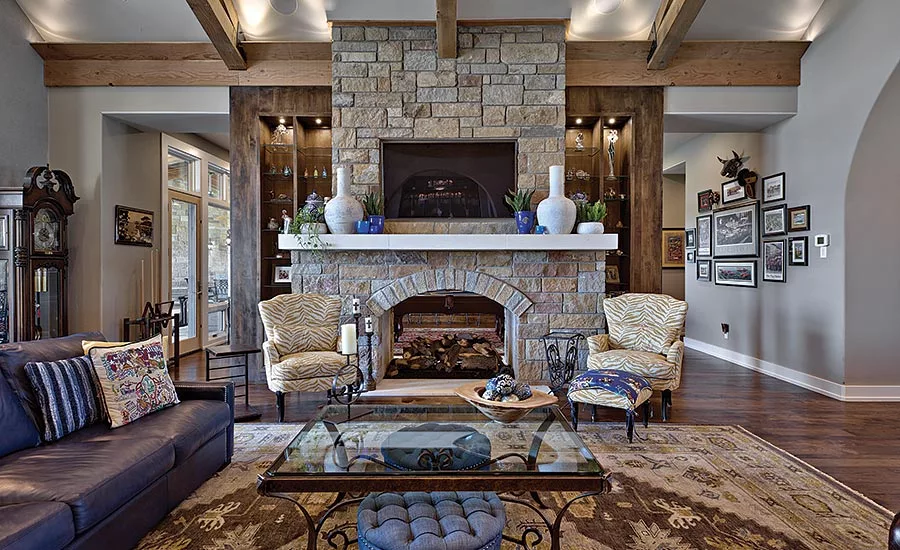
A rough-cut stone fireplace adds a touch of rustic elegance to the interior living space.
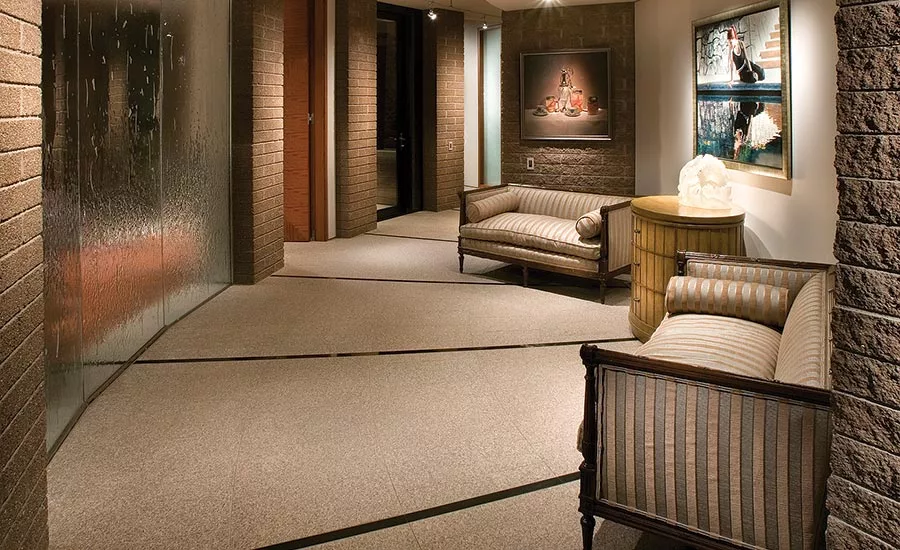
Jon C. Bernhard, AIA, senior partner at Swaback Partners pllc in Scottsdale, AZ, created a high-end luxurious feel for the interior living space of a residence in Paradise Valley, AZ, with a variety of natural stone. The floor pattern follows a radial pattern of Oklahoma Pink granite — originating at the main entrance of the approximate 10,000-square-foot home.
Photo by Dino Tonn
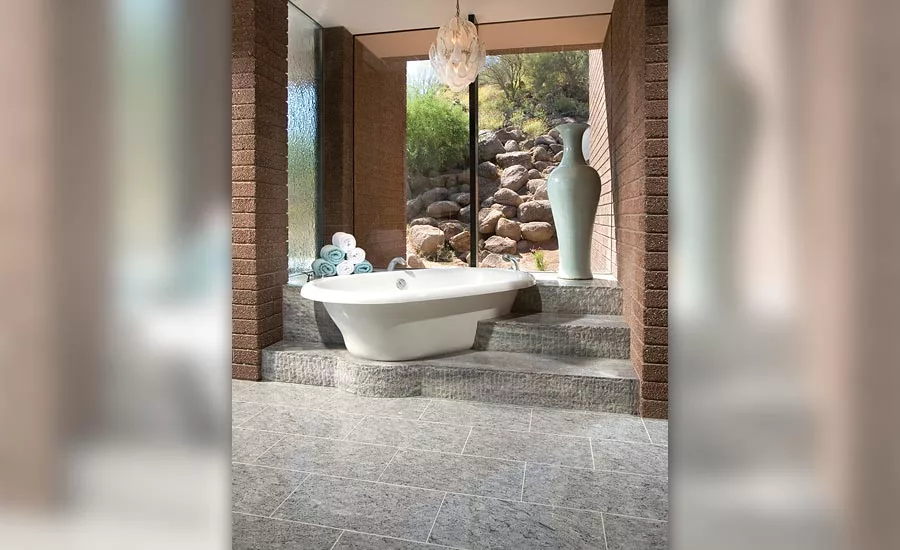
For the master bath of the Arizona residence, Bernhard selected large-format Lavender Blue granite floor tiles. A chiseled finish was applied to the steps leading to the tub to conceal the seams that were accentuated with this particular material pattern.
Photo by Dino Tonn
While times change and trends come and go, natural stone remains a popular choice in both residential and commercial design. Stone World recently had the opportunity to talk with a few experienced architects — representing various regions of the U.S. and diverse areas of architecture — to ask their opinion on a range of issues related to designing with natural stone. Participants include:
- Jon C. Bernhard, AIA, senior partner at Swaback Partners pllc, Scottsdale, AZ
- David Costea, senior project manager, Burleson Design Group, Wimberley, TX
- John G. Waite, FAIA, John G. Waite Associates, Architects PLLC, Albany, NY
Here is what the architects had to say during our discussion.
SW: How often do you use natural stone in your designs?
Bernhard: It is rare and unusual that I do not use natural stone. In addition to the beauty, durability and a broad range of available sizes and shapes, natural stone limits introduction of toxins into the designed environment and has a modest carbon footprint from production through end of life cycle, or recycle.
Costea: Natural stone in some fashion is used in almost all of our projects, stone veneer being the primary use. We use stone for a couple of reasons: 1. Durability and longevity of the material with a relatively maintenance-free quality. 2. Design aesthetics of the building to fit with surrounding architecture.
Waite: Our firm, John G. Waite Associates, Architects, has a practice focused on the preservation, rehabilitation and restoration of existing buildings and the construction of new buildings within historic contexts. Because of this, we are strong advocates for the use of natural stone either to match existing stone in historic buildings or to be compatible with historic materials in new construction. In our restoration work, we go to great lengths to match original stone. If that is not available, we look for a similar stone that matches in color and texture, with the same physical and chemical properties. We do not like to use substitute material, such as cast stone, glass reinforced concrete or reinforced polyester (fiberglass) in the restoration of historic buildings. Those materials do not behave the same as natural stone and certainly don’t weather and patinate the same. They also don’t have the life expectancy of natural stone, which is not a good characteristic for a material to be used in a building that is being restored to last hundreds of years into the future.
SW: How do you go about sourcing stone for your projects?
Bernhard: In addition to local suppliers, I have had the good fortune of visiting natural stone fairs and stone conventions around the world. These opportunities included touring quarries and production facilities, meeting suppliers and other extraordinary sources, enabling access to virtually any stone, in any quantity or configuration delivered to any jobsite, with confidence.
Costea: In collaboration with the stone supplier or mason working directly with the project’s general contractor.
Waite: We begin a project by researching the history of the building — both its original construction and subsequent modifications. Usually there is information on the original stone and its origin. We also may check with a geologist to determine if the stone is actually the same as identified in the historical records.
We then would work with a stone supplier or fabricator to determine if the original stone is still available, or if it isn’t, we have to determine a suitable match. In Albany, we frequently work with Adam Ross Cut Stone, a company that has been in business for over 125 years. We have worked extensively with Adam Ross over the years, and they are very knowledgeable about stone sources and installation.
SW: Do you find more stone varieties are available now than say five or 10 years ago?
Bernhard: I find new stone varieties every year, likely as a result of better extraction and cutting technology. This has also created expanded sizes and uses for stone varieties that have a long history of availability.
Costea: We are seeing more stone varieties available due to the expanding or changing design climate. As clients are willing to explore design beyond what was once thought of as traditional, they are also looking at how materials are incorporated in the building.
Waite: For our purposes, I would say it’s about the same over the past 10 years. However, some of the quarries, such as the Longmeadow Brownstone quarry, are no longer in production and it is difficult to find a match.
SW: What are some current trends you are seeing when it comes to stone in architecture and design?
Bernhard: The trend of sustainable design and extensive availability of natural stone products has provided greater exposure, and subsequently, a greater understanding of stone. This familiarity shifted the perception of natural stone as a limited application, premium cost material, to understanding the range of potential uses for natural stone and realization that modestly priced stone is available.
Costea: Trends we see are very contemporary or modern, as well as an aged or weathered appearance with popularity in reclaimed material (especially wood). That same trend is carrying over to stone.
Waite: In the historic preservation field, I think that there is a growing awareness that natural stone should be used to repair historic buildings rather than substitute material such as cast stone, glass reinforced concrete or reinforced polyester (fiberglass). These materials behave differently than natural stone and do not weather and patinate the same. They also do not have the same life expectancy.
Also, today there is a growing concern for authenticity in the restoration of historic buildings. The use of natural stone only reinforces the sense of authenticity and integrity.
SW: How closely do you work with a quarrier or stone supplier when working on a project? What are some matters you discuss or are looking for prior to installation?
Bernhard: Working with a supplier early in the design process has great value. I discuss design concept with suppliers early and often. The supplier can advise on size, availability and alternate materials to consider. This expands the potential for better design with material that accommodates or exceeds expectations. Final design is often influenced and altered as a result of the challenges and opportunities presented by the supplier.
Costea: Not directly. The project’s general contractor generally acts as an intermediary between our practice and the stone supplier or mason.
Waite: Depending on the project, we usually work very closely with the supplier and quarries. Often it is difficult to find the same stone as what was used originally. If that isn’t available, finding another stone that is compatible with the original stone with similar physical and chemical properties, as well as appearance (color, texture, veining, etc.), is essential. Some of the things we discuss are block size, color variation, natural imperfections, bedding plans, finish and tooling.
SW: What is a recent project you completed that included stone in its design?
Bernhard: I am working on a large estate using natural stone as a primary material. The majority of the walls of the home are finished with large split-faced limestone. As a feature, large-format honed Italian travertine is being installed on a massive wall that runs from the exterior of the main entry through the foyer and great room and continuing out the exterior. The stone is selected and installed to appear as a solid 30-inch-thick, 60-foot-long mass of stone, pulled straight out of the ground in one piece.
We visited the quarry in Tivoli, [Italy], to select the ideal stone, with limited striations and imperfections to allow book-matching with no mirror/repeat appearance. We worked intimately with the installer to establish invisible seams and corners, with sufficient opportunities for structural movement.
Natural stone is the primary contributor to this home’s extraordinary and unique design.
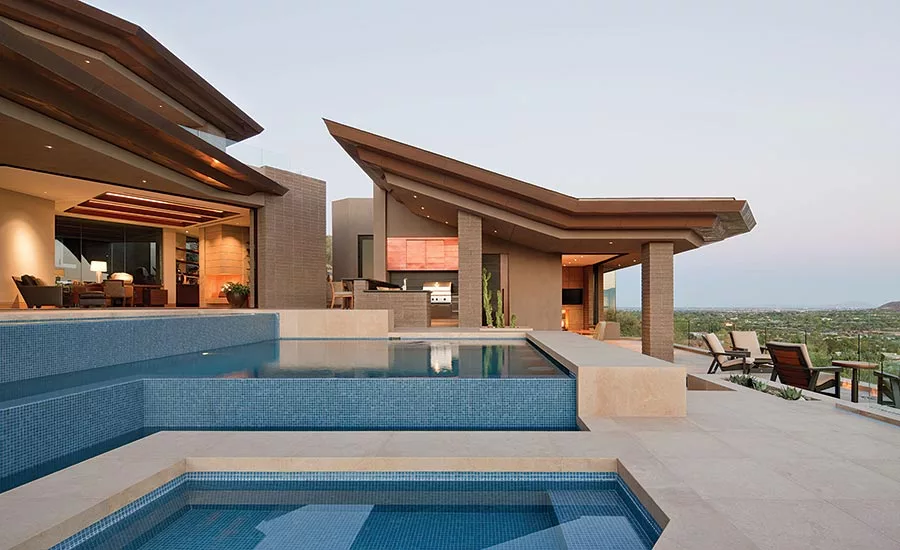
Costea: A custom residence with an expansive pool deck flowing into a negative edge pool overlooking a hilltop view. Large span stone arches are incorporated to capture the hilltop view.
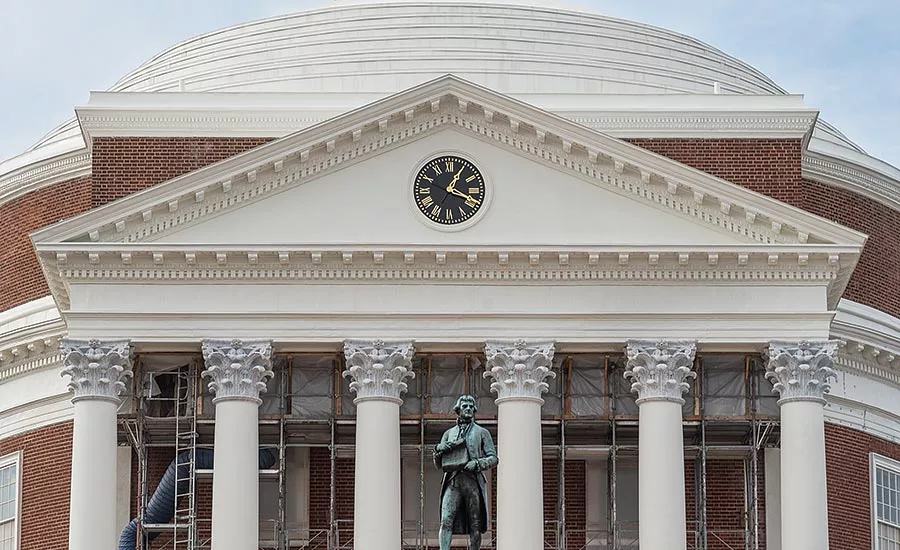
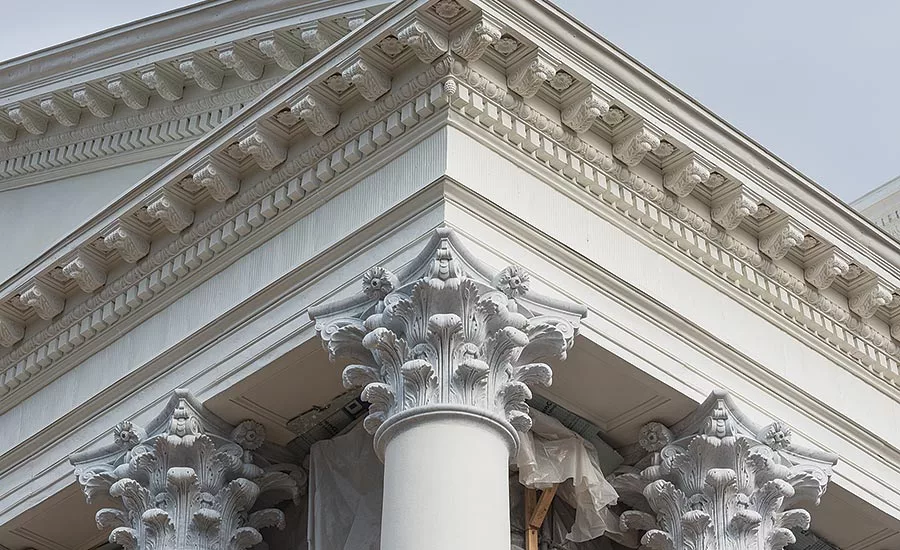
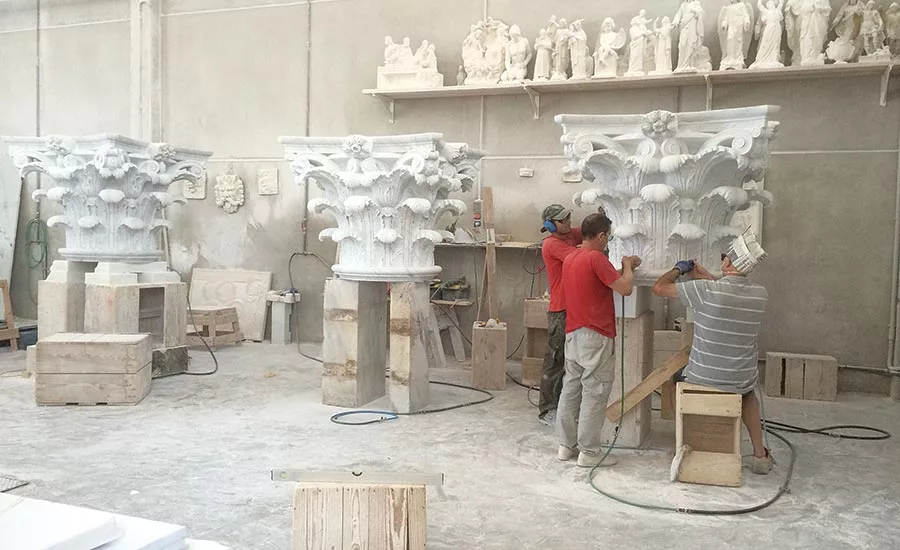
Waite: We recently created new construction documents to restore the rotunda at the University of Virginia to its original glory. A fire in 1895 destroyed all the marble capitals, and so there was not one intact example of a complete capital. All there was to work with was one partial lower capital base and two to three small fragments from the upper portion of the upper capital, as the original capitals were fabricated in two portions: lower and upper. There were no close-up photos either, just an image from 1895 which showed the capitals at a 100-foot distance. There were also no original drawings and architectural design plates which would confirm the original design.
SW: What would be some advice you would give to someone who has not worked with natural stone before?
Bernhard: Go visit your local supplier to get an initial understanding of the wide range of available materials and have a discussion about the different ways to use natural stone. Visiting a fabricator will provide an invaluable understanding of what is possible with regard to shapes, sizes and details. Then let your imagination run wild.
Costea: Natural materials act and behave differently than manufactured materials. Treatment of natural materials differs from that of manufactured materials.
Waite: Meet with the stone supplier/fabricator early in the design process and visit the quarry. Discuss the proposed details and technical issues such as bedding, type of mortar, installation, finishing, etc.
SW: Have you ever encountered difficulties when working with natural stone on a project? If so, when looking back, what would you have done differently?
Bernhard: Like any product, difficulties can occur if you don’t think through how the product is used, exposure and durability. Consider finish/texture to accommodate slip resistance with exterior application, specifically around pools and wet locations; consider resistance to wear, UV exposure and chemicals; know the material’s performance specifications relative to your installation, and if test data is not available, have the materials tested.
Costea: Using natural stone at or around certain type of pools can be challenging while providing a surface that will not react with the pool water.
Waite: We have encountered difficulty in securing the original stone in the restoration of Tweed Courthouse, after the quarry closed. We have not had difficulties with stone we specified if the proper research and evaluation was done to avoid surprises.
SW: Do you think there is anything the stone industry can do differently to improve the process for architects and designers who work with natural stone? If so, what?
Bernhard: Based on personal experience, the more architects and designers are educated on the merits of natural stone, the more stone will be used — the more that is known about natural stone, the more appealing it is. Generally speaking, this knowledge results in better design.
Costea: Stone selection or review can be daunting for clients, and an online resource to view available stone materials would help and offer the client a clear vision.
SW: Through the efforts of the Natural Stone Council (NSC), more stone producers are receiving their ANSI/NSC 373 Sustainable Production of Natural Dimension Stone certification, which is a testament to running an environmentally friendly operation. Do you see the benefits of selecting stone from one of these quarriers, as opposed to someone who is not certified? Why or why not?
Bernhard: If an environmentally friendly supplier is available, all other variables being equal, this responsible operation is the preferred source. Based on my observation of the growing awareness and sensitivity to sustainability in schools and from clients, environmentally friendly certified operations will continue to grow in importance.
Costea: If possible, both we and our clients prefer to use sustainable materials, however, the biggest impact on stone selection is the location of the quarry. If a sustainable quarry is within a reasonable distance, as not to add cost due to transportation, it would be the quarry of our choice.
Waite: With our work, this certification is not particularly relevant or helpful.
Author’s Note: Heather Fiore contributed to the content of this article.
Looking for a reprint of this article?
From high-res PDFs to custom plaques, order your copy today!