A custom granite was sourced to give one of New York's oldest parks a new look
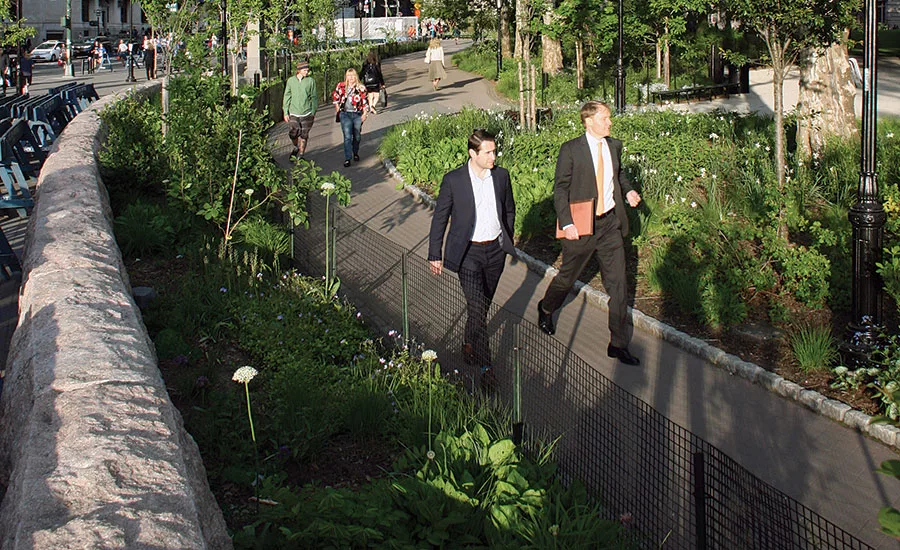
New York City’s renowned Battery Park, now known as The Battery, was recently transformed to update its look. One of the focal points of the new design is a 1,500-foot-long bench wall constructed of granite from Stony Creek Quarry in Branford, CT.
Photo courtesy of Suki Choe, Quennell Rothschild & Partners
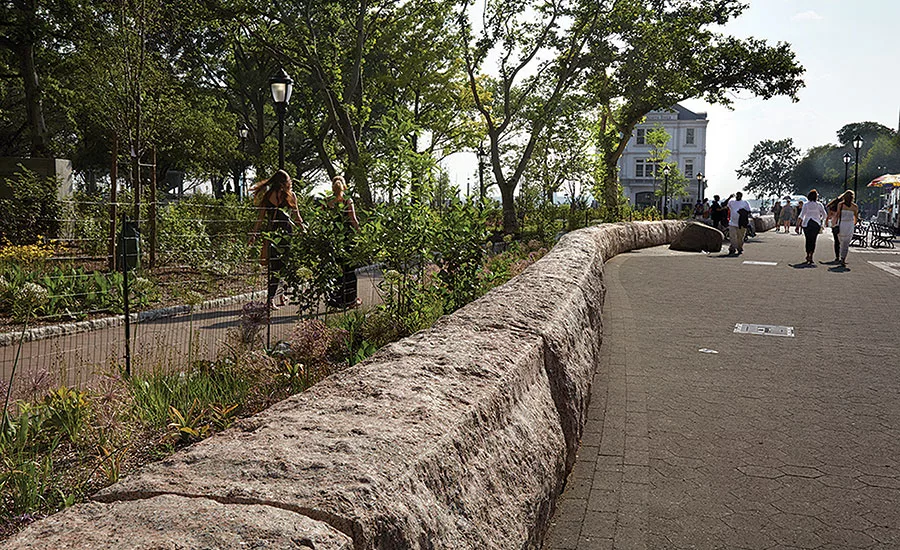
The Stony Creek granite, which embraces a very irregular texture, was the “first and only choice” specified for the project, according to Warrie Price. “It is strong and beautiful in its color tones, and has the historic significance of being the pedestal stone base of the Statue of Liberty,” said the president and founder of The Battery Conservancy, a private organization that manages the park in partnership with the City.
Photo by Sean Kernan for Stony Creek Quarry
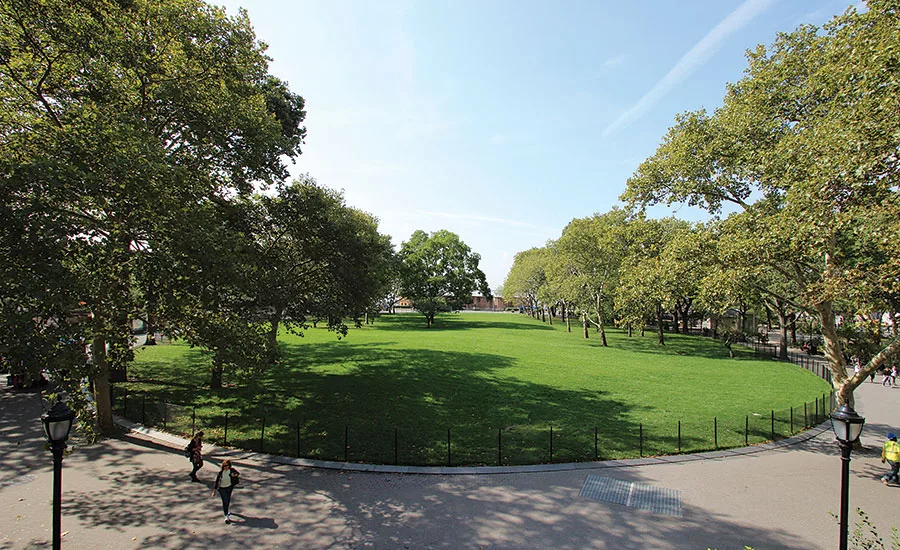
Photo courtesy of Josie Connell, The Battery Conservancy
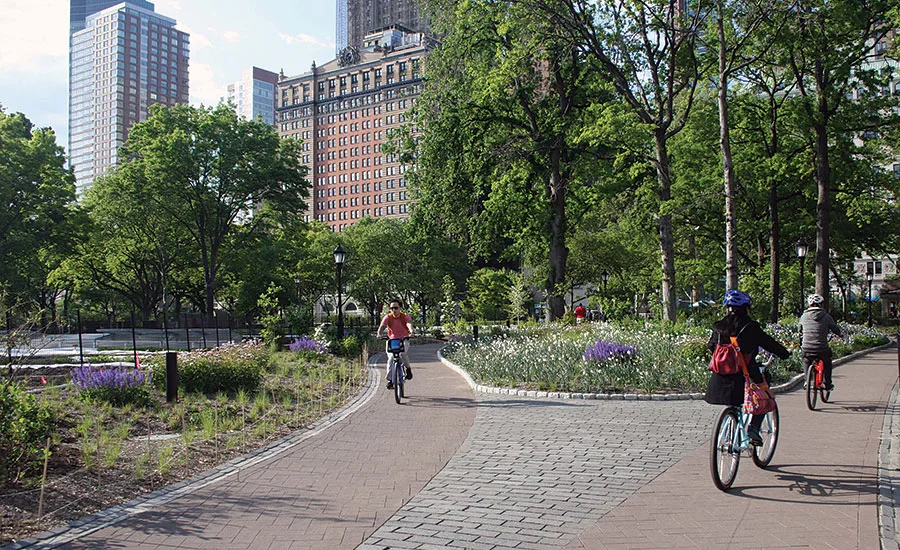
Aside from the feature wall, the Stony Creek granite was also used to complement various pathways.
Photo courtesy of Suki Choe, Quennell Rothschild & Partners
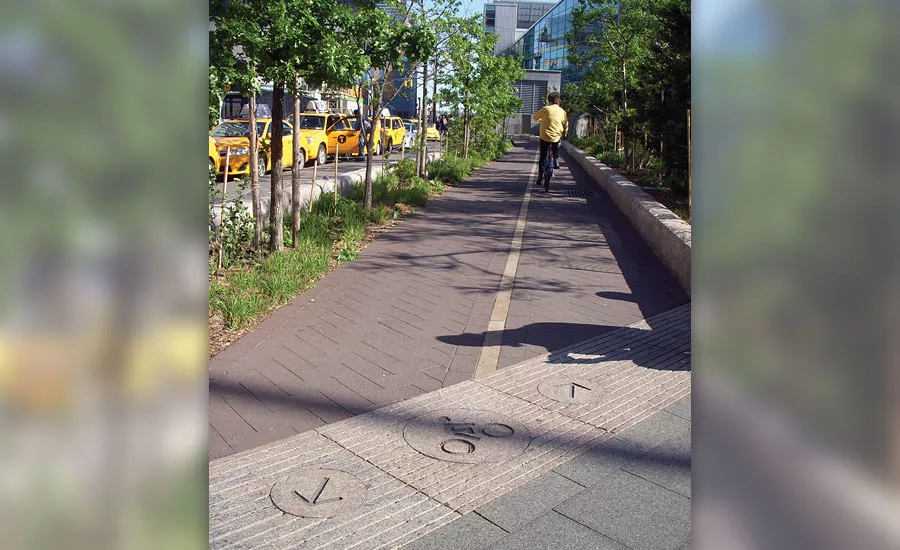
The granite was also utilized for smaller aspects, such as bicycle symbols, which highlight the stone’s slightly rugged texture. The new symbols, which include rumble strips for safety, also incorporate directional signals.
Photos courtesy of Suki Choe, Quennell Rothschild & Partners
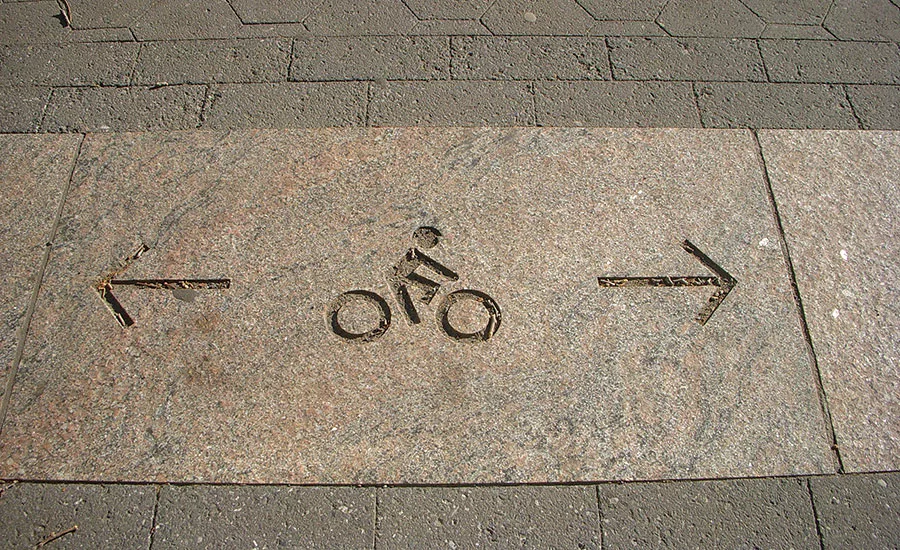
The granite was also utilized for smaller aspects, such as bicycle symbols, which highlight the stone’s slightly rugged texture. The new symbols, which include rumble strips for safety, also incorporate directional signals.
Photos courtesy of Suki Choe, Quennell Rothschild & Partners
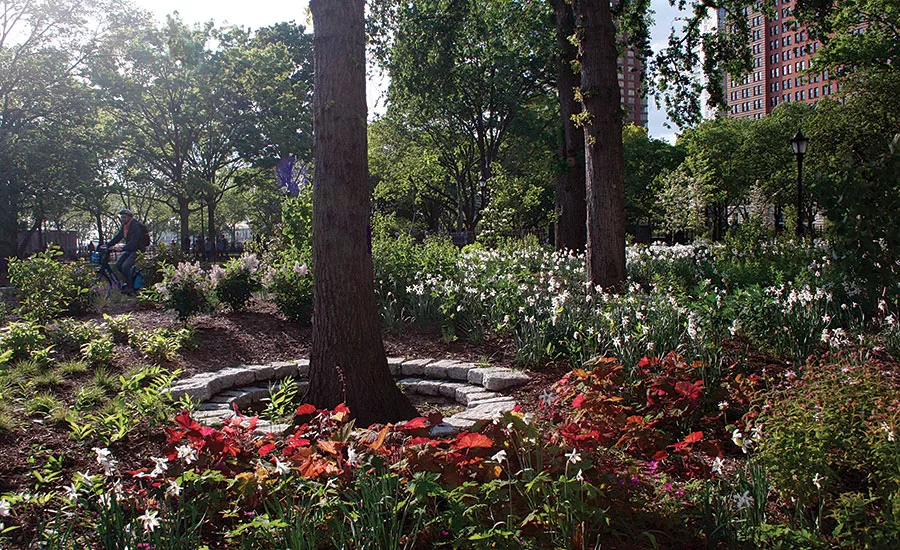
For each of the 38 trees within the Battery Oval, tree pits were engineered to extend the life of the mature trees, which are edged in granite blocks.
Photo courtesy of Suki Choe, Quennell Rothschild & Partners
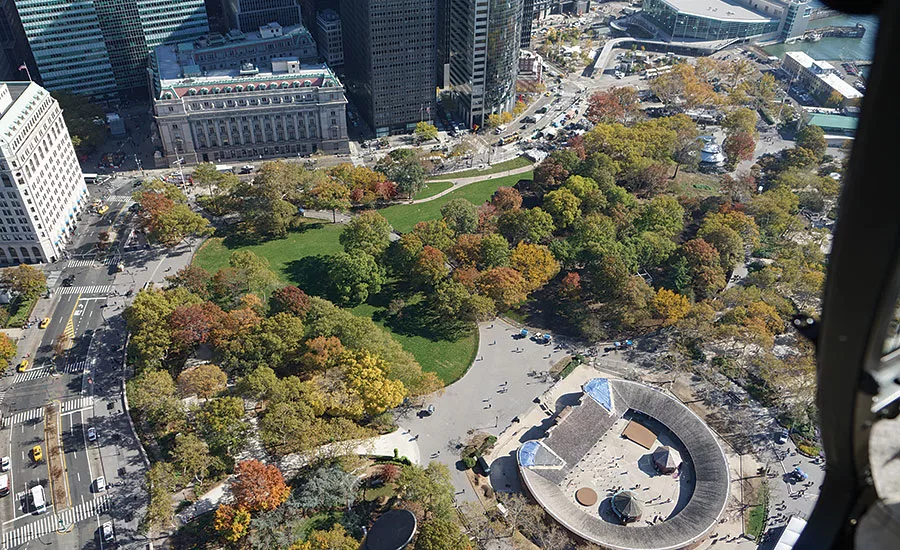
“The Battery is the gateway to visit Liberty Island. It is the waterfront where most visitors come to view and to salute The Lady [Statue of Liberty], so of course this granite adds a unique presence to this experience,” said Price.
Photo courtesy of Rick Darke, The Battery Conservancy
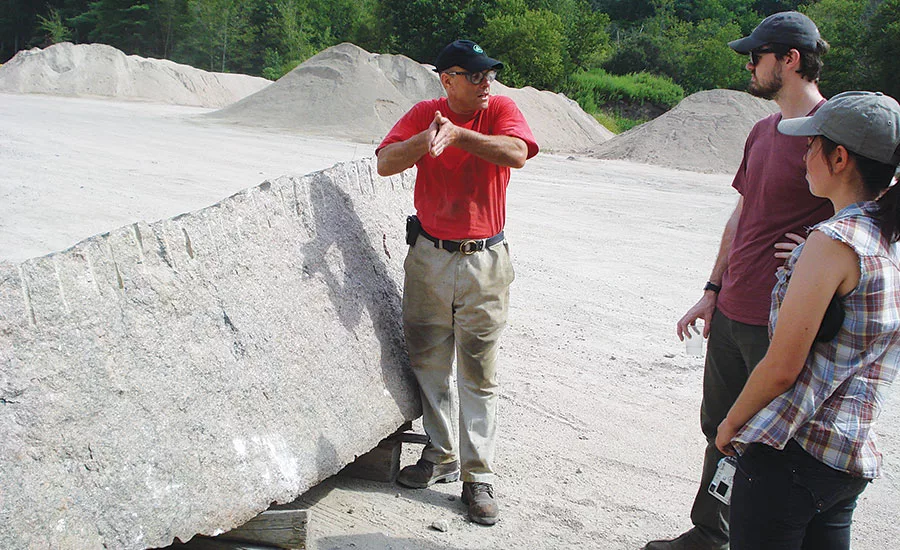
Darrell Petit, who is in charge of business development at the Stony Creek Quarry, shows members of New York City’s Department of Parks and Recreation the orientation of the rift and the nuances of splitting the custom Stony Creek granite during a quarry visit in August 2012.
Photo courtesy of Hannah Gall, The Battery Conservancy
New York City contains some of the country’s oldest parks. Throughout each of the five boroughs, these patches of open land help relieve the surrounding chaos. One of the city’s most historic parks, now known as The Battery, was recently renovated using a variety of local granite which provides a fresh revived look.
The Battery, formerly known as Battery Park, is a 25-acre public park located at the southern tip of Manhattan, where 17th century maps referred to it as “the Battery.” To commemorate the park’s historical significance, a proposal was submitted last year to officially reinstate the park’s name by Warrie Price, president and founder of The Battery Conservancy, a private organization that manages the park in partnership with the City.
Price, who also serves as New York City’s Battery Administrator and New York State’s Harbor Park Director, founded The Battery Conservancy in 1994 to rebuild the park and recapture its original luster. With an approved master plan in place, Price faced several roadblocks throughout the years, including the 2001 terrorist attack on the World Trade Center and Hurricane Sandy, which halted the project until 2015. Twenty-one years and $109 million later, Price was finally able to help carry out the extensive transformation, which involved the construction of a new bikeway, greenway, perimeter edge and signage.
“The design goal for the reconstruction of The Battery perimeter was to create a meaningful and beautiful edge to welcome our seven million annual visitors, to present 10 historic monuments and to integrate a garden bikeway, while giving pedestrians a safe and separate sidewalk as they border the busy streets of Battery Place and State Street,” said Price, who worked in conjunction with New York City’s Department of Parks and Recreation to help bring the new park to life.
To create a more modernized look for various aspects of the park, Price and local landscape architecture firm, Quennell Rothschild & Partners, contacted Stony Creek Quarry in Branford, CT, which supplied 11,000 cubic feet of its granite for the rock/split face finish. The pieces were fabricated by Polycor, Inc., in Quebec, Canada and used for a 1,500-foot sculptural bench wall, walkways and steps; slightly larger pieces were cut to create customized bikeway symbols, which are each engraved with directional signals. The rock/split face finish is further accentuated by a hand-tooled arris edge to highlight the stone’s natural rugged texture.
“Stony Creek Quarry worked closely and diligently with Quennell Rothschild at the very early stages of design to help them better define the Stony Creek Granite spec,” said Darrell Petit, who is in charge of business development at Stony Creek Quarry, an ANSI/NSC 373 Gold Certified corporation. “Quennell Rothschild did the right thing by reaching out to the origin of the material to more thoroughly understand the specific nature of the granite, its orientation and how the split face perimeter seat wall could be best achieved. As a result, the well written spec guided a successful collaboration between the quarrier and fabricator to best achieve the design intention of the landscape architect to the highest standard.”
Stony Creek’s granite, which is quarried less than 100 miles away from New York, has been used for various city landmarks. The marked nature of this stone is its very irregular texture, which is due in part to pegmatite injection, in part to flow structure and in part probably to gneissic foliation. Embracing a faintly pink hue, speckled with black and white spots, the granite was the “first and only choice” specified for the project, according to Price. “It is strong and beautiful in its color tones, and has the historic significance of being the pedestal stone base of the Statue of Liberty,” she explained. “The Battery is the gateway to visit Liberty Island. It is the waterfront where most visitors come to view and to salute The Lady [Statue of Liberty], so of course this granite adds a unique presence to this experience.
“The pinks and grays of Stony Creek granite reflect the sunset hues of the sky,” Price went on to say. “Our magnificent perennial gardens laid out alongside Stony Creek blend and enhance the natural beauty of both geology and horticulture.”
|
The Battery [formerly Battery Park] New York, NY Owner: New York City Department of Parks and Recreation, New York, NY Administrator: The Battery Park Conservancy, New York, NY Landscape Architect: Quennell Rothschild & Partners, New York, NY Stone Supplier: Stony Creek Quarry, Branford, CT Fabricator: Polycor, Inc., Quebec, Canada |
Looking for a reprint of this article?
From high-res PDFs to custom plaques, order your copy today!