Interview: Dusty Rhoads, AIA, Zimmer Gunsel Frasca Partnership
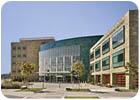
Rhoads' completed stone projects with ZGF include the Rebecca and John Moores Cancer Center at the University of California, San Diego, campus in La Jolla, CA. For this project, a “village atmosphere†was created by combining a series of buildings with differing heights and mass.
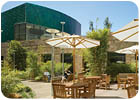
Exterior courtyards at the Moores Cancer Center combine stone with other natural elements, such as wood and abundant plant life.
Recently, Contemporary Stone & Tile Design had a chance to speak with Dusty Rhoads, a design partner in ZGF's Los Angeles office, about the firm's use of stone and tile in its architecture. Rhoads is responsible for the design of a diverse range of projects on academic, institutional and corporate campuses.
The recipient of a Bachelor of Architecture and a Bachelor of Science in Architecture from Lawrence Institute of Technology, Rhoads has led the design of many of ZGF's projects for the University of California, in addition to major buildings at the University of Arizona, Cornell University, Northwestern University, Children's Hospital Los Angeles, Dickinson College and University of Chicago.
Additionally, as a LEED Accredited Professional, Rhoads has been involved in developing sustainability design concepts for many of the firm's projects.
CSTD: How did you first develop an interest in architecture? Rhoads: I always enjoyed drawing and building things, but hadn't considered how that might factor into a career.
Rhoads: I enrolled in college, but was really pursuing a career in tennis. One of my coaches, Vic Braden, suggested architecture as a career option. He was very influential, and provided the nudge I needed.
CSTD: What were some of your first design experiences as a professional or as a student?
Rhoads: When I was in school as an architect, I had a teacher named Paul Lynn. He opened my eyes to the fact that architecture was about Ideas - with a capital “I†- and that Ideas were critical to architecture. I was still teaching tennis at a club at the time, and teamed up with friends to start a design business. We designed the day care center at the club and some children's bedrooms; we also did a park. It was real hands-on work. Even though I was still an architecture student, I got a lot of projects built.
My first job out of school was with Helmut Jahn. We were doing a lot of speculative office buildings, and stone was integral to that. Helmut was very rigorous about design, and he was knowledgeable about constructability and building systems. It was all one topic; they weren't divorced ideas. The rigor and ethics of the profession is what I remember getting from that office.
Most of the buildings I worked on with Helmut were office buildings, and stone was an important part of the skin [as well as] the lobbies of those building.
CSTD: Was that your first experience in learning about the physical properties of stone?
Rhoads: Yes. In school, it was much more abstract, paper architecture. I was fortunate to be able to learn on large projects with reasonable budgets.
CSTD: How often does ZGF use stone or ceramic in its designs?
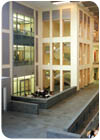
ZGF was responsible for the interior and exterior design of Cornell University's Duffield Hall Nanotechnology Research Facility. The atrium features Unfading Green slate from Vermont for the flooring as well as staircases and ramps. The material used for the flooring has a flamed finish, while the stone on the wall is honed. Stone Supplier: Vermont Structural Slate, Fair Haven, VT
CSTD: When you're working with stone tile, what are some of the details you can include that stress the stone's natural qualities? Have you combined different stones in a pattern?
Rhoads: We do not typically [combine materials], but we do apply different scale modules of a selected tile. For a number of buildings, we have used a 12- x 12-inch field with 6-inch x 2-foot honed bands to break down the scale. We may use stone in a pretty flat application, but the fenestration will be projected forward; the three-dimensionality may not be from the stone, but from how it interfaces with the window system. An example of this is the large bay windows that project out at the Rebecca and John Moores Cancer Center at the University of California, San Diego.
Even though we are using stone in a flat application, we have applied it in almost every way, so the stone reads and shows thickness - it's not just wallpaper. We deal with stone in planes and with a more modern attitude. There is not a lot of three-dimensionality in the stone itself.
CSTD: How would you describe the firm's design philosophy?
Rhoads: First of all, there is not a “house style†for how we design a building. Our design is really tied to place and climate, to each specific site, and to the culture of the institution and the program. It is married to place in a holistic way that includes the people and the physical setting.
[Our design philosophy] may be guided by a common set of principles, but the architectural design is not intended to give each of our projects the look of a “ZGF building.â€
CSTD: How do you go about choosing stone for a project? Does the industry do a good job letting you know about “new†materials and finishes available?
Rhoads: The stone that we use is pretty traditional, and is really selected for technical compatibility, design and cost. In fact, cost is a driving force in our use of tile. We would like to use dimensional stone more often, and we are aware of the technology out there, but we are not currently working on projects where we're using [advanced stoneworking] technology.
CSTD: When using stone for a project, how closely do you work with the stone contractors; the fabricators or installers? Have you ever visited the stone quarries during the selection process?
Rhoads: Certainly during the installation of the stone, our people are working very closely with the contractors. It is our preference to work as early as possible with the contractors during the drawing phases of the project. Our office has only been involved in one project where someone has gone to the quarry and worked with the fabricator. But ZGF [as a whole] has done more of that. The Ronald Reagan Courthouse in Orange County is all travertine, and someone from ZGF did travel to Europe to look at the material for that project, though not someone from our Los Angeles office.
CSTD: You have worked on a broad range of project types. Are certain types of work more conducive to the use of stone?
Rhoads: No. Of course there are some building types, a courthouse for example, that traditionally incorporate a lot of stone, but we tend to use some application of stone on every building type we undertake.

At the Pfizer Global Research & Development Center in La Jolla, CA, the exterior features Silver Blue slate from Africa as the primary building material. The stone has a cleft finish and was used in 12- x 12-inch tiles, and it is accented by horizontal bands formed by 6- x 24-inch pieces of polished Silver Shine slate from India. Stone Supplier: Amsum & Ash, Minneapolis, MN
Rhoads: Not necessarily. The preference does not have to do with project type, as much as it has to do with collaborating with a client who wants to create a good building. If design is important to the client, then the project type doesn't matter as much.
CSTD: Would you say there is an understanding of stone among your clients?
Rhoads: Absolutely. A lot of our work is done with institutional clients - universities, for example. We are working at Dickinson College in Pennsylvania, where the whole campus is laid up limestone in an 18th century style. While we have designed a more modern building there, we are bringing limestone into it. The client gets it.
At the University of Chicago, there is a real tradition of using limestone for the whole campus, so there is an expectation by that client that we use the same material.
CSTD: What have been some of your most positive experiences working with stone? What have been some of your negative experiences working with these materials?
Rhoads: I think things have traditionally worked out well when using stone. My impulse is to think of the buildings that I am working on now. I do tend to say, “I hope my next one is going to be my best one,†and, since they all are incorporating stone, I guess I am anticipating even more positive experiences. [At Dickinson College,] the material is really the bridge for taking an 18th century architectural quality campus and adding a 21st century building using random laid-up pieces of 18th century-type stone in a contemporary design.
We are also working on a very interesting project at the University of Arizona, where the building is essentially the first in a new precinct. The campus has historically used brick, and we, too, are using brick, but are combining it with red Indian sandstone. By introducing a new material, the whole precinct will have a new palette, but one that is still sympathetic to the desert and addresses “place†in a direct way.
CSTD: What would you say is the biggest challenge working with the stone industry?
Rhoads: Being able to afford it. In our present economy, costs are escalating. This has multiple impacts. Stone is a big part of our design language, and we are fighting to keep it in our buildings. One solution that we are applying to a number of our buildings is to add several materials, including stone. Elevations, for example, are more responsive to a very specific set of circumstances. In our Arizona State University projects, the elevations facing the courtyards are clad in stone, while the elevations that face the main campus are in the traditional brick of the main campus. We are using less stone, but, where we are using it, it is for a very specific reason. We are getting more bang for our buck by having the building speak to a very specific circumstance.
Looking for a reprint of this article?
From high-res PDFs to custom plaques, order your copy today!