The “microshop†is born
A “microshop” is defined as a a small fabrication shop -- 5,000 square feet of space or less - equipped with a FabCenter that fabricates between 200 and 500 square feet of installed product per week, with occasional stints of up to 1,000 square feet.
Sometime in 2005 in Fredrikstad, Norway, Jan Waerness contemplated a new stone fabrication model. He wanted to digitally fabricate stone in the most efficient manner by himself; however, there were no machines out there that are set up for this task. After doing some research, he decided to convert a 4-axis CNC machine with a saw blade into what will eventually become the FabCenter. With a little ingenuity and a fistful of patience, he set up his one-man shop that would evolve into the very first “microshop.” These were the seeds that drifted onto the Stone Fabricators Forum at www.StoneAdvice.com, and it set off a chain reaction of events that would have three major manufacturers developing this type of machinery and dozens of microshops popping up all over the country.
What is a microshop?
While you can classify a number of small fabrication shops in this category, the following criteria will define this microshop. First of all, as the name implies, it is a small fabrication shop - with 5,000 square feet of space or less. The second important component is a FabCenter (mine is from Breton of Italy). While it may be possible to digitally fabricate stone efficiently with other types of fabrication equipment, the added labor and material handling - coupled with the cost of purchasing and maintaining more than one machine - excludes most combinations from this model. The third major defining factor is scope. The scope of the business must be to fabricate between 200 and 500 square feet of installed product per week, with occasional stints of up to 1,000 square feet.
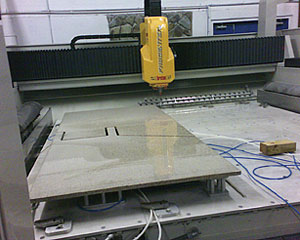
FabCentering is all about quickly splitting the slab
or parts. Here we simply run the finger across the slab to split the two parts.
The one in the foreground did not move, and we cut the line
on
the sink cutout, leaving
1.5
mm overmaterial. On the other part, we will finger it once it is moved so we
don’t have to add overmaterial, then add it again once it has been relocated.
Those of you who already run a stone shop know how difficult and costly this business can be. Up to this point, there was no middle in the business. Either a shop can stay manual and avoid the price tag of automation, or they can embrace it. Manual fabrication costs are more or less linear. It costs roughly the same per square foot to produce 100 square feet of finished product as it does 1,000 square feet.
A typical small shop consists of five individuals. Usually they wear many hats and manage to fabricate and install somewhere on the order of 250 square feet per week. Now, if that same shop invests in a CNC, they still need the same number of people. They can certainly do more work, but will the work be there? An automated shop can generally lower their expenditures with increases in volume. Those that invest in CNC technology usually gravitate toward more volume because they can, and they may quickly evolve into a “large” shop. This is great as long as sales meet the demands of the day. But as evidenced by the hundreds of shop closures in the last year, a slowing economy can be the death blow to even the healthiest of shops.
The microshop is able to produce the same amount with one less worker. With the reduction of just one full-time employee, you can pay for more than half of your CNC payment. This is significant when operating in the lower-volume range. It is less important with higher volume. In fact, there is a point where it would be more efficient to employ a dedicated digital cutting solution and just run the FabCenter as a CNC. It is possible to profitably operate this kind of shop all the way down to just an owner and a helper - due to the almost complete eradication of labor. It is also possible to add labor as needed and run double shifts in order to enjoy maximum productivity for short time periods in order to cover large contracts or unusually high periods of sales.
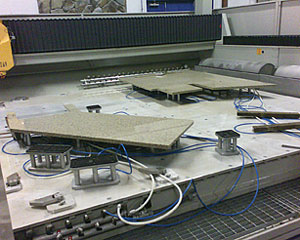
With the half-slab part, you can move it with one
hand. It works by the process of elimination; you cut, remove scrap, pods, cut
some more, remove material, etc. Eventually the table is empty, and you have
finished parts.
This is because of the gains achieved by utilizing a digital cutting solution, along with digital templating and reduced material handling. With a manual saw, usually the fabricator has to lay his wooden templates on the slab and try various layouts in order to achieve the desired end. This becomes increasingly difficult as the number of slabs in the job increases. It is not unusual to spend hours laying out a difficult four-slab job. Usually these tasks are accompanied by a crowd of fellow workers that feel compelled to give their input on how the layout can work - usually to the dismay of the guy trying to concentrate on the task at hand. He then has to proceed to saw manually - with a limited ability to cut complex shapes - and then transport the parts to the CNC.
Meanwhile, the microshop employs a programmer in an air-conditioned office who can try multiple layouts in any weather in minutes. This allows him to achieve better material utilization because of his ability to easily try various possibilities. Most systems include a dynamic digital rendering of the completed job, which takes some of the question marks out of the process. The ability to digitally cut complex shapes saves material when the cutting is done.
With some systems, the parts are not removed from the table, they are simply “floated” apart in order to gain tool clearance, and the routing begins immediately. The operator can normally accomplish other tasks while the machine is running. It is very easy for one man to process a slab with the help of a vacuum lifter. In both cases it is troublesome to move odd-shaped parts, and in such cases, parts are usually left on the table until help arrives.
Another important byproduct of the microshop is the ability to share critical information with only a few key individuals. For example, the owner can sell and template the jobs, and the programming and machine operation can be done by another. Most of the key information is privy to these two individuals. The other employees generally do not need to know what size radius the corners get, what sink will be used, what edge, how deep should the edge be run, whether or not a piece needs under-polishing and a seemingly endless list of other queries. This leads to a lot less responses that start with “I thought.”
FabCenters seldom call out sick, whine about overtime and will work for very little once the payment cycle has concluded. They are also not subject to Workers’ Compensation.
The “digital showroom”
Some of the other criteria for defining this microshop is a digital showroom. It is normally not possible for a small shop to have vast inventory of slabs or large showrooms. Therefore, flat-screens and large computer monitors are utilized to display slabs, remnants, examples of various installations and consumer education. While it is necessary for the client to view the actual slabs, this process significantly reduces the time it takes to narrow choices. This is especially true with remnants, as they do not show well and are generally packed into an almost un-viewable configuration. An overhead crane and vacuum lifter are other required elements for a microshop. While there are other components, most can be found in any fabrication shop, so I will leave them out for the purposes of this discussion.
The advantages of the microshop are many. One is the reduced dependence on skilled labor. Tooling costs are also reduced over a manual operation. A microshop can also be a stepping stone to a large shop. A dedicated digital cutting solution can be added easily - doubling the amount of output that can be achieved. Profitability can be maintained in just about any market condition. The microshop appears to the customer as a small, but highly organized and capable modern shop. The ability to operate in a hub spoke or in nodes for a company with multiple locations is another possibility. A large shop in a busy metropolitan area - surrounded by a small network of microshops - can satisfy just about any market demand. Probably the most important gain is the sanity that an organized and highly automated process brings to an otherwise insane business.
Looking for a reprint of this article?
From high-res PDFs to custom plaques, order your copy today!