Historic museum addition rediscovers Vermont marble
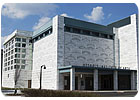
Photo by Scott Just
Working with Michael Graves & Associates, Inc. of Princeton, NJ, in collaboration with SmithGroup’s Detroit office, the Detroit Institute of Arts (DIA) recently completed a $158.2 million, six-year renovation and expansion project. The project includes ongoing expansion and renovation of the south and north wings, the restoration of portions of the original building and a 57,650-square-foot addition to the existing south wing of the museum, bringing the total building area to 657,650 square feet. The original building, designed by Paul Cret in 1927, featured extensive use of Danby white marble from Vermont, and the new building features a similar Danby marble, quarried and fabricated by Vermont Quarries Corp. of Rutland, VT.
Michael Graves & Associates, Inc.’s team, consisting of Michael Graves, FAIA, Tom Rowe, AIA, Principal-in-Charge and Gregg Wielage, Senior Associate, AIA, LEED AP, led the design and Master Plan of the DIA. Graves explained that one major design goal for the building was to “in a sense, be good friends with the original building.” “Cret did an extraordinary job with the original building, and gave many clues as to how it was planned and how to add to such a structure,” Graves explained. “The new building tried to take those clues and run with it, and to devise a new plan within the old structure and make something compatible.”
The Master Plan, according Wielage, was used to correct many museum deficiencies. “One of the major deficiencies was an exterior wall construction that would not support a conservation environment,” he explained. “Another major goal was the creation of a set of new linear galleries that would be used as a means of circulation to connect the museum’s existing north and south wings. Graves acknowledged that this idea was inspired by the original Cret building’s plan.”
According to Carolina Lopez, AIA, LEED AP, Project Manager with SmithGroup, which served as the Architect of Record, “the main 1920s building represents classical Beaux-Arts style architecture with a distinct base, cornice and arch details.”
“One major goal for the project was to improve the exterior construction,” she explained. “We had to design a system to maintain the conservation environment which requires high relative humidity levels within the art galleries.”
“Our intent was not to match the look of the existing stone building, but to use the same marble,” Lopez said. “Over the years, the original material was damaged from acid, dirt and debris. The new marble actually looks very different from the old marble, and people are surprised to learn that it came from the same quarry.” Lopez went on to explain that the material was utilized in a way that is more streamlined and more simplistic in detail, but with the same proportions that the original building has.
The new design called for the north and south wings on both sides of the original building to be reclad with Vermont Montclair Danby marble. The master plan also included window replacement and some interior work as well as the rebuilding of the front stairs, which were completely replaced with new stone that matched the existing stone used in 1927, according to Lopez.
“One major goal was to improve circulation between the north and south wings by creating a clearer path throughout the entire museum,” Lopez explained. “We created a circulation spine on all levels, featuring marble floors. The main lobby floors and walls are marble as well. The gathering spaces have Montclair Danby in a variety of patterns with Appalachian Green marble accents along with features of Bursting Stone slate.” The slate was quarried in England by Burlington Slate and supplied by its U.S. office, Burlington Natstone of Plano, TX.
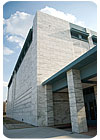
Photo by Wendy Zaremba-Just
Selecting the stone
SmithGroup and Michael Graves & Associates, Inc. worked closely with stone consultant Malcolm Swenson of Swenson Stone Consultants from New Hampshire, in matching the new stone to the original material. “He was very instrumental in identifying the stone and helping to advise us during construction,” Lopez said.“Malcolm identified that the Cret building was made of the Vermont stone, and got us thinking that we could find this same white marble now,” added Wielage. “Vermont Quarries is one of the oldest quarries in the U.S., and Malcolm reminded us about it, and that’s when we went on our first trip there eight years ago.”
According to Wielage, he took several trips to Vermont Quarries during the stone selection process. “I first went to Vermont eight years ago and brought back a photo of the Danby marble slabs to show Michael,” he said, adding that this was the point when using large bookmatched slabs came about. “We used both vein cuts and fleuri cuts, and when you see the building, you see these large panels with a mortar around them, and they are cut a different way so you see the bands. You can actually read the composition that Michael used on the facade.”
One of the reasons that the firm felt the project was so successful, was due to the dedication of all of the personnel from Vermont Quarries. “Vermont Quarries was involved in the project from concept design through construction,” said Wielage. “They were responsible for stone cost budgeting, stone quarrying and fabrication of final pieces. They became an integral part of the team. Jerry May’s [Plant Manager of Vermont Quarries] skill and hard work can be seen in all of the stonework.”
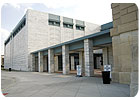
Photo by Scott Just
Interior stones
Monclair Danby marble was also implemented for walls inside the building, and a variety of other stones were also used indoors. Vermont Appalachian Green marble, also from Vermont Quarries, was selected for flooring throughout some of the main areas of the museum, according to Graves. “It’s so utterly beautiful that we wanted to use it as much as we could, and we did,” he said.Additionally, Crystal Stratus Danby marble was used to design a stone “carpet” on the flooring in the main lobby, and Bursting Stone was used as a border to the marble. According to Wielage, the stone carpet is seen when one enters the museum, and it leads visitors throughout the facility.
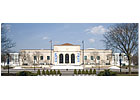
Photo by Scott Just
Overcoming obstacles
According to Michael Graves & Associates, two challenges came into play during the duration of the project. “One challenge was a technical challenge in that we had to build these stone walls from the outside,” explained Wielage. “The existing construction wasn’t able to support the new construction, so we had to come up with a scheme of how to support the stone and set it from the outside.“We also wanted to leave the museum open as long as we possibly could, and this phasing of the project caused delays and didn’t make construction as smooth as one would want if you were just working on an empty building,” he continued to explain. “But, we worked from the outside, so there is a European rail system where you can set the stone only on one side, and we used that.”
Lopez added that the detailed stone patterning also posed challenges. “Due to the fact that the patterns were such an important part of the design, it was somewhat challenging,” Lopez said. “Dry lay outs and mock ups were done on site at the quarry, then packaged and shipped as construction allowed for it. All of the book-matched pieces had to have matching adjacent pieces, which required a large logistic coordination effort to make sure the right pieces were there at the right time.”
According to Graves, budget was never a concern with the stone for the DIA project. “Here, because of the Cret building, there was such a strong influence to make a match and do something significant for the City of Detroit,” he said. “We tried some other more economical stones, but in the end, the idea that we could use the same stone as the original building was so compelling that they decided to go ahead with it.”
According to Lopez, the results were more than pleasing to everyone involved. “Ultimately, not only did the exterior see improvement, but the museum had the opportunity to rebuild the majority of the interior galleries and reinstall the art using new display techniques.
“To start with a clean slate for a museum of this size was pretty impressive,” she continued. “It was a really exciting thing for the City of Detroit. The project has given the people in the city and southeast Michigan region a lot of hope, and it is good to see things like this happening.”
Looking for a reprint of this article?
From high-res PDFs to custom plaques, order your copy today!