Latin American stone industry holding steady
Photo courtesy of Pemagran Pedras Mármores e Granitos Ltda.
For U.S. importers, Latin American stone producers are certainly not a new resource. Stone from countries such as Mexico has been around for ages, and Brazilian granite has been a staple of the U.S. countertop sector since the early to mid-1990s. But over the last five years, the growth of U.S. stone imports from Latin America has seen remarkable growth, and even though the industry has leveled to some extent, leading stone exporters from the region are still reaching extremely high, near-record levels of trade.
Photo courtesy of Bramagran - Brasileiro Marmore e Granito Ltda.
The Brazilian giant
Of all the Latin American countries, Brazil has by far had the greatest impact on the U.S. market - and the world as a whole. When examining the numbers, the increases in granite exports from Brazil to the U.S. are staggering. The dollar value of Brazilian granite exported to the U.S. in 1993 totaled $12.43 million, making Brazil the fourth leading granite exporter to America (representing 11.4% of all U.S. granite imports). By 2006, Brazilian granite exports to the U.S. reached $538,240,658, which easily made Brazil the leading exporter of granite to the U.S. For comparison, Brazil’s granite export total to the U.S. was nearly 75% greater than the second largest granite exporter, Italy, which reached a total of $308,354,302 in 2006.Looking at the situation on a larger scale, of the $1.488 billion worth of granite exported to the U.S. in 2006, Brazilian granite exports accounted for $538,240,658 million. This means that approximately 36.18% of the granite exported to the U.S. comes directly from Brazil.
Some of the most impressive growth can be noted between the years 2002 and 2006, when the value of granite exports to the U.S. grew from $127,700,017 to $538,240,658 (See Figure 1). During this period, many well-established European stone producers either established or upgraded large-scale stoneworking facilities in Brazil. This merger of European expertise and machinery with Brazil’s impressive natural resources has proven to be a very successful formula - as many of these companies have made Brazilian materials a critical component of their stone collections. In fact, the exhibits of many of these companies at major trade fairs in Italy, Germany, the U.S. and the Far East often feature Brazilian stone as a highlight of the overall display - and most of these companies also have a major presence at the Vitoria Stone Fair in Vitoria, Brazil.
Of course, there are many well-established companies with Brazilian roots that remain major players in the international industry, and they have also continually upgraded their operations with innovative new material selections and investments in state-of-the-art machinery.
Yet another factor is the presence of relatively new stoneworking companies in Brazil. And while they may not have the years of experience of some of their counterparts, many of these firms have quickly developed a reputation as high-quality, reliable suppliers of granite and other materials to the U.S. market.
A closer look at Brazil's industry
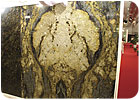
Stone being extracted and processed in Brazil ranges from the more traditional varieties of gold, green and tan to much more exotic materials with distinctive patterning and a myriad of color combinations. And a report that was recently released by Milanez & Milaneze, the organizer of the Vitoria Stone Fair, confirms that the infrastructure of Brazil’s stone industry has grown by leaps and bounds.According to the report, Brazil exactly doubled its extraction of natural stone between 2000 and 2005, growing from 2.25 million cubic meters to 4.50 million cubic meters. In terms of volume, this increased its share of global rough block production from 3.8% to 5.3%.
Together with China, India, Italy, Spain, Turkey and Portugal, Brazil has become what is termed the “G-7 Natural Stone Exporters.” Production of finished products rose from 0.85 million tons to 2.04 million tons between 2000 and 2005, and the present trend indicates high growth rates in the coming years as well.
The report went on to state that more than half of Brazil’s stone production is exported. “Brazilian exports of finished natural stone products are heavily geared to the North American market, and it could even be said that the industry is currently completely at the mercy of the U.S. building sector and a continuing natural stone boom in this country,” stated the report. “Almost 80% of the total 767,000 tons of Brazilian exports of finished products in 2005 went to the U.S. Although Germany crops up in the statistics as the fourth most important customer - after Canada and Spain - exports to countries outside the North American continent play a clearly subordinate role.”
In terms of weight, around half of Brazilian natural stone exports (1.06 million tons) are accounted for by rough blocks, practically all of which is granite. Over one-third of these raw goods are exported to China and more than one-quarter to Italy. Other major customers are processing blocks in Spain, Hong Kong, Taiwan, Belgium and France. In contrast, Germany purchased just 2,000 tons of rough blocks from Brazil in 2005.
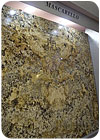
Photo courtesy of Tec Tear Granitos Ltda.
The slate trade
Brazil not only plays a major role in granite production, but also in slate production. According to the report released by Milanez & Milaneze, the country exported 203,000 tons of slate in 2005 - almost one-sixth of total world trade.The most important export target for Brazilian slate is once again the U.S., which brought in $12,377,685 worth of Brazilian slate in 2006. This figure places Brazil third among slate exporters to the U.S. in terms of value, but is still well behind slate shipped from China or India, both of which exported more than $50 million worth of slate to the U.S. in 2006. (The U.S. Department of Commerce does not supply complete tonnage figures for slate exported to the U.S.)
In general, U.S. slate imports from Brazil have hovered between $10 million and $12 million since the beginning of the current decade (see Figure 2), and that trend should continue in 2007 - as the projected total looks to be around $10.44 million for the year.<
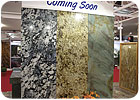
Photo courtesy of World Wide Stone Corp.
Challenges in 2007
After years of remarkable growth, it appears that the Brazilian stone industry hit a plateau in 2007. The projected value of Brazilian granite exports to the U.S. for 2007 stands at $539,986,359 - only a tiny percentage (0.31%) higher than 2006’s figure of $538,240,658 million. And considering the fact that most U.S. stone importers felt that the first half of 2007 was stronger than the second half, the actual 2007 total of Brazilian granite exports will likely fall short of the projections and actually show a decrease for the year.Looking at the monthly figures for Brazilian granite exports to the U.S. in 2007, the totals were relatively consistent over the first nine months (see Figure 3). In general, the monthly totals didn’t stray very far from the average figure of $45 million - with two exceptions. The strongest month was July, when the U.S. imported $59,934,600 worth of Brazilian granite, and the weakest month was February, when that total was $27,454,737. These monthly fluctuations, however, are typical for any given year.
But even if Brazilian granite exports to the U.S. level off or even decline, the Brazilian stone industry is still extremely tied in to the American market. Moreover, its position as the leading granite exporter to the U.S. appears to be secure well into the foreseeable future. One of the greater challenges facing Brazilian stone exporters is increased competition. The playing field of Brazilian slab producers is more crowded than ever before. New companies for granite slab production are being formed, and existing firms are expanding their production capacity - and for the most part, they are all competing with an eye on the American marketplace.
U.S. stone importers should be cautioned, however, that increased competition does not automatically mean reduced material prices. An emphasis still needs to be placed on quality as well as consistent materials, and most Brazilian stone suppliers who keep an eye on long-term success are not “slashing prices” to get a sale. In fact, the average price for Brazilian granite exports to the U.S. rose from $550.93/ton in 2006 to $626.92/ton in 2007. Of course, charting these figures is not an exact science, since the import statistics released by the U.S. Department of Commerce do not allow for an efficient breakdown of material types (other than the basic category of “granite”) or how elaborately a finished product has been worked.
The Brazilian slate sector was also challenged in 2007, and U.S. imports of slate from Brazil are on pace to drop off approximately 15% from 2006’s total value of $12,377,685. Projecting from the first nine months of last year, the U.S. exported $10,436,878 worth of Brazilian slate in 2007. The best month of the year (through the first three-quarters) was July, when the U.S. imported $1,364,604 worth of Brazilian slate, and the worst was April, when that figure was less than half that total - $542,243.
The Mexican stone sector
Looking elsewhere in Latin America, the U.S. market has been quite consistent in its imports of stone from Mexico - particularly marble, limestone and travertine, which are simply categorized as “marble” in the monthly Stone World import statistics from the U.S. Department of Commerce.The popularity of Mexican “marble” products - particularly tiles in a range of sizes and finishes - has grown tremendously over the past 15 years. Whereas U.S. imports of Mexican marble, limestone and travertine were valued at $12,209,949 in 1993, that figure reached $40,635,833 in 1998 and topped out at $135,345,906 in 2006 (see Figure 5). The projected total of $131,885,221 for 2007 looks to be a slight decline from the previous year, but still represents a solid year for exports of Mexican marble to the U.S.
Contrary to the trends for Brazilian stone, U.S. imports of stone from Mexico actually increased a bit as the year went on (see Figure 6). Whereas 2007 began with a relatively down month for Mexican marble exports to the U.S. - the January figure was only $8,898,789 - the numbers were markedly better after May, reaching a high of $12,915,079 in August (monthly figures for October, November and December 2007 were unavailable at press time).
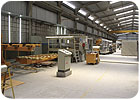
In recent years, some of the leading producers of Mexican marble have invested significantly in their facilities, bringing in the latest generation of large-scale stoneworking technology from Italy. Moreover, these top producers are also investing large sums of money to develop new quarry sites - thus ensuring a consistent and reliable source of material for their U.S. clients. For these reasons, it is once again critical that U.S. stone importers look beyond the initial price per square foot and ensure that they know their supplier’s history and record of reliability.
Latin American producers
Among other Latin American nations exporting stone to the U.S., a few countries stand out. Peru exported $26,995,969 worth of stone to the U.S. in 2006. This was followed by Argentina ($7,854,410), the Dominican Republic ($4,333,329) and Colombia ($2,734,951). No other Latin American countries topped the $1 million mark in terms of stone exports to the U.S.Peru, in particular, has shown significant growth over the past few years - especially in the area of “marble” (also including travertine and limestone). Exports of “marble” from Peru to the U.S. grew from $8,795,205 in 2002 to $26,701,974 in 2006. This figure exceeds the U.S. import totals from marble-producing nations such as Greece, Portugal, France (including limestone) and India (marble only), and it places Peru only slightly below Israel’s U.S. “marble” export figure of $28.722,135.
Editor’s Note: The source for all U.S. stone import statistics is the U.S. Department of Commerce, compiled by the Stone World editorial staff.
Looking for a reprint of this article?
From high-res PDFs to custom plaques, order your copy today!