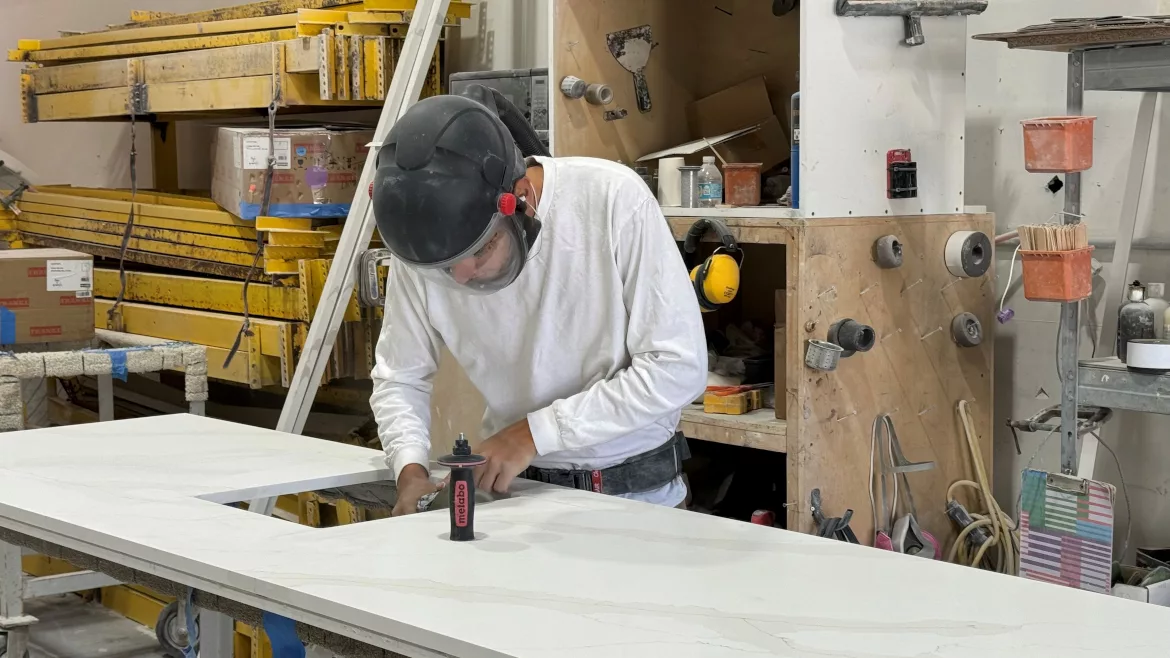
Understanding electrical power needs

With only a few exceptions -- hand tools that may be pneumatically operated and possibly air-powered water pumps -- almost every hand tool and small or large machine will run on electric power.
By now, a lot of you know that I am not at all ashamed to share my “screw-ups” and mistakes with the readers of Stone World Magazine. This also transcends to the attendees of Stone World’s Stone Fabrication Workshops, which take place throughout the year across the U.S. (www.stoneworld.com/fabworkshops). Mistakes can occur because a fabricator is improperly prepared and informed, or because they have simply made the wrong choice. However, all mistakes are opportunities to learn from. As the saying goes, “If we don’t learn from it, we are bound to repeat it.”
While in the process of setting up my first natural stone fabrication shop, one of the first oversights that I made was to not fully understand the ratio of electrical power supply to demand, and how this all interacts at the shop level. I did not have a clear understanding of “budgeting” available power to peak demand, so this would be a big learning experience for me. I had never been very good with electricity, but I had what I thought was a very basic understanding (enough to be dangerous), and so I basically trusted other people to re-enforce and otherwise make up for my weakness in the subject. My thinking was that as a manager, I did not have to fully understand every small detail of a subject that I did not know very much about. I was quite wrong on that idea!
Having learned from my mistakes, I thought that it might help some of my fellow stone fabricators if I wrote a piece on basic electrical knowledge. I’d like to share as much of the fundamental stuff (that I wished I’d known then) for folks that are either getting ready to open a fabrication shop, or have found that they have outgrown their shop and are looking at expanding their present location into a larger operation.
Early on in my career, I had a conversation with my dad when I told him that I was going to branch out into the natural stone fabrication end of the business. When I discussed all of the machines that would be required to make my own shop run efficiently and make money, he said, “Kid, that’s going to take a lot of power. Real Power!” For a guy who had spent most of his career doing tile work, he already understood the ramifications of branching out into the natural stone side of the industry, and what it would take to be successful.
With this all in mind as a “preamble” to what I’m going to lay out for you now, the only other thing that I want to stress is that first and foremost, I am a fabricator. I am not a whiz when it comes to electricity, and even though I have done a great deal of research to write this article and have experiences to draw from, I do not in any way consider myself even close to being an expert when it comes to electrical knowledge. I’m just a guy who wants to help other fabricators to not make the same mistakes that I have made. I enjoy sharing information with other like-minded folks in the natural stone industry as a way of giving back to the business that I have enjoyed working in for the last 29 years.

“Basic Electrical Knowledge 101â€
Just about every major machine that you will contemplate purchasing for your business will require some amount of electric power to function. With only a few exceptions -- hand tools that may be pneumatically operated and possibly air-powered water pumps -- almost every hand tool and small or large machine will run on electric power. There are different units of measure that will differentiate one electrical device from another. The starting point to knowing “what uses what” is to have a basic knowledge of units of measure in electrical power terms.At the risk of putting too much information out here to work with, I want to outline some of the most basic units of measuring electricity. Primarily, there are the “Big Three” units that I feel relates to us as fabricators. Every fabricator should have an understanding of these units BEFORE they start their planning for their new shop -- or their current shop’s expansion:
• Voltage -- Most of the devices that we use are built to operate using one of the following voltage ratings: 120, 220, 230, 240, 440, 460 and 480. In the home that you live in, most of the electrical outlets that you’ll see in your kitchen will be 120 volt. The only exceptions are usually for larger devices that require more power than common 120-volt circuits, such as the electric range in your kitchen and the electric dryer in your laundry room; these are usually wired for a 220-volt service. “Voltage” is defined as: “A unit of electromotive force. The electrical potential needed to produce one ampere of current with a resistance of one ohm.” (Source: Youngco Glossary -- http://www.youngco.com).
As far as your fabrication shop is concerned, your hand tools will normally be available in 120-volt current, leaving the larger-sized devices, such as bridge saws, edge machines, surface polishers, CNCs and waterjets to be supplied in usually your choice of either 240- volt or 480-volt service. Which type of service setting you choose will largely be dependent upon what kind of power (measured in volts) is available to your facility. If you are building a new fabrication shop, it’s better to opt for 480-volt service. If you already have a shop set up, the power supply has most likely already been decided.
If you do not know what kind of voltage you have, first check the electrical breaker panel boxes. In some cases, there will be a label on the inside of the panel box that will tell you what’s inside. It is a very wise investment to hire a reputable electrical contractor who knows his stuff, and let them investigate the power that’s available to your facility. This way, you’ll know for sure what you have available, and what you can and can’t do in terms of electrical power.
• Amperage -- The unit of measure that rates the flow of electricity required to operate a device. “Amps” or “amperage” is defined as: “The unit expressing the rate of flow of an electric current. One ampere is the current produced by a difference in potential of one volt across a resistance of one ohm; an electric current flowing at the rate of one coulomb per second. (Source: Youngco Glossary -- http://www.youngco.com).
The next most important thing that I’d want to know about the electrical service to a new or existing building is the amount of available “amps” that I’d have to work with. The amp load to a building is a fixed amount in most cases, and I relate this to the amount of money you have in your bank account, or the amount of money that the bank is willing to loan you.
In fact, one of the basic tools of setting up a fabrication shop is to establish budgets, and this “budget” does not end with finances. You will also have a budget of how much electricity your building will have available, and this amount is measured in “amps.” Before you start picking out machines and power tools -- and stereo systems with big woofers -- for your production shop, you have to know the maximum number of amps that you will have available to work with for the shop and office.
• Single-phase versus three-phase -- Wiring for electric motors and other electrical devices is usually separated into two categories -- single phase and three phase. Most residential and older industrial applications are set up for single-phase wiring. On the other hand, most industrial applications or more “heavy duty” electrical applications are set up for three-phase wiring. The easiest way I keep the two in perspective is that most all of the newer machines and tools that are heavy duty are going to be three phase. “Single phase” refers to “the distribution of electric power using a system in which the voltage is taken from one phase of a three-phase source. Single-phase distribution is used when loads are mostly lighting and heating, with few large electric motors. The generation of AC electric power by electric utilities is nearly always three-phase, in which the waveforms of three supply conductors are offset from one another by 120 degrees. The standard frequency in the U.S. is 60 Hz. (Source: Youngco Glossary -- http://www.youngco.com).
“Three phase” refers to “an electric power system having at least three conductors carrying voltage waveforms that are 2ð/3 radians (120 degrees, 1/3 of a cycle) offset in time. Electric utilities generate three-phase power and transmit it to load centers, where it may be consumed at three phase or single phase. Also see “Polyphase.” (Source: Youngco Glossary -- http://www.youngco.com).
What's right for your shop?
Now that we have the basic material out in the open, we can look at how this all affects you as a fabricator. The “basic electrical knowledge point” could be summed up best like this:• Voltage -- Working with 480 volts is always better than 208 or 240. Newer buildings have a better chance of having 480 volts already in the breaker box than in older buildings. For future expansion, (in most cases), if you already have 480-volt service in your building, you will more than likely be able to add machines without too much added electrical infrastructural costs. If you are looking at an existing building that only has 208- or 240-volt service (and the prospects of adding 480-volt service don’t look too good), chances are that you will be looking at a substantial dollar investment with your local electrical power company to upgrade your service to accept the 480-volt service. You’re looking at possibly pulling in all new and heavier cables to run the increased voltage through bigger switch boxes and transformers, etc. The end result will be lots of dollars coming out of your pocket.
• Amps -- As a fabricator, the rule should always be: “You can’t have too many amps available for you to work with; the more, the better. This is especially true if you are planning to expand your shop and add machines in the future.”
• Single phase versus three phase -- Most of the newer machines today are being produced in a three-phase configuration. Plus, three-phase power requires less amperage than single-phase power. In my opinion, three-phase power is the way to go -- hands down.
I don’t encourage people to take other people’s opinions and very dogmatically adopt those opinions as their own. However, in the case of the above three items, I’d make an exception. They are all valid points to use as guidelines for your own fabrication shop.
In the end, you can never have too much electrical power at your disposal for your everyday operational requirements. Having an over-abundance of amperage to draw from will always allow you to expand the size of your fabrication shop into something more along the lines of a “factory.” But as my dad said to me a very long time ago: “It takes power, kid. Lots of Power!”
Looking for a reprint of this article?
From high-res PDFs to custom plaques, order your copy today!