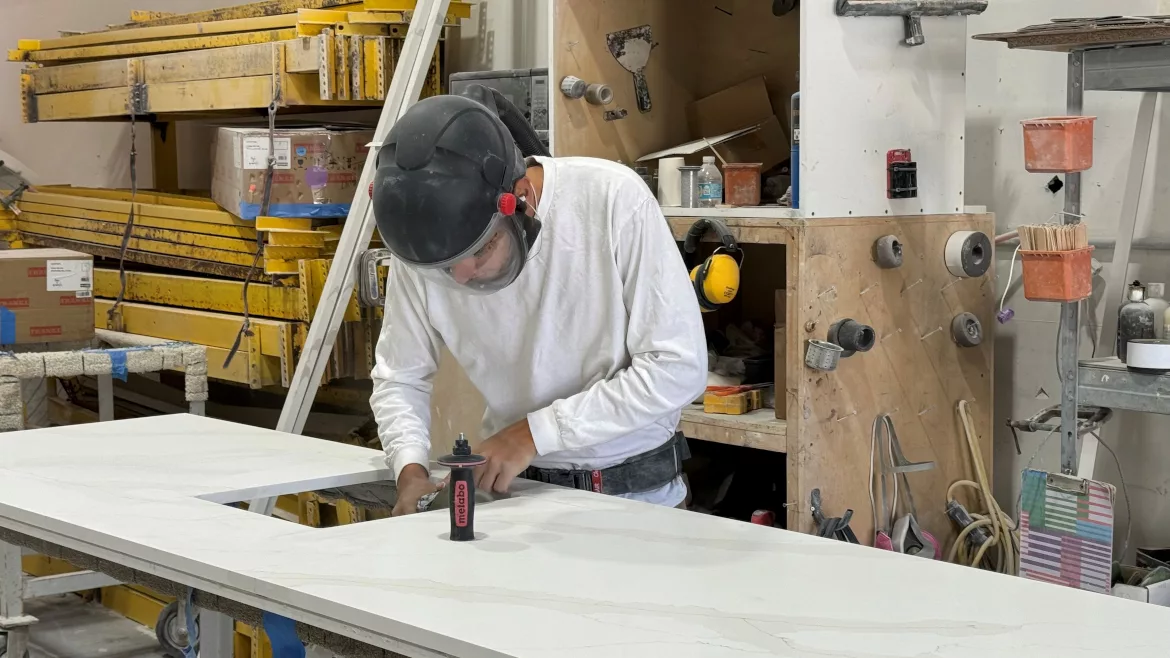
The need for environmental safeguards

The dust created from the silicon portion of the quartz in granite is a carcinogen, and prolonged breathing of it can cause silicosis, a disabling, nonreversible and sometimes fatal lung disease. Control measures can range from dust booths or tables to stand-up water walls.
Preventing silicosis
The fabricators most at risk are those with poor or non-existent air quality controls in their shops, exposing their employees - and possibly even their neighbors - to crystalline silica dust, a hazardous by-product of many granite-processing operations, notably dry cutting, grinding or polishing.The dust created from the silicon portion of the quartz in granite is a carcinogen, and prolonged breathing of it can cause silicosis, a disabling, nonreversible and sometimes fatal lung disease. Overexposure to dust that contains microscopic particles of crystalline silica can cause scar tissue to form in the lungs, which reduces the lungs' ability to extract oxygen from the air we breathe. More than 1 million U.S. workers are exposed to crystalline silica each year, and more than 250 American workers die with silicosis. There is no cure for the disease, but it is 100% preventable if employers, workers and health professionals work together to reduce exposure. In addition to silicosis, inhalation of crystalline silica particles has been associated with other diseases, such as bronchitis and tuberculosis. Some studies also indicate an association with lung cancer - per the Occupational Safety and Health Administration (OSHA).
If OSHA finds a fabricator in violation of the federal Permissible Exposure Limit (PEL) for crystalline silica, the company faces fines in the $40,000 to $50,000 range, plus being shut down until acceptable corrective measures are installed and approved - which OSHA is authorized to do. The lost production time could easily equal or exceed the amount of the fine.
PEL is the maximum amount of crystalline silica to which workers may be exposed during an eight-hour work shift. The current OSHA Permissible Exposure Limit (PEL) in mg/m3 for respirable dust containing quartz is calculated from the following formula:
PEL + 10 / % silica + 2
Maintaining optimum shop ventilation is a key to ensure a shop is not at risk for OSHA fines and penalties.
We've visited many shops so thick with silica dust that you could barely see through the haze when you walked in the door. Others have taken minimum steps at ventilation, including installing roof vents and fans to expel the dirty air outside, a measure that not only fails to meet OSHA air quality standards inside but spreads the risk to the fabricator's neighbors, potentially putting the business at risk of being sanctioned by the Environmental Protection Agency (EPA).
One fabricator we know recently found out just how costly this type of poor housekeeping can be. When he was found in violation of OSHA standards, his business was fined $50,000 and shut down until he installed air purification systems to correct the problem. The total cost was well over $100,000 in fines and lost revenues - on top of the immediate cost of control equipment plus personal respirators for all employees, which was another $30,000 to $40,000. In the long term, there is the very real possibility that workers who were exposed to the dust will contract silicosis.
These dire consequences can be avoided with a few up-front investments in control equipment at a fraction of the cost of a confrontation with OSHA or worse, facing the consequences of a debilitating and potentially fatal disease among your employees.
This threat alone should be reason enough for any responsible fabricator to take the necessary steps to safeguard the health and well being of their employees, regardless of cost.
With a little advance planning, a fabricator can lease/purchase the necessary control equipment and pay for it over a five-year period, minimizing the immediate cost impact and protecting their company from legal exposure and their employees from threats to their health.
Control measures can range from dust booths or tables costing $8,800 to $15,000 to 40-foot dust bank water walls. These walls can cost from $15,000 to $50,000 or more, depending on size.
All of these systems are basically vacuums that pull the dirty air through a cleaning process - a filter or water screen - then returned to the environment.
We have found stand-up water walls to be the most efficient and effective in cleaning the air. Using this dust control equipment takes 96% of the dust out of the air, and basically filters it through a water screen; then through a high-quality air filter when it's returned back into the environment of the shop.
An additional advantage of the water wall equipment is its efficiency in comparison to a dust table. With the water wall, a variety of products placed on a mobile table can be moved in for performing dry-processing operations, then moved to another location for wet polishing or whatever other non-dust creating operation is required, freeing the space for the next product to be dry processed.
A stationary unit such as a dust table, on the other hand, can be tied up while an operator remains in place to complete all processing of the product he is working on, even though no dust is being created (when wet polishing, for example).
Dust intake units can eliminate dust from grinding and sanding operations, filtering the air to create a cleaner, healthier environment. Such units have been proven to outperform other units because of their dual capture system, which use a power fan and micro-misting system delivered by several jets to break down the dust. The captured air is then filtered, cleaned and returned to the shop.
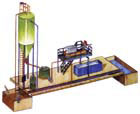
Water reclamation systems are an effective investment to help control water and sewer bills. Some operations may consider a complete filter press and holding tank system that is tailored to the individual needs of the shop.
Water reclamation
Many fabricators also are shouldering inordinately large water and sewer bills because they haven't invested in their own purification systems to reclaim water used for machine cooling or dust damping so the same water can be used over and over again.Unfortunately, most fabricators tend to look at investments in environmental equipment as non-productive - even counter-productive, since they don't add immediately to the bottom line. However, the longer-term value of water reclamation equipment is obvious. It is a 100% economic benefit to the fabricator, because it not only eliminates the ongoing cost of the water, but the cost of sewage disposal as well.
Not only has water become quite costly in most industrial centers, its disposal into the sewage system in most cases costs more than the water itself.
Add to this the cost of filtering the effluent to keep hazardous waste from entering the sewer system, and businesses that don't recycle their water are shouldering a major expense that could be avoided with a relatively small up-front investment.
Consider the fact that each machine may require anywhere from 12 to 30 gallons of cooling water per minute. By recycling rather than discharging this water, an effective water reclamation system will pay for itself over time - typically two to three years, although paybacks as quickly as six months are not out of the question.
A number of water reclamation systems are available, ranging from self-contained water reclamation to complete filter press and holding tank systems tailored to the needs of any size fabricating shop.
Larger systems solve the problem connected with sludge and contamination in the shop's water. Water sludge separation is accomplished by using liquid flocculent and gravity, extracting the sludge and dehydrating it through a series of filtering bags for easy disposition.
Fabricators have an easy choice. They can step up and install equipment that will help ensure a healthy shop environment for their employees and neighbors, or they can pay for their judgment lapse in downtime and lost income because of employee sick time, possible lawsuits and government fines and shut downs.
Looking for a reprint of this article?
From high-res PDFs to custom plaques, order your copy today!