Fast-track installation of large-format stone and tile on vertical surface

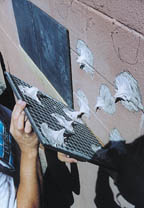
Engineered metal anchoring systems offer a high degree of performance for securing large-format stone to these wall claddings. Now, engineered high-performance epoxy adhesives provide similar levels of performance and an ease of installation that can increase productivity by 30 to 50%. Epoxies have long been known for their high-performance adhesion properties. Long used by the automotive and construction industries, epoxy adhesives have proven their advantages over mechanical systems. While some mechanical systems rely on a base course of anchored stone to carry the weight of all stones above it, chemically anchored stones are each individually bonded with high-performance epoxy adhesive, thus providing a high degree of security.
In addition to speed of installation, epoxy adhesives provide other important advantages over mechanical anchoring systems. Thinner, lighter weight modules can be used because no kerfs or cuts in the stone are required for fixing. This reduces dead load to the structure as well as the cost of the cladding. Also, mechanical anchor fixing results in damage to a percentage of stone and tile, which does not occur with "chemical anchoring" via epoxy systems. In summary, there is a lower installed cost advantage with epoxy adhesives due to greater productivity, thinner modules required and less waste.
Not all epoxy adhesives are suitable for this high performance application of interior and exterior wall claddings. Suitable epoxy adhesives must be flexible (low modulus) to accommodate the movements of the building, especially in exterior applications. Exteriors are subjected to extreme forces such as:
* Thermal shock
* Freeze thaw
* Building vibration and movement
Thermal shock relates to the expansion and contraction of all materials due to changes in temperature. A dark stone or tile may reach temperatures up to 150 degrees F on a hot, sunny day and then get "shocked" by a sudden rainstorm that can drop the temperature by 90 degrees F in less than a minute. Freeze/thaw shock relates to the cycles of freezing and thawing that occurs in exterior applications in cold climates. This cycling puts additional stress on building materials. And since buildings are designed for movement, building adhesives and anchoring systems must be able to accommodate these normal stresses.
The method of installation used with chemical anchoring epoxy adhesive is called spot bonding or spot fixing. Key elements of this method include:
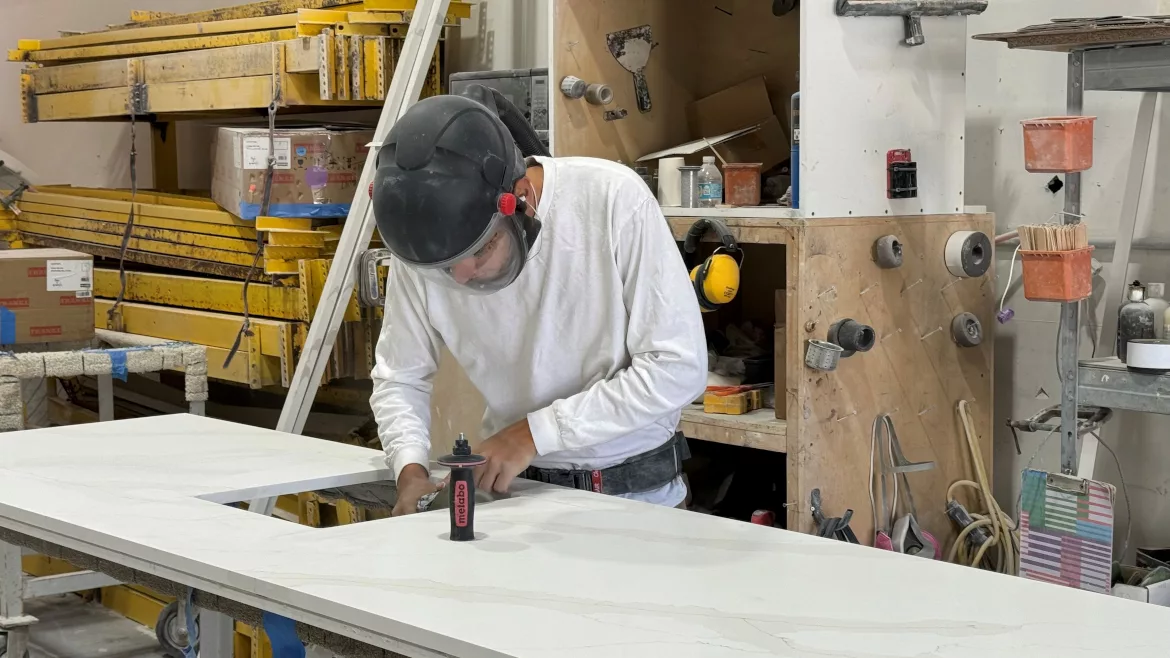
Surface Preparation -- As with all adhesive applications, proper surface preparation is crucial to performance. Substrates must be clean and structurally sound. The substrate must be suitable for the desired application (for example, epoxy adhesive bonds very well to plywood, but plywood is recommended only for interior applications, not exteriors). The substrate must be sound to handle the weight of the veneer. Generally, concrete, masonry and Portland cement backerboard are suitable substrates, but wall renders are not. Lastly, surfaces in contact with the adhesive must be free from dust, oils, paints, contaminants and other bond inhibitors. Mechanical grinding of the back of the stone and of the substrate is recommended. It is best to review a project with the adhesive manufacturer before starting a project to ensure a proper installation.
Mixing -- The epoxy adhesive is 2-component mixed to a 1:1 ratio. There are two grades of epoxy adhesive. Rapid grade has 3 to 5 minutes of working time and is used for quick setup projects such as overhead and base course applications. Standard grade has 30 to 45 minutes of working time and is used for normal application. Both grades have similar performance properties. Mixing can be done in small quantities (rapid grade) or with a slow speed drill mixer (standard grade). The epoxy adhesive must be mixed thoroughly to ensure proper performance. The two components are different colors to assist with mixing, and there must be a uniform color, with no swirls, for a proper mix.
Application -- Layout of the applied veneer should be planned with surface preparation. A base course of stone or tile can be set first, and then spacers can be used for additional courses. A temporary block or board can be used to hold the base course until the epoxy adhesive sets. For each stone or tile module, five or more dabs of epoxy adhesive are applied evenly on the back. Press the epoxy adhesive into the module and swirl up additional adhesive like an ice cream cone. A minimum of 10% of the surface area must be bonded with epoxy adhesive. Then press the stone back against the substrate, tapping and beating in to ensure good contact. Pull or push the stone to plumb and level. Check work as you proceed.
Finish -- Protect work until epoxy adhesive fully sets. Joints can be grouted with Portland cement grout or sealant. Follow specifications and design requirements for expansion joints. Use special non-staining silicone sealants for stone applications.
Epoxy adhesives for anchoring stone and tile wall claddings comply with the direct adhered requirements of building codes. It is recommended to check your local code requirements before beginning work on any project. Your epoxy adhesive manufacturer can help you with identifying and reviewing specific code requirements. Once you have cleared these issues, you now have a permanent, problem-free veneer.
Looking for a reprint of this article?
From high-res PDFs to custom plaques, order your copy today!