Natural stone reflects Indian culture
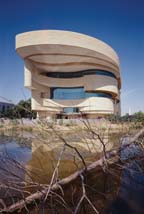
On September 21, the Smithsonian Institution's National Museum of the American Indian (NMAI), located just South West of the U.S. Capitol in Washington, DC, opened its doors to the public as the first national museum in the country to be dedicated exclusively to Native Americans. The 250,000-square-foot museum serves as a living exhibition space for Indian arts, history and present day culture. The five-story, limestone-clad building is located on a four-acre site in the National Mall, between the Smithsonian's National Air and Space Museum and the U.S. Botanic Gardens. Seattle-based architectural firms Jones and Jones Architects and Landscape Architects, Ltd., and SmithGroup, Inc. and the Polshek Partnership worked side by side on the design of the museum.
“The intent of the project was to create an enduring and provocative building that represents the unique and diverse cultural attitudes of Native people from across the Americas,†said Kevin Carl, project architect and manager for Jones and Jones. “The building's form is inspired by a stone outcrop carved by wind and water over time.â€
Choosing Minnesota limestone
For the main portion of the building, the architects selected Kasota limestone, from Vetter Stone Co. of Kasota, MN, which refers to the material as Minnesota Buff limestone. “The team searched across the U.S. for an appropriate stone material for the project,†said Carl. “When the Kasota [limestone] was found, the architects were attracted to the warmth of the golden buff color and the textural quality.â€Before deciding on Kasota limestone, however, the architects considered several other options. “Since this project site is on the Federal Mall, a white limestone that matched or complemented the other museums, the Capitol and the monuments was considered,†said Carl. “The design team first pursued the same limestone used on the Washington Monument, but discovered that the quarry [that supplied the stone] was nearly depleted and only had what was reserved for future needs of existing projects.â€
According to Michael Dobbs from SmithGroup, Inc., the stone was specified in various heights and lengths. “We requested pieces as long as possible while allowing a small percentage [5%] of stones below the minimum lengths, evenly distributed,†he said.
Howard Vetter of Vetter Stone Co. said that his company supplied over 2,400 cubic feet of cut stone, and over 25,000 cubic feet of split-faced stone for the museum. Sizes of the stone ranged from 1-foot pieces to large blocks weighing several tons for the base of the building. Considering the variations of the curvaceous building, Vetter said that the job was complex to fabricate. “There is not a straight edge on the building,†he said. “The stone splits to over 50 different curves, both concave and convex. The ever-changing curves were quite a challenge. No curve is repeated. Every wall has a different curve, and no two same radii can be found on the building.†He said that since none of the stones are interchangeable, every piece was shipped in sequence for each specific area as it was being worked on.
Dobbs said that the random - sized Kasota blocks at the base of the building are roughback with an unworked, unfinished face, varying in height, length and depth for randomness in appearance. “It is the first material exposed when the quarry opens up a new area, and its variation in color and texture comes from eons of contact with minerals, moisture, soil, etc.,†said the architect. “We asked that the largest possible blocks be used in the area; some are as long as 1,500 mm [60 inches] and as high as 1,000 mm [40 inches]. The bulk of the exterior cladding above the base is split-faced, and the sills, copings and surrounds feature a smoother finish called tapestry, which is sawn and then sandblasted for a natural-looking, pitted finish.â€
A diverse stone palette
For the building's exterior paving, the architects specified American Mist granite, which was fabricated by Granicor of Quebec and quarried by Rock of Ages at its quarry in Morgantown, PA. This material was supplied through Natural Stone and Tile, Inc., and approximately 100,000 square feet of thermal-finished American Mist granite was used for paving, water features, retaining walls and at the base of the building. “We had problems with a lot of the water features because they are in a big cubic, radial pattern,†said George Kyriacou of Natural Stone and Tile, Inc. “It was very labor intensive as far as the coordination of everything. I began working with the architects on this project back in November of 1995. [The museum] took seven years to develop and to put in place.â€Kyriacou added that all of the water features were hand-carved from cubic pieces, while the paving pieces were random sizes. American Mist granite was also used on a bench in the museum's “Potomac Room.†The back of the seat is split-faced, and the seat itself is polished. Complementing the black granite, thermal-finished Missouri Red granite surrounds the maple floor in the center of the Potomac room, and red sandstone -- the same used to build the original Smithsonian -- is in the center of the Potomac Room to represent the “hearth and heart of the building.â€
Additional stones were also fabricated by Granicor for the project. At the cascade portion of the watercourse, Golden Sand limestone was used in both rock-faced and honed finishes, according to Dobbs. He also said that Mount Airy granite in a thermal finish decorates the curbs of planters along the site's perimeter as well as the exterior stair treads. Also, polished Cambrian Black was used in the museum store and café, polished Giallo Sahara marble was used on countertops in the public restrooms, and honed Calizza Capri limestone was used for interior handrails, as well as the cap of the monumental stair.
Natural boulders of Peribonka granite, from Alma, Quebec, were also incorporated into the design of museum. “I took numerous trips with one of the Native American representatives -- Donna House, a Native American from New Mexico -- to Canada to select the boulders,†said Kyriacou. “We wanted to keep them in the same direction as they were [originally] in Canada.â€
Granicor supplied a total of 60 boulders for the project, which were positioned to represent natural outcroppings on the site. “The Native Americans believe that the boulders have religious significance,†said Ed Zimmerman, a representative of Granicor. “They held a ceremony at the Peribonka quarry to bless the boulders with cornmeal. Then they lit up a peace pipe and passed it around to each other.â€
Installation challenges
According to Dobbs, the most difficult part of the project was dealing with the curves of the building. “The wall stone -- both interior and exterior -- is curved at all conditions below a certain radius where using straight stone would produce an unacceptable, faceted-looking surface,†said the architect. “For the split-face stone, this required the fabrication of several custom curved blades for use in the shop. Organizing and controlling this process was paramount to success, as there were more than 100 different radii to deal with. We also wanted to stagger the control joints rather than have them be continuous from ground to roof, which added another degree of difficulty to an already complicated process. On floor surfaces, radial and curved cuts had to be made when the paving patterns were below a certain radius as well. In addition, the granite has natural white streaks in it, which we wanted oriented in line with the direction of flow -- human and water. This required numerous visits to the shop, extreme oversight by the fabricators and review with the field personnel.â€The stone was installed by GA Masonry Corp. of Crestwood, KY. Project Manager Channing Strom from GA Masonry -- who worked closely with his co-workers General Super-intendent Ed Neddo and Project Coordinator Bob Vancoillie -- agreed that the round geometric shape of the building made the installation harder to coordinate. “[The cavity wall] was designed with 2-inch rigid insulation where scoring the board was not permitted. We submitted a spray-on installation system using polyurethane foam to get around the curves, “ he said. “Because of the difficult layout, it was harder to figure out where we were and where we were supposed to be, in space.†Strom said that their masons were able to overcome the obstacles involved with the complex installation with some engineering support from the General Contractor -- Clark Construction Group of Bethesda, MD. “Cooperation with the design and coordination teams was vital. Our people developed unique methods to figure out where they were in terms of plumbness and location of inflection point changes from one curve to another, “ said Strom. “We had to vary air space in some cases where the engineers provided shots marked on the walls [to show 3D location]. We also had plywood templates made up of about 150 different curves to approximate where a given change in curve was.â€
Construction of the NMAI began in September of 2000, and finished this past September. According to Carl, there has been an “overwhelmingly positive [reaction] by the Native community, the client and the general visitors.â€
End box
National Museum of the American IndianWashington, DC
Architects: Jones and Jones Architects and Landscape Architects, Ltd., Seattle, WA; SmithGroup, Inc., Washington, DC; Polshek Partnership, New York, NY
Landscape Architect: EDAW, Alexandria, VA
Stone Quarriers: Vetter Stone Co., Kasota, MN (Minnesota Buff limestone); Rock of Ages, Morgantown, PA (American Mist granite)
Stone Fabricators: Vetter Stone Co., Kasota, MN (Minnesota Buff limestone); Granicor Inc., St. Augustin, Quebec, Canada (American Mist granite)
Stone Supplier: Natural Stone and Tile, Inc., Chesapeake, VA
Stone Installer: GA Masonry Corp., Crestwood, KY
General Contractor: Clark Construction Group, LLC, Bethesda, MD
Looking for a reprint of this article?
From high-res PDFs to custom plaques, order your copy today!