Responding to the climate

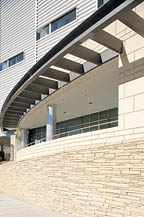
"Location plays a major role in the design of a building, controlling most of the decisions from selecting materials to choosing color schemes," Pfeiffer said. In this case, Arizona sandstone was chosen for its connection with the locality, as well as its earth-toned desert color. The unique setting was one of the first aspects taken into consideration when HHPA began work on the federal courthouse.
"It is hot for most of the year," Pfeiffer said. "So, there was a desire to be responsive to the climatic elements. As a result, the parts of the building where the judges and staff sit are oriented toward the north and east, which take less sun and have spectacular views of the mountains. The public side and the circulation corridor, which links the doors of all of the courtrooms, face the harsher side of the building, however, it is a place where people rarely sit for very long. They're always in motion, so there is less concern for solar issues."
The materials used for each face of the building were a direct reflection on the elements each would have to withstand. Stone was a natural choice for construction of a courthouse in the desert, however, due to the harsh sun and the budget restrictions, stone could not be used throughout. "The architecture responded differently to the sunny side," Pfeiffer said. "Faceted, angled metal panels were erected to shade the windows without obstructing the view."
While the windows were fewer and smaller on this public side of the building, other public spaces granted a better view of the buildings natural surroundings. "Since the weather allows people to remain outside year round, public outdoor realms were created, and specific courtyards were defined," said the architect. "The winter courtyard faces the south and west to make the most of the sun in the colder months, and the summer courtyard faces north and east to provide relief from the heat."
Since stone could not be used generously, partly as a result of new budget restrictions implemented by the General Services Administration program, it was installed in the most public places first. The exterior areas include a wall that flanks the building, the low retaining walls that define the courtyards and several planters and other design elements within the courtyards.
"Stone is used for the public experience of the building and for the surfaces that people come into contact with most often, so they can go right up and touch it," Pfeiffer said. "There is a major wall that forms a part of the entry to the courthouse from the corner of the site, which faces downtown. It runs right through the building and links the summer and winter courtyards, allowing people to pass through from one garden to the other. This multi-story [sandstone] wall was honed smooth and laid up as a fairly thick veneer with mortar joints."
According to the sandstone installer, Jim Smith of B&B Masonry in Tucson, AZ, the stone used was Buckskin Tan Arizona cut sandstone, which was supplied and fabricated by American Sandstone in Chino Valley, AZ. "We used a basic anchoring system onto a steel structure. We had a steel-tubing substructure, and we anchored to it. They had a channel that anchored to the tube steel and then the individual anchors screwed into that," Smith said, adding that Hohmann and Barnard supplied all of the installation products out of Hauppauge, NY.
"The installation was a typical job," Smith said. "The most difficult aspect was basically the same thing we always run into with this type of design. In layman's terms, the ironworkers that put up the steel tubing didn't have the same standard of tolerances that we did. Their tolerances for plumb were quite a bit different than ours, and the inaccuracies forced us to constantly adjust our anchors to maintain our standard 1/8-inch tolerance. The standard for ironworkers does not always take into consideration the cladding that goes onto the iron. It's one of those things that falls through the cracks all the time."
Smith also installed the stone in the courtyard. The low retaining walls that hold up the earth as planters were also constructed from the Arizona cut sandstone, however the installation process was completely different. "These are made of the same sandstone laid in an ashlar pattern in which the stone is cut and broken naturally and laid flat on its side without any mortar joints," Pfeiffer said.
"[The architects] had a pattern consisting of about 4,000 square feet of cut stone for the bonded stone walls and those with the sandstone laid in random ashlar patterns. The size of each ranged from 2 to 6 inches in height," Smith said.
The use of stone continued inside the U.S. Courthouse as well, again within the most public places within the building. "The special proceedings courtroom, a more ceremonial room used for all kinds of public events rather than criminal trials, has a panel of [sandstone] immediately behind the judge's bench, so the entire wall has that as a major focal point," the architect said. "We also added terrazzo floors in two major places. The entry is made out of black terrazzo in which raw copper is introduced. This is a reference to the copper ore found in the desert around Tucson. Immediately to the left of the entry is a large three-story tall space with a switchback ramp stair leading to the special proceedings courtroom. The vertical surface here is also terrazzo, but in a lighter color without the copper. It's as if you were going up a trail in the desert."
The use of this copper ore in the terrazzo is an example of the architect's goal to bring the desert into the building as it has been brought into the desert. "We were trying to find materials that were indigenous to the area so there would be some association with the building and the place it was built," Pfeiffer said. "The main area in which black is used defines the entry vestibule and announces dramatically that you have arrived. A lighter-colored terrazzo lines the corridors creating a pathway connecting all of the courtrooms."
In addition to the selection of indigenous materials and natural stone, the desert inspired the color schemes within the building. "The building in color and tone was created in response to the earth-tone colors of the desert, since the desert comes almost right down into the town," Pfeiffer said. "While from a distance the desert looks to be all the color of sand, upon closer look there are brilliant vibrant colors such as red, yellow and turquoise in the wild flowers. We did the same thing with color. It is subtle from afar, but if you look closely, there is a layer of richness superimposed on top of the sand colors."
According to the architect, this project's design was not problematic during the construction stages. It was the tight budget restrictions that had to be accommodated during the design process that posed a challenge. "This project was not difficult to implement," Pfeiffer said. "The site was good to us because it was oriented in such a way that we could make common sense moves without jeopardizing the GSA requirements.
"I guess the most challenging thing was that this was the first courthouse that was required to be built with new budget restrictions implemented after the first round of courthouses under the GSA program had been criticized for being too lavish for the use of taxpayer dollars," Pfeiffer said. "We had substantially less to work with due to these budget requirements. There was a need to make a building that is creative, appropriate, and responsive with economical materials. This is why the building isn't made completely of stone, but is intermixed with plaster and concrete. We wanted to give the building stature and permanence, so it would have been nice to use more stone or stone in more places. And while the use of concrete is not necessarily a detriment to the design, it was definitely a challenge to make it work."
Looking for a reprint of this article?
From high-res PDFs to custom plaques, order your copy today!