Staying true to California tradition

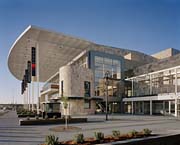
Although The University of California at Davis campus is comprised of a large student body, the city itself is a close-knit community. With students making up a significant portion of the city's population of 56,000, Davis is one of California's few remaining college towns. As a way of further strengthening the bond between the city's students and residents, the university recently built the Robert and Margrit Mondavi Center for the Performing Arts. This building, which was partially funded by California winemaker Robert Mondavi, not only serves as a "front door" building for a newly developed section of the campus, but it also offers locals the opportunity to experience art and culture. Adding to the signature look of the new structure is the warm golden sandstone veneer -- quarried in the Gwalior region in Madhya Pradesh of central India -- that adorns the exterior and interior walls.
Jade White/Gwalior Yellow sandstone, which was quarried by Tab India Inc. and fabricated in its facilities in Jaipur, India, and supplied by the company's U.S. office, Amsum & Ash of Minneapolis, MN, is slightly softer than the other varieties of sandstones available from India, making it an easy material to work with, according to its supplier. The material was selected because its coloring reflects the surrounding environment.
"We wanted to symbolize the land because of the history of the university, which is a land grant school," said Project Designer Stan Boles of BOORA Architects in Portland, OR. "It's the original agriculture school for California -- the leading school for research in farming -- and as of the last 40 or 50 years, it's been a leader for the wine industry. It's only 45 minutes to Napa Valley. There's a real stewardship of the land. It's the tradition of the university. This manifested itself architecturally in what we built the building out of."
According to Boles, the Mondavi Center was the first of a series of structures that will be built on a new section of campus. "The building is at a new front door to the campus," he said. "We were involved with master planning and the building design to create a kind of new precinct to the campus -- making a regional entry. There's literally a new road, new quad and new parking structure." The designer continued to explain that the other planned construction will include "front door" buildings such as a hotel/conference center and wine and food research center.
The campus is adjacent to Interstate 80, and before the performing arts center was built, motorists passing by really couldn't see the school. "[The university's administration] wanted a new identity," said the designer. "The university loved the quality connotations of the sandstone at the 'front door.'
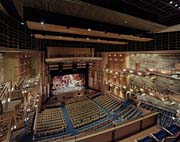
Robert Mondavi and his wife presented the university -- known as UC Davis -- with a gift of $35 million. While $25 million will fund a new Robert Mondavi Institute for Wine and Food Science, the other $10 million was allotted towards the construction of the 104,000-square-foot performing arts center, which totaled $60.9 million when all was said and done. In March 2001, Barbara K. Jackson donated $5 million to the project. The 1,800-seat main hall was then named the Barbara K. and W. Turrentine Jackson Hall in honor of Jackson and her late husband, a former UC Davis history professor.
Construction was completed in September 2002, and the center opened its doors the next month. UC Davis is the largest of the 10 University of California campuses, with 5,200 acres.
Reflecting the region
"The stone was carefully selected to fulfill those goals of literally relating to the land," said Boles. "We were evaluating all kinds of stone, and drawn to the sandstone for the richness of color. It literally related to the color of the land. Also, there are a lot of buildings on the existing campus that are masonry and painted concrete, or brick in some instances. They're lighter tones of buff. We wanted to keep a certain consistency for the gateway to the campus."Expense was also a concern during the selection process, according to Project Architect John O'Toole, also of BOORA Architects. "We began a search looking for something that would work and fit within the budget," he said. "The bottom line though, was the look. The sandstone had the warmth and surface character we were looking for on the building. The color was this kind of nice natural tan adobe with pinks and rust colors."
A total of 90,000 square feet of the sandstone was used in a combination of both cleft and honed finishes. "The honed pieces had a smoother surface," said the architect. "The darker colors were cut out during the honing process. The cleft pieces have a broader color range and lots of texture. We wanted as much texture as we could get on that thin stone. We found through discovery that the product contained some unique fossil forms such as leaves and vegetation, which added to the rich texture."
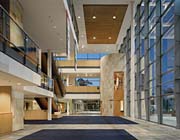
Approximately 30% of the pieces were honed, while the other 70% had a natural cleft finish. The honed pieces were used for the base of the interior and exterior walls, and the natural cleft tiles were employed as cladding on the interior and exterior of the theatrical spaces, namely the main hall and studio theater. Additionally, tiles with the cleft finish were used for a large wall in the lobby, which runs from the floor to the ceiling. The lobby design complemented the stone with glass.
The lobby also included a donor wall, which features the names etched into the cleft-finished sandstone. "A number of options were explored as to where the donor wall could go," said O'Toole. "But it was not initially envisioned to be where it is now. A month or two before the opening, an independent contractor set up a tent and sandblasted the names into the cleft stone."
Complementing the warm golden sandstone is Ocean Green quartzitic slate, which was also quarried in India and supplied by Amsum & Ash. Approximately 15,000 square feet of the material was employed as exterior and interior paving as well as for outdoor planters. Just as the sandstone, the slate was used in a combination of honed and natural finishes.
Using stone veneer
Because cost played a large factor, the stone was utilized as 5/8-inch-thick veneer panels for the exterior and interior cladding, and the stone was adhered to the building. "We had close to a stucco budget, so we had to rule out thick mechanically attached stone like used on the Getty Center," said O'Toole. "We looked at adhered stone veneer, and the cost went down."According to O'Toole, in his 15 years of working for BOORA Architects, which has over 60 theater designs in its portfolio, this was the first time that he had used an adhered stone veneer. "As an office, our big fear was that giant pieces of stone would be falling off," he said. "But through research, we became comfortable with it. The specification was set up based on the Laticrete system -- workability was very important. We were worried about products that had a shorter workable time."
The architect explained that a large concern with other products was that they would dry up on the wall before the stone was put up. The architectural firm felt confident that the Laticrete system, which includes Latapoxy 310 stone adhesive, would provide an adequate time period for the stone veneer to be installed properly.
The sandstone pieces included an assortment of sizes -- ranging from 12 x 24 to 24 x 30 inches. All of the tiles had a thickness of 16 mm. The construction phase took approximately 28 months to complete, with ground-breaking beginning in May 2000.
While the architects were new to the use of adhered stone veneer panels for this type of application, the installation team was confident in the choice, according to Al Weinstein, president of American Tile & Brick Veneer, Inc. of Signal Hill, CA, who explained that his company has had many experiences with this method of installation. "We had previously done a building bigger than this one at Cal Poly Pomona," he said. "It was a similar installation."
Weinstein explained that the first step for the exterior installation was to install a substrate of Durock cement board, which provided optimal adhesion properties and needed protection against any potential moisture problems. Following that, a double coating of Laticrete Waterproofing 9235 was applied. The final step before putting the stone up was to apply an adhesive -- Crete 4237 with 211 powder, according to the installer.
"The Laticrete system is basically a waterproofing and adhesion system," he said. "It bonds the stone to the substrate." Inside, the waterproofing step was eliminated and only the adhesive was used, explained Weinstein.
The Durock panels were also used in multiple layers over interior walls to provide added mass to enhance acoustics. In total, approximately 80,000 square feet of cement board was installed throughout the center.
Acoustics was a primary concern when designing the building, according to O'Toole. "Collectively, we were holding our breath until the first performance, when the critics start writing about the acoustics," he said. The architect happily continued that after the first season, a Sacramento newspaper rated the new performing arts center on various categories, and while it did well overall, it scored particularly high marks for its acoustics and sight lines.
Installing the slate
One of the most challenging aspects of the project for the stone installers was the paving, according to Weinstein. "The architects specified pavers with clefting," he said. "There are guidelines, though, of what the tolerances in variations are for floors. If there is too much clefting, there could be tripping hazards or heels could get caught."According to the installer, the architects had originally specified larger pieces such as 2 x 3 and 2 x 4 feet, but in the end, only about 15% of those pieces could be used. "We couldn't get enough material to fall within the allowed range of clefting," he said. "We had to reject a lot."
Weinstein said that the architects had to redesign the plans for the paving to incorporate smaller size pieces of slate. Amsum and Ash went through tremendous lengths to reduce the clefting, according to the installer. "They really did a bang up job -- just terrific." Weinsten also said that the architects were easy to work with as well. "All in all, everyone was very professional," he said.
The slate was also used for the exterior planters. "They are an interesting design," said Weinstein. "The slate pieces are 3/4 inches thick by 4 inches wide and up to 4 feet long. They were stacked in a masonry application. We laid one on top of another."
The pieces, which had ragged edges, were held together with colored mortar that was specially formulated for this particular job by Patio Industries. The slate paving was installed with Laticrete Grout 500 series with 1776 admix.
In the end, all those involved with the project were pleased with the results. "It's been a huge success," said O'Toole. "We received a lot of positive feedback. The arts center is for the entire district. It's the university's way of extending its hand to the community."
Robert and Margrit Mondavi Center for the Performing Arts University of California at Davis
Architect: BOORA Architects, Portland, ORGeneral Contractor: McCarthy Building Company, Inc., Roseville, CA
Stone Quarrier/Fabricator: Tab India Inc., Jaipur, India
Stone Supplier: Amsum & Ash, Minneapolis, MN
Stone Installer: American Tile & Brick Veneer, Inc., Signal Hill, CA
Installation Products Manufacturer: Laticrete International, Bethany, CT
Drywall Contractor: W.F. Hayward Co., Diamond Springs, CA
Substrate Manufacturer: United States Gypsum Co., La Mirada, CA
Looking for a reprint of this article?
From high-res PDFs to custom plaques, order your copy today!