Working together for a common goal
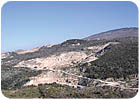
Presently, there are four quarries in operation in the Perlato Coreno Royal® marble basin, which is located in the Aurunci Mountains.
Among the many stoneworking areas in Italy is the Perlato Coreno Royal® marble basin, which is rich in Perlato Stone - a material noted for its distinctive characteristics, including fossils of fish, shells, algae and sea plants on its surface. And while the use of the stone dates back to Roman times, strong efforts have been made in more recent years to promote Perlato Stone to the international market. As part of this marketing campaign, “Consorzio per la valorizzazione del Perlato Coreno†was established in 1991 by local entrepreneurs and municipalities of the entire marble basin. The Consortium, as it is called, has grown to include more than 100 firms with about 1,300 employees. It works together on issues related to the quarrying and processing of Perlato Stone, and as a result, the area of Perlato Coreno Royal has been recognized as an “Industrial District.â€
The material is quarried in the Aurunci Mountains, and starting from Coreno Ausonio - the primary quarrying area for Perlato Coreno - the marble basin extends approximately 65 million square feet. And although the material has a name similar to the “Perlato di Sicilia†marble of Sicily, Perlato Coreno Royal differs in that its fossils and veining are larger. There are about 25 working sites today - mainly “hillside quarries†and “opencast†types - that occupy the southwestern slope of the mountain.
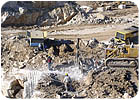
At the quarrying sites, drills and wire saws are used to cut out blocks, and detonating powder is used in the drill holes to loosen the block. The detonating powder is necessary due to the hardness of the stone, according to quarry workers.
History of the stone
Coreno Ausonio's marble basin is divided into three main periods:“Roman†- the period during which dwelling areas of Coreno Ausonio utilized the stone as raw materials for building
“Stone†- the period during which this material was used in an artistic and hand-crafted fashion
“Marble†- the period representing the history of the last 50 years, in which the stone of Coreno has been elevated to the rank of a highly esteemed material and connected to a strong industrial production.
Archeological sites such as Minturno, Cassino and Pompei clearly display the methods in which the Roman civilization used Perlato Stone. Architecture in these areas, which are not far from the marble basin, display the stone in applications such as columns, bases, friezes, bas-reliefs, theaters and pavement.
Throughout the “Stone†period, Perlato Stone was used as a primary material for building castles, noble palaces and residential dwellings of historical areas in local villages. The stone was skillfully crafted for decorative elements such as jambs, lintels, windowsills, and door and window surrounds.
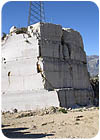
Lavalle A.G. - a company owned by two brothers who lived in the U.S. for 20 years - created a 9/11 memorial on a quarry face as a tribute to those who lost their lives in the attacks of September 11, 2001. “We owe this to the states,†said Joe Lavalle. “We are thankful to have lived there.â€
It was during the 1950s and 1960s that commercial quarrying began in the Perlato region on a broad scale. In 1962, there were a total of six quarries employing about 40 workers. During the early 1960s, the local population started evolving into an industrialized working culture, and there was a noticeable shift from agriculture. Companies in Carrara and Verona were the first to realize the potential of the marble basin, and they helped Perlato Royal Coreno® to emerge on the international market.
In the 1970s, an organization called “Cooperativa Cavatori Coreno†was started to better manage the health and safety of employees working in the region, as well as to strengthen relations with both the banking sector and trade unions. Also at this time, the first saw mills were developed. Until then, processing had been done abroad.
Quarrying today
Currently, there are four quarries in operation in the Perlato region. Equipment includes drills and wire saws, which are used to cut out blocks. Detonating powder is also used in the drill holes to loosen the block. The detonating powder is necessary due to the hardness of the stone, according to quarry workers.Stone World visited one of the sites in the area that had already been quarried 30 meters down. Workers also explained that it is intended to work at least another 35 to 40 meters deep at this quarry.
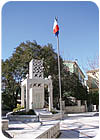
The use of Perlato Stone is evident throughout the town of Coreno Ausonio - one of six townships involved in the Consortium. In 2003, a piazza was built with the material. The stone was laid on a concrete base, and no expansion joints were necessary - illustrating the stone's strength.
Still feeling ties to the U.S., the Lavalle brothers created a 9/11 memorial on a quarry face as a tribute to those who lost their lives in the attacks of September 11, 2001. “We owe this to the States,†said Joe Lavalle. “We are thankful to have lived there.â€
In addition to quarrying, Lavalle A.G. also operates a stone-processing plant, which cuts blocks. “We concentrate on quality, not quantity,†said Joe Lavalle, adding that the company recently supplied Perlato Stone to a project in Jordan, which took about six months to fulfill.
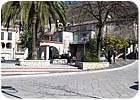
Additionally, a large expenditure for the town is maintaining the roads. A reconstruction of Coreno Ausonio's roadways was in place at the time of
Stone World's visit, and was expected to be completed by April 2006.
Modern-day Coreno and the Consortium
The use of Perlato Stone is evident throughout the town of Coreno Ausonio - one of six townships involved in the Consortium. In 2003, a piazza was built with the material. The stone was laid on a concrete base, and no expansion joints were necessary - illustrating the stone's strength.Additionally, a large expenditure for the town is maintaining the roads. A reconstruction of Coreno Ausonio's roadways was in place at the time of Stone World's visit, and was expected to be completed by April 2006.
“Marble is the main industry in the area today,†said Antonio Gargano, Mayor of Coreno Ausonio. “We are very proud that the stone seen here cannot be found anywhere else in the world.â€
The Consortium cooperates with many institutions, such as the Frosinone Chamber of Commerce, University of Cassino and labor unions to get their message across. Its members approach initiatives and solve complex problems, including:
- training, management and employment
- technological research: testing of new machinery for workmanship innovation
- product quality: quality systems and environmental respect
- national and international commercialization: 80% of Perlato Coreno Royal is exported worldwide
- employee safety: the recent percentage of work injuries has been close to zero
Looking for a reprint of this article?
From high-res PDFs to custom plaques, order your copy today!