Upgrades Continue at the Leaning Tower of Pisa
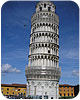
Started in 1173 and continuing for nearly two centuries, the Leaning Tower of Pisa - the Belfry of the Cathedral of Pisa - has been undergoing extensive stabilization and restoration work.
Known worldwide for its dramatic inclination and Romanesque architecture, the Leaning Tower of Pisa recently saw the completion of a seven-year stabilization project in the Spring of 2008. Although much of the tower’s signature “lean” (which had reached nearly 15 feet by the end of the 20th century) was retained, the engineering project ensured that the tower would avoid collapse. Now that the stabilization work has been completed, attention has now turned to improving the tower’s aesthetics - particularly its ornate stonework.
The tower is currently being restored by the conservation group, Conservazione Beni Culturali (CBC) of Rome, Italy, which has been responsible for restoring many of Italy’s architectural treasures. A scaffolding platform is currently making its way up the building as work is completed, and CBC has installed a series of signage to explain the scope of the project to visitors in Italian as well as in English.
History of the tower
Work on the tower - erected as the Belfry of the Cathedral of Pisa - began in August 1173 by Bonanno Pisano, and continued without interruption for five years. However, in 1178 the work, which had reached the fourth gallery, was stopped for unknown reasons. Construction resumed in 1272, and it reached the seventh cornice in 1278. This was followed by another long work stoppage, and it was only in 1360 that construction of the actual belfry began. This aspect of the work continued for several years, and according to CBC, it was during this ultimate phase that a significant correction was made to the angle of inclination by building four steps to the north and six steps to the south at the level of the pavement at the base.
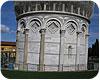
A variety of local marble varieties were used to build the tower. While much of the components were made of marble from the nearby village of San Giuliano, they were gradually replaced using White Carrara marble, quarried approximately 60 miles away.
“Signs of structural damage began to appear only a few years after the completion of the tower, and four columns had to be replaced at the end of the 14th century,” CBC continued. “Over the years, many other stone elements were replaced, and chains, clamps and hoops were applied. Thus, the original components, mainly made of San Giuliano marble, were gradually replaced using White Carrara marble [quarried approximately 60 miles away]. Today, only 33 of the 180 pillars of the open galleries are made of marble from the nearby village of San Giuliano, and these are mostly on the northeastern side. Most capitals, too, were replaced with White Carrara marble.”

The restoration includes 11 cleaning systems, five products for consolidation, 18 types of mortar for plastering and special treatments and products for the removal of chewing gum and for graffiti.
According to CBC, the studies and analysis of the interactions between the environmental conditions and the tower have shown that erosion, stone decay, calcium sulphate deposits and build-up of lime encrustations are linked to the impact of rainfall and other forms of water particles, as well as the various ways water flows over the surface. “On the other hand, in the area under the overhang of the tower, which is shielded by the tower itself, airborne particles which are deposited are not washed away and form black crusts,” stated the CBC report. “Widespread cracks, fractures and detachment of fragments are evidence of the compressive forces arising from the inclination and also of the greater exposure to the sun’s rays of columns and capitals. In the wetter areas, microorganisms, mosses, lichens and weeds have developed.”
In all, over 75,000 square feet of interior and exterior surfaces were gauged using historical studies and scientific analysis, coupled with a long and complex process of mapping and graphic rendering of the different forms of degradation. “The computerization of these data has enabled a clear picture to be obtained of the damage and its extent,” stated CBC. “Black crusts, for example, cover [21,183 square feet] and are mainly located on the lower colonnades of the south side. Meanwhile, decay of the stone is more severe in the upper areas of the north and south side, affecting [22,452 square feet], and cracks extend for [28,405 lineal feet] and are worst at level three.”
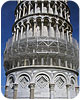
A lightweight, circular scaffolding made of an aluminum alloy has been built to restore the outer surfaces of the open galleries, and work will be completed in 2010.<
In planning remediation work for the tower, conservation methods were devised to account for the results of the studies as well as the direct experience gained working on the site in 2000 - when a large block in the southeastern area was addressed.
The restoration includes 11 cleaning systems, five products for consolidation, 18 types of mortar for plastering and special treatments and products for the removal of chewing gum and for graffiti.
CBC reports that the work is constantly monitored, and gradual interventions are made so that the restoration specialists can adapt for different conditions. Stone was consolidated by localized impregnation or by immersion, and cleaning was done using an atomized water spray, solvent poultices or micromechanical tools.
In repairing the cracks, fractures and joints between stone blocks, the restoration team has been establishing the levels and methods both for the removal of old fillings and application of new fillings. The methods vary based on the stone type and level of exposure. The final step has been to identify methods and types of surface protection.
The first areas to be addressed were the belfry and the first level, and they were accessible through traditional scaffolding. Restoration has also been completed inside the open galleries, in the stairs and in the inner flue of the tower.
A lightweight, circular scaffolding made of an aluminum alloy has been built to restore the outer surfaces of the open galleries, and work will be completed in 2010.
Looking for a reprint of this article?
From high-res PDFs to custom plaques, order your copy today!