Technology investments bolster Canadian producer
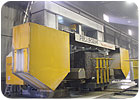
A. Lacroix et Fils Granit Ltée has made a number of technological advances at its plant in Saint-Sébastien, Québec, Canada. One of the most recent investments has been a Polywire 32 multi-wire saw from Pellegrini Meccanica of Italy, which is used to process blocks into raw slabs.


Nestled among the pine-covered hills of Saint-Sébastien in Québec, Canada, A. Lacroix et Fils Granit Ltée processes stone with advanced stoneworking machinery that is being updated on a continual basis. Operating with a dedicated staff of experienced workers, the family-run company has invested in the latest generation of technology for slab production as well as custom architectural stonework.
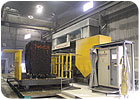
According to the firm, the unit does the work of several gangsaws. Blocks are fed to the saw by means of a trolley.

Slab and tile production

The centerpiece of the company’s slab production is a Polywire 32 multi-wire saw from Pellegrini Meccanica of Italy, which is used to process blocks into raw slabs. According to the firm, the unit does the work of several gangsaws, and the foundation is a fraction of the cost of a gangsaw. “This will be our future,” said Simon Lacroix, the company’s vice president.

The saw can cut slabs ranging from 2 to 5 cm in thickness, and A. Lacroix currently has the unit set up for 3-cm slab material. When processing material of this size, A. Lacroix equips the saw with 22 wires.
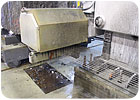
A. Lacroix credited Diamant Boart for developing the optimum diamond wire for use with the machine.

In terms of production speed, the saw can process a block into raw slabs in four to four and a half hours. “We put a block on the wire saw in the morning, and it is ready to polish later that day,” Simon Lacroix said, adding that the wires cut at a rate of 50 cm per hour.

He credited Diamant Boart for developing the optimum diamond wire for the machine. “They have come up with a very good endless wire,” he said, adding that the precision of the wire allows them to recover an extra one or two slabs per block processed.
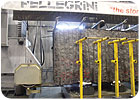
In terms of production speed, the saw can process a block into raw slabs in four to four and a half hours.

The machine is also well suited for inconsistent quality blocks because it will cut evenly through the soft spots rather than ripping through them and damaging the slabs.

A. Lacroix did a great deal of research before making the investment in this new technology. “We were balancing the investment and the payback, and we were also looking at our long-term production,” Simon Lacroix said.
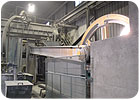
The company also has seven gangsaws, including a Masterbreton HG from Breton.
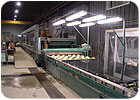
The company not only researched the machinery, but also the software, explained Claude Lacroix, the company’s president. “We had to make sure the software that runs the machine would be easy to operate,” he said. “We were watching for a long time, and we also reviewed what is operating in Italy.”

Slabs are polished on a Levibreton polishing line with 19 polishing heads.

In addition to processing blocks on the multi-wire saw, A. Lacroix has a total of seven gangsaws, including models from Giorgini Maggi as well as the company’s newest gangsaw, a Masterbreton HG from Breton. It also has a Pellegrini single diamond wire saw for block trimming.

Slabs are polished on a Levibreton polishing line with 19 polishing heads. On average, A. Lacroix has a polishing capacity of 1,500 square feet per hour.
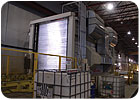
As needed or by request, A. Lacroix also has automated machinery for resin treatment of slabs. This includes driers from Protec that can house 60 slabs at one time.

As needed or by request, A. Lacroix also has automated machinery for resin treatment of slabs. This includes driers from Protec that can house 60 slabs at one time and allow for optimum application and penetration of the resin products, which are supplied by Tenax.

In general, though, A. Lacroix only treats 5 to 10% of its slab material with resin, using the process on materials such as Atlantic Black or Orion, which have surface fissures. “They are not structurally poor, but [resin treatment] enhances the look,” Simon Lacroix explained.
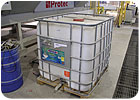
Resin products are supplied by Tenax.

Tile production is carried out using a Zambon tile line. Although not a major component of the company’s business, A. Lacroix invested in a tile line to satisfy the needs of its existing customer base in-house, rather than subcontract the tile fabrication.

Slab and tile production is mainly comprised of material from A. Lacroix’s own quarries, in addition to some U.S. granite varieties such as Deer Isle, Kershaw, Dakota Mahogany, etc.
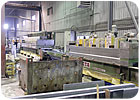
The production is carried out using a Zambon tile line. Although not a major component of the company's business, A. Lacroix invested in the machinery to satisfy the needs of its existing customer base, rather than subcontract the tile fabrication.

Architectural work

In addition to investments in slab production, A. Lacroix is also continually updating its machinery in the cut-to-size end of the business. This includes a multi-head saw from Breton that can automatically execute a broad range of specific cuts on a workpiece. After the unit is pre-programmed with the desired sizes of the project, the workpiece moves to the cutting heads via conveyor and the initial cuts are made. The piece then leaves the cutting area, is automatically repositioned, and then returns to the blades for further cutting as needed.

A. Lacroix is also continually updating its machinery in the cut-to-size end of the business. This includes a multi-head saw from Breton that can automatically execute a broad range of specific cuts on a workpiece.
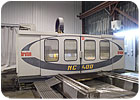
A Contourbreton NC 400 CNC multi-axis stoneworking center from Breton is also among the advanced equipment used for cut-to-size work, including countertops that A. Lacroix fabricates for outside installers on a contract basis. The machine is equipped with a double workbench in order to eliminate downtime due to loading, unloading and set-up. The two mobile benches slide on wheels, and while one bench is positioned inside the machine during the work phase, the second bench outside the machine can be loaded with the pieces to be worked in the subsequent cycle. The bench movement is motorized and moves by simply pressing a button.

A Contourbreton NC 400 CNC multi-axis stoneworking center from Breton is also among hte advanced equipment used for cut-to-size work, including countertops that A. Lacroix fabricates for outside installers on a contract basis.

A Flow waterjet for custom production also features a double worktable, allowing for faster production and less downtime.

For three-dimensional work, Lacroix has a range of advanced machinery. When processing large-scale pieces of this type, one of the key pieces of equipment is a Pellegrini Robot Wire saw, which can be programmed to make a range of intricate, complex cuts. The company also re-engineered a 7-axis Fanuc unit for three-dimensional stoneworking, and it has become a vital piece of machinery for custom stonework.
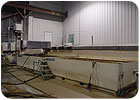
A Flow waterjet for custom production also features a double worktable, allowing for faster production and less downtime.

For columns and other circular work, stone is processed on a large-scale lathe. A variety of bridge saws and three Thibaut T108 polishes are also used when processing architectural pieces.

In terms of surface finishing, the company invested in a line that is capable of flaming, waterjet finishing and sandblasting. When processing material on this line, the company will often use combinations of the three different surface finishes. “The waterjet finishing brings out the color, especially in darker materials,” Simon Lacroix said. “The pearls also flash.”
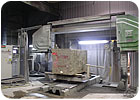
When processing large-scale cubic work, one of the key pieces of equipment is a Pellegrini Robot Wire saw, which can be programmed to make a range of intricate, complex cuts.
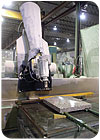
Over the years, the company has become a specialist in completing difficult projects. “In the 1980s, much of the work was flat and rectangular, but then the architects began to push more, and that’s what makes the job fun,” Simon Lacroix said. “We are doing a lot of difficult work, but it becomes easier when you do it on a regular basis.”

The company also re-engineered a 7-axis Fanuc unit for three-dimensional stoneworking.
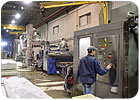
“If it is a challenging project, we will certainly go after it. That’s what gave us work in the difficult years and when competition was up,” Claude Lacroix said. “When a project is difficult, the customers know it is a job for us. We don’t negotiate these projects for a long time, since we have a reputation for doing difficult projects well. The people working in our factory actually feel bad if they don’t have that kind of work.”

A. Lacroix also invested in a line that is capable of flaming, waterjet finishing and sandblasting, and materials are often finished using a combination of these methods.

When working on architectural projects, the key is on-time delivery, Claude Lacroix said, adding that maintaining a strict schedule has given the company a strong reputation with stone installers and general contractors as well as architects. “Good news travels slow. Bad news travels much faster,” he said when emphasizing the need to be on time.

Only about one-third to one-half of A. Lacroix’s architectural work is done in its own granites. Because it works on many government projects in America, much of the work tends to be completed in U.S. granites, as well as materials like Vermont marble and Indiana limestone.
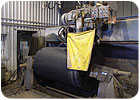
For columns and other circular work, stone is processed on a large-scale lathe.

Company history and structure

A. Lacroix was founded in 1962 by Armand Lacroix and four of his sons, and the company has remained a family-owned business over the decades. Claude Lacroix is the company president and owner, and he is joined in the business by three of his children. Simon Lacroix is vice president; Fréderic Lacroix is secretary-treasurer; and Dominique Lacroix is director.
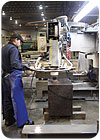
Thibaut T108 polishers are also used when processing architectural pieces.
“We have an ongoing structure in place for the next generation. Our customers don’t have to worry who will be next,” Claude Lacroix explained. “[My children] studied engineering with plans to be part of the business, and I am proud to pass the company to my family.”

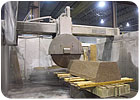
Custom cutting is completed using a variety of bridge saws.
In all, the company has approximately 100 workers in the plant and 30 in its 16 quarries. Simon Lacroix pointed out that the company is fortunate to have a solid labor force, with many workers having 20 or more years of experience. “We have always stressed the quality of people, from the management to the office to the factories.”

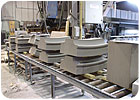
The company has been fabricating more limestone over the past year, including a great deal of radius and curved work.
Claude Lacroix explained that it has been part of the firm’s history to invest back in the company. “We brought in the first automatic polishing line back in 1977,” he said, adding that the average investment over the past 15 years has been $1.6 million per year. The company also has an in-house development team as well as mechanics who perform maintenance and modifications on the equipment and tooling. “When we have a job, we look to build tools that will save time,” Simon Lacroix said. “Some specific jobs require specific tools.”

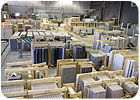
A vast amount of finished products are on hand, ready for shipment.
Overall, 50% of the company’s business is architectural work, 30% is slab production, and the remaining 20% is comprised of tiles and countertop fabrication for outside installers. Approximately 70% of production is currently shipped to the U.S., although Toronto is a strong market within Canada. Among the different U.S. markets, areas such as Boston, New York, Washington, DC, Pennsylvania, Chicago and Ohio are strong, particularly for architectural work.

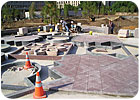
The First Lady Garden in Washington, DC, is among the company’s recently completed architectural projects.

Completed projects in the Northeast U.S. include the World War II Memorial in Washington, DC, which was done in conjunction with New England Stone, the 90 West Building in New York, which won a MIA Pinnacle Award, Foley Square Courthouse in New York, and the First Lady Garden in Washington, DC, which was recently completed.

Did you enjoy this article? Click here to subscribe to Stone World 

Column-picsmall

Michael Reis has been working for Stone World Magazine since 1993. In his role as Editor and Associate Publisher, he covers all aspects of the stone industry, from quarrying to fabrication to installation. He contributes feature articles as well as writes the Stone Column, which is a monthly commentary on industry issues and trends. Emailmichael@stoneworld.com

Recent Articles by Michael Reis

You must login or register in order to post a comment.

Multimedia

Videos

Image Galleries

Surfaces 2013 preview

Surfaces 2013 -- to be held in conjunction with StonExpo/Marmomacc Americas -- is slated for January 29 to 31 at the Mandalay Bay Convention Center in Las Vegas, NV. The show, which also includes an extensive educational program that will be held from January 28 to 31, provides a place for thousands of floor covering retailers, distributors, installers, architects, designers and builders from around the world to gather and view the latest products, get vital education, network with other floor covering professionals and conduct business.

More than 600 of the largest manufacturers and suppliers representing products in every major category, including carpet, tile, hardwood, rugs, laminate, resilient and stone, are expected to exhibit at the trade show. Hanley Wood, owner and operator of the exhibition, reports that they have many new exhibiting companies and returning ones who have expanded their booth size. Additionally, Surfaces 2013 will host more than 40 workshops, seminars and mini sessions led by industry experts in the fields of business, sales, marketing, installation and design. Attendees can earn AIA, NKBA, AIBD, IICRC and AIA/CES industry designation. Here is just a small sampling of some of the displays that will be present at Surfaces 2013.

THE MAGAZINE

Stone World Magazine

June 2013 Stone World cover

2013 June

Stone World's June issue highlights a series of stone companies and quarries such as PBA Stone, Mag Ban, Gramil and San Gabriel Black quarry. Also, check out some exclusive coverage from the annual Vitoria Stone Fair, which took place in Espírito Santo, Brazil.

Table Of Contents Subscribe

Contemporary Stone & Tile Design Magazine

CSTD Summer 2013 cover

2013 Summer

The Summer issue of Contemporary Stone & Tile Design highlights some of the top products from Coverings 2013, which took place in April. Also, read about the designing of a custom pool and spa by Rock Solid Tile.

Table Of Contents Subscribe

Green Practices

Are you promoting green practices and the life-cycle of stone in your sales and marketing efforts?
View Results Poll Archive

The Stone World Store

How_To_Polish_&_Restore_Mar.gif
How to Polish & Restore Marble Flooring

This video will show you step-by-step how to resurface and polish marble flooring from grinding and removing lippage and scratches to achieving a highly reflective polish.

More Products

Stone Guide

cover

The directory for Stone, Equipment and Supplies - the single information resource readers turn to.

Visit Stone Guide today!


Stone Industry Education

stone industry educationStone Industry Education is sponsored by Stone World Magazine and Marble Institute of America. The SIE events will help you: strengthen your skills, build your business, and  increase profit in your shop.  Check out stoneindustryeducation.com to register for upcoming fabricator and installer seminars.

STAY CONNECTED

facebook logo Twitter  YouTube