Taking sculpture to the next level
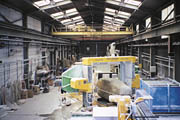
The stone division of Johnson Atelier is a systematic blend of artistry and state-of-the-art technology. On one side of the studio, computerized technology methodically cuts and shapes large blocks of stone. And just a few feet from this machinery, skilled carvers work stone pieces by hand, plying the craft of stoneworking in its most basic form.
The Johnson Atelier Technical Institute of Sculpture was founded in 1974 by J. Seward Johnson, Jr., a noted sculptor and relative of the Johnson & Johnson pharmaceutical family. Johnson's goal was "to provide emerging artists with an opportunity to work together with experienced art technicians to gain the knowledge they need to produce their own work."
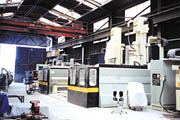
Today, Johnson Atelier operates the original equipment as well as two additional Omag CNC stoneworking centers and a computerized Omag lathe. The lathe can fabricate pieces as large as 10 feet long x 4 feet in diameter and has an option for a fixed table that allows it to work as a three-axis milling machine. For smaller columns, the company also operates a smaller version of the CNC three-axis lathe. "We [often] found ourselves doing things that were not monumental in size," Spath said.
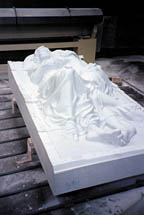
Spath explained that working on the machine requires an artistic background and knowledge of natural stone in addition to computer skills. "You still have to know stone and how it will react," he said.
Operating the equipment for stone is also complicated because much of the software designed for CNC operation was originally intended for metal fabrication, which does not rely on the use of a blade as stone fabrication does. "Also, there are things that you can do with metal that you cannot do with stone and vice versa," Spath said.
Today, much of the software in use at Johnson Atelier was provided by Scan Technology of Denmark, which custom designs many of the programs. Because most of the work begins with a laser scan - either of a model or of an historic piece that is being replicated - the software must coordinate with the scanners, the PCs and the machinery.
The studio operates three scanners, each of which has a different depth of field, and they also have a semi-portable machine for laser scanning objects outside of the studio. After scanning is completed, the data is fed into the PC, and the operator uses the Scan Tech software for a multitude of functions. Tasks include defining which milling tools and sizes are used; how much material should be left, since pieces must be roughed out; determining the parameters of processing the different layers; selecting the milling path and feed rates; and deciding which areas of the workpiece will be milled out.
The software will then show the tool pass and demonstrate how the tool will move. Ultimately, it produces numerical codes that control the machine movements and commands. The system is completely networked so that every computer has a direct feed to the PCs that control the machinery. The PC file is transferred and movement begins, with each command displayed at the machine's control panel. Approximately 75% of the studio's work requires some CNC fabrication.
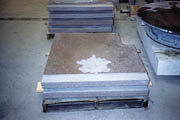
Johnson Atelier's project lineup is currently comprised of 75% public arts work and 25% restoration work. At the time of Stone World's visit to the facility, the studio was fabricating large boulders of granite from Cold Spring Granite Co. for a project at the FBI building in Minnesota. While one boulder was being split on the robot wire saw, another piece for the project was being further worked by an artisan. The project was designed by artist Jon Isherwood.
Meanwhile, the Omag CNC machinery was also hard at work in the studio. The four-axis machine was fabricating granite panels for a public arts project along the Brooklyn-Queens Expressway in New York. The project, which will include 400 square meters of panels in total, will feature relief carvings depicting the flora and fauna of the area. In addition to producing the relief designs, the machinery must also cut the panels with angled edges, as they will be used for a curved wall.
Also during Stone World's visit to the facility, the seven-axis Omag machine was in the process of roughing out the designs for an arts project in Kansas City, MO. This project, which is being completed in marble, features two life-sized figures carved from a single block of marble.
Recently completed restoration projects include the Tweed Courthouse in New York City. For this project, Johnson Atelier recreated 340 modillions from Georgia White marble, and their machinery allowed them to shape three pieces at a time. The three modillions were then cut apart by the wire saw and finished by hand.
The company has a total of eight full-time workers on staff, and there are currently 20 apprentices who spend time at the studio in addition to visiting sculptors and artists. As a non-profit organization, Johnson Atelier's stone division must reinvest the monetary gains from its work, so it is planning further investment in machinery in the near future.
Looking for a reprint of this article?
From high-res PDFs to custom plaques, order your copy today!