Restoration secures chapel at Ivy League campus
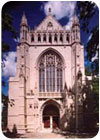
Due to decades of exposure to outdoor elements, the exterior of the Princeton University Chapel faced extensive deterioration, fracturing and loss of stonework, requiring an in-depth renovation and restoration designed by Farewell Mills Gatsch Architects, LLC, of Princeton, NJ. The project was completed in two separate year-long sections, with the second year focusing on the west facade pictured here. The successful completion of the project earned a 2004 Tucker Award from the Building Stone Institute.
The two-phased restoration of the exterior stonework at the Princeton University Chapel involved the replacement of some sandstone and limestone to match existing materials
Comprised of Pennsylvania sand-stone and Indiana limestone, the Princeton University Chapel, located in Princeton, NJ, was originally designed by the noted Gothic Revival architect Ralph Adams Cram during the mid-1920s. Decades of exposure to outdoor elements caused extensive deterioration, fracturing and loss of stonework at the chapel, and, as a result, the chapel underwent a two-phased renovation, which included a complete restoration and cleaning of all exterior stonework. The Masonry Preservation Group Inc. of Merchantville, NJ, was selected to execute the extensive restoration designed by Farewell Mills Gatsch Architects, LLC of Princeton, NJ. As a result of its outstanding restoration work, the project received a 2004 Tucker Award from the Building Stone Institute.
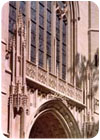
In addition to sandstone, Indiana limestone, carved by Old World Stone Ltd. of Toronto, Canada, was used as trim on the building, for more than 60 freestanding carved limestone pinnacles that line its facade, and for the chapel's sculptural door heads and borders.
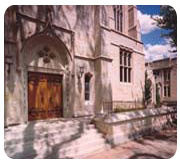
Pennsylvania sandstone was used to restore decorative trim, gothic pinnacles, some infills and to patch existing sandstone. Although the original sandstone used, known as “Roaring Run†sandstone, was no longer attainable, the architects found a similar material through Delaware Quarries Inc. of Lumberville, PA.
The exterior of the chapel is comprised of Pennsylvania sandstone in a random ashlar pattern. Although the original sandstone used, known as “Roaring Run†sandstone, was no longer attainable, the architects found a similar material through Delaware Quarries Inc. of Lumberville, PA. According to Farwell Mills Gatsch Architects, LLC, the stone was handpicked to match the range of colors found at the chapel and tooled on site to match the existing stonework. The material was used to restore decorative trim, gothic pinnacles, some infills and to patch existing sandstone.
In addition to sandstone, Indiana limestone, carved by Old World Stone Ltd. of Toronto, Canada, was used as trim on the building, for more than 60 freestanding carved limestone pinnacles that line its facade, and for the chapel's sculptural door heads and borders. The same material was used to replace damaged units that had been patched with Dutchmen or other materials with new decorative pieces, according to Frey. “The supplier got the stone from Indiana, carved it in Canada and shipped it to the jobsite,†she said. “Over the period of carving, the design team went to Canada to review the models and shop drawings to make sure they resembled the original pieces.â€
In cases where the original stone details could be improved rather than completely replaced, a number of protective steps were taken. Wash surfaces were added, the number of vulnerable joints created through creative design and carving were reduced, and the thickness of units where pins were prone to corrosion because of water infiltration were increased.
On site, stone craftsmen carved limestone Dutchmen to replace “losses in engaged stone which were decorative, vulnerable to water infiltration or in an overhanging location,†according to the architects.
Frey said that the project's demanding schedule posed minor challenges for the crew, as a stained glass restoration was occurring simultaneously at the chapel. “The stained glass is set in the limestone, so the removal and reinstallation of the stained glass pieces and the coordination with the stonemason were challenging,†said Frey.
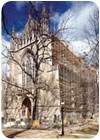
The chapel remained open during the entire two-year restoration, despite the elaborate scaffolding, intricate masonry work and the removal of 28 of the structures figural stained glass windows.
According to Project Manager/Vice President Jeff Frake of the Masonry Preservation Group, the limestone and ornamental limestone were severely eroded and soiled when they arrived on site. “It required in-situ carving and replacement,†he said. “The ashlar masonry was soiled and needed 100% repointing.â€
Frake said that an aggressive schedule, site logistics and the restoration and replication of existing stone posed problems for the 30 workers who were involved with the restoration.
“The project required an immediate start and the scaffolding had to be designed/engineered. MPG engineers and Princeton University engineers had to work long hours to achieve this,†he said, adding that the Chapel had to remain in operation for all events, including services, concerts and weddings. “Interior scaffolding and protections had to be designed and installed so that the public would not be affected in anyway in terms of access or view of the event. This was achieved by working closely with the client and understanding their needs.â€
Frake also said that the restoration and replication of existing stone involved intricate in-situ carvings of limestone ornamentation, which was achieved by master stone carvers. Additionally, various masonry cleaning techniques had to be tested in order to project intricately carved limestone trim while tenacious dark staining was removed from the sandstone ashlar.
Princeton University Chapel Restoration
Princeton, NJ
Architect: Farewell Mills Gatsch Architects, LLC, Princeton, NJ
Stone Installer: Masonry Preservation Group, Inc., Merchantville, NJ
Stone Suppliers: Delaware Quarries Inc., Lumberville, PA (sandstone); Old World Stone Ltd., Toronto, Canada (limestone)
Looking for a reprint of this article?
From high-res PDFs to custom plaques, order your copy today!