Replicating a stone icon with Texas limestone

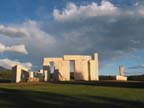
Three years ago, TexaStone Quarries in Garden City, TX, received a request like none other. An inquiry was received for the company to help recreate Stonehenge, a prehistoric monument on Salisbury Plain, north of Salisbury in southwestern England, which dates from the late Stone and early Bronze ages -- about 3000 to 1000 BC. Intrigued by the idea, TexaStone Quarries agreed to supply the tremendous amount of limestone needed for the project.
“In 2002, an individual walked through the doors of TexaStone Quarries and said that he wanted to build a replica of Stonehenge,†said Brenda Edwards, co-owner with her husband Connie of TexaStone Quarries. “He wanted to build it on his golf course at his private residence in Montana.â€
This person explained to Edwards that he and his brother had been standing on his golf course, and his brother said, “Wouldn't it be nice if Stonehenge was sitting out there?†As a result, the brothers made a bet to see if it could be built.
“The man said he had done his homework, and that TexaStone was one of a very few stone companies that could duplicate the many stones and large stones required to build the monument,†said Edwards. “Everyone at TexaStone Quarries became intrigued.â€
Modeling the original
The original Stonehenge is a series of structures that were rebuilt, revised and remodeled over a period of approximately 1,500 years, said Edwards. Construction of Stonehenge in Salisbury is thought to have consisted of three phases.The first phase consists of a circular ditch 360 feet in diameter and 1.5 meters deep. In a second phase, lasting from 2900 to 2500 BC, timber posts were erected in the flat ground at the center of the encircling ditch. Posts were also raised at a break in the ditch to the northeast, a place that served as an entrance to the site. During a third phase of building, which lasted from about 2550 to 1600 BC, about 80 pillars of stone were erected near the center of the site in two concentric circles. The double circle was soon dismantled, and great blocks were erected with 30 pillars with a diameter of about 108 feet. This structure is now known as the Sarsen Circle. Each pillar stood approximately 13 feet above the ground. Mounted atop the 30 pillars was a continuous ring of crosspieces or lintels. Today, 17 of the original 30 pillars remain standing, as well as six of the lintels.
Within the Sarsen Circle, a massive horseshoe-shaped structure was constructed of five pairs of gigantic upright blocks, each block weighing 40 metric tons or 88,200 pounds. A lintel on top of each pair makes each into a great archway called a trilithon. Three of the five original trilithons remain standing and measure 24 feet above the ground. Several other features include the Altar Stone, four station stones, the Slaughter Stone and the Heel Stone.
Quarrying the stone
For the replica, all of the stone was quarried from TexaStone Quarries' North Cream pit.“The homeowner did all of the research, and gave us the exact sizes of the blocks, length, width, etc.,†said Edwards, adding that working with the size of the blocks created somewhat of a challenge. “One of these blocks was 23 feet long and weighed 92,000 pounds. We have large machinery, but we thought we would have to rent a crane to get the block above ground. But, we put weights on the back of our forklifts, and it worked.â€
To put the scale of the project into perspective, on average, blocks quarried by TexaStone Quarries measure 8 feet, 6 inches x 4 feet, 6 inches x 5 feet, and weigh 32,000 pounds, according to Edwards. “Our part of the project took six months,†she said. “Some of the smaller blocks were already on top of the ground, but we had to special cut and quarry the larger ones. Using big cranes, forklifts and block haulers, the stones were removed from the ground and placed on the trucks. Trucking permits for oversized loads were obtained in order to transport the 45 truck loads of stone to Montana. Six months later, a life-sized replica was standing on a golf course in Montana.â€
Sidebar: Also appearing in Texas
In 2002, TexaStone Quarries once again received a request to supply enough material to build a replica of Stonehenge. This time it was to be resurrected on the campus of the University of Texas of the Permain Basin (UTPB).“Two men in Odessa, TX, wanted to do something big and artsy, so they decided to build Stonehenge on the campus of UTPB,â€said Brenda Edwards of TexaStone Quarries. “They took their idea to the Board of Regents of the University of Texas, and approval was given to begin the project.â€
According to Edwards, the second time around was “a piece of cake.†“When the man from Texas approached us, I just said, 'Here we go again,'†she said. “There were no surprises. Of course, it was only an 85% replica. This one took about 1 1â„2 months, because the blocks were smaller and most were already on top of the ground.
“The enthusiasm of the two men grew through the community, and people came forth and wanted to dedicate their time and energy,†Edwards continued. “Geologists, historians, heavy equipment operators, architects and astronomers all got behind the effort.â€
A total of 40 truckloads of stone were hauled from the quarry to the art building on the UTPB campus. “The replica is 85% of the size of the one on the Salisbury Plain in England, but it certainly serves its purpose in West Texas,†said Edwards.
Looking for a reprint of this article?
From high-res PDFs to custom plaques, order your copy today!