Renovation relies on new and reclaimed stone
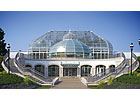
The Phipps Conservatory and Botanical Gardens in Pittsburgh, PA, recently renovated its Welcome Center and Tropical Forest Conservatory, both of which were designed by local architect, IKM, Inc. The first phase of the project included a new Welcome Center at Phipps historical ‘front door’ in Schenley Park, and involved major additions to its historic 1893 glass house, including limestone features such as the trim and archways.
The Phipps Conservatory and Botanical Gardens in Pittsburgh, PA, recently renovated its Welcome Center and Tropical Forest Conservatory, both of which were designed by local architect, IKM, Inc. The first phase of the project included a new Welcome Center at Phipps historical “front door” in Schenley Park, and involved major additions to its historic 1893 glass house, including limestone features. The Tropical Forest Conservatory, which features a rotating exhibit schedule where every two years a different tropical environment will be on display, opened featuring a “Thailand theme.” Reused sandstone was saved from the original building and implemented into the new structure for interior walls.
About 15 years ago, the Phipps Conservatory was owned and operated by the City of Pittsburgh, which also owned the National Aviary and the Pittsburgh Zoo. When the City needed to cut operating expenses, three different independent non-profits took over each of the three institutions and began raising money to put into the architecture of the buildings, according to Joel Bernard, AIA, Principal-in-Charge of Pittsburgh-based IKM, Inc.
About 15 years ago, the Phipps Conservatory was owned and operated by the City of Pittsburgh, which also owned the National Aviary and the Pittsburgh Zoo. When the City needed to cut operating expenses, three different independent non-profits took over each of the three institutions and began raising money to put into the architecture of the buildings, according to Joel Bernard, AIA, Principal-in-Charge of Pittsburgh-based IKM, Inc.

While the original building featured sandstone accents, the architects selected a darker, more cost-effective limestone for the new building. “It’s not a perfect match to the existing building, but fairly close,” said Joel Bernard, AIA, Principal-in-Charge of Pittsburgh-based IKM, Inc.
Welcome Center
Ultimately, the Phipps organization decided that it needed more support for the existing conservatory. “The original glass house building was constructed in 1893,” said Bernard. “In the 1960s, a small plain ‘state-park-style’ building was put up in front of the glass house, and this is where tickets and refreshments were sold.” The architect went on to say that over the years, Phipps continued to raise money in hopes for a real gift shop and café. “The idea with this new renovation was to tear down the 1960s building, and to build something new and more exciting.”
According to Bernard, the existing conservatory building includes 3- to 4-foot-high sandstone walls. “The sandstone features a rough-face finish, and the top course was beveled all the way around the building,” he said. “The new 10,000-square-foot Welcome Center was going to feature sandstone to match, but pricing would have been quite high. We found a more cost-effective, darker limestone and used it for the front of the building. It’s not a perfect match to the existing building, but fairly close.” The limestone they ultimately selected was Indiana Oolitic supplied through Franco Masonry of Pittsburgh, PA, which also installed the stone.
The architect continued to explain that Phipps plans to clean the existing sandstone, so that there will be a little more cohesiveness between the two materials.
“The limestone walls feature 4-inch-thick limestone with a cavity and rigid installation behind it,” said Bernard, adding that Franco Masonry did a beautiful job with the stone installation. “The limestone will always look yellow and the sandstone more orange, but it’s a fairly close match.”
Additionally, a new interior curved staircase - built of honed French Blue limestone, was also implemented into the Welcome Center, and Franco Masonry supplied this material as well.
According to Bernard, the existing conservatory building includes 3- to 4-foot-high sandstone walls. “The sandstone features a rough-face finish, and the top course was beveled all the way around the building,” he said. “The new 10,000-square-foot Welcome Center was going to feature sandstone to match, but pricing would have been quite high. We found a more cost-effective, darker limestone and used it for the front of the building. It’s not a perfect match to the existing building, but fairly close.” The limestone they ultimately selected was Indiana Oolitic supplied through Franco Masonry of Pittsburgh, PA, which also installed the stone.
The architect continued to explain that Phipps plans to clean the existing sandstone, so that there will be a little more cohesiveness between the two materials.
“The limestone walls feature 4-inch-thick limestone with a cavity and rigid installation behind it,” said Bernard, adding that Franco Masonry did a beautiful job with the stone installation. “The limestone will always look yellow and the sandstone more orange, but it’s a fairly close match.”
Additionally, a new interior curved staircase - built of honed French Blue limestone, was also implemented into the Welcome Center, and Franco Masonry supplied this material as well.

The limestone employed for the Welcome Center is Indiana Oolitic supplied through Franco Masonry of Pittsburgh, PA, which also installed the stone.
Tropical Forest Conservatory
The original Tropical Forest Conservatory featured stone in the back of the building with some production greenhouses made of glass. “It was a 1930s idea, being that they would grow the plants in the back greenhouses, and then bring them in to the display houses for show,” explained Bernard. “The problem was that the greenhouses were leaky and wouldn’t heat correctly; therefore the plants wouldn’t grow.” It was then decided to tear the building down and rebuild a new 40,000-square-foot production facility and a new 12,000-square-foot display house structure, which currently exhibits a “Thailand theme.”
Bernard said that the original buildings used a great deal of sandstone for walls and foundation parts, which the contractor left on site and stockpiled for use in the new building. “Franco Masonry took the stone and split it open to expose the interior faces and then used it for interior walls,” he said, adding that the material was used with a bullnose edge for the wall caps. “[The sandstone] really has such a beautiful effect on the interior walls, and we used quite a bit of it. The beaded grout joint mimics the same joints used on the original conservatory building, which you can see out front. We duplicated that look.”
“We have been really pleased,” said the architect, adding that everyone loves the new facility. “The Welcome Center earned a LEED Silver Certification from the U.S. Green Building Council. Tropical Forest has too much glass on it to submit it for LEED, but it still won a Pittsburgh AIA Chapter award for green building design because of all of the innovative techniques, the reused sandstone and recycling of onsite materials. The building is stunning, and is now a major landmark in Schenley Park.”
Bernard said that the original buildings used a great deal of sandstone for walls and foundation parts, which the contractor left on site and stockpiled for use in the new building. “Franco Masonry took the stone and split it open to expose the interior faces and then used it for interior walls,” he said, adding that the material was used with a bullnose edge for the wall caps. “[The sandstone] really has such a beautiful effect on the interior walls, and we used quite a bit of it. The beaded grout joint mimics the same joints used on the original conservatory building, which you can see out front. We duplicated that look.”
“We have been really pleased,” said the architect, adding that everyone loves the new facility. “The Welcome Center earned a LEED Silver Certification from the U.S. Green Building Council. Tropical Forest has too much glass on it to submit it for LEED, but it still won a Pittsburgh AIA Chapter award for green building design because of all of the innovative techniques, the reused sandstone and recycling of onsite materials. The building is stunning, and is now a major landmark in Schenley Park.”
Looking for a reprint of this article?
From high-res PDFs to custom plaques, order your copy today!