Reconstructing Gothic architecture in granite
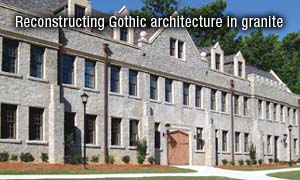
Built in 1942, the structure once known as Faith Hall on the campus of Oglethorpe University in Atlanta, GA, was never consistent with the Gothic architectural style prevalent in the school's other buildings. As a result, the granite structure was almost completely reconstructed years later, and renamed J. Mack Robinson Hall after its latest benefactor.
"Basically, what we had was a two-story structure, with a flat wood framed roof supported by 2-foot-thick solid granite exterior walls," said Bob Sussenbach, principal of CGLS Architects in Atlanta, who worked on the renovation. "We were asked to study the building and consider ideas to renovate it to house the school's growing arts department, and to redesign the building's exterior to better complement the Gothic architecture of the original 1942 campus buildings."
Overall, the campus has a distinctive Gothic Revival style, which was inspired by the honorary alma mater of founder James Oglethorpe's Corpus Christi College in Oxford, England. "The only thing that the building had in common with the original campus architecture was that it used a similar granite stonework on its exterior walls," said Sussenbach. "Everything else on the building reflected an odd mix of non-standard materials and styles. We came up with a concept and drawing, and presented it to the school officials. They were quite surprised that the building could be improved in such a way. Essentially, what we did was take off the entire roof and all existing windows, and built it back from there."
The cost for the conversion of the 12,000-square-foot building into a facility for Oglethorpe's arts and communications departments totaled approximately $2 million. "Once the conceptual design drawings were completed, the school held a fundraising campaign, which lasted about a year," said the architect. "From there it took about 11/2 years to complete."
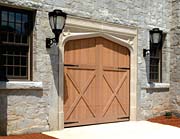
Sussenbach explained that the original buildings on campus were comprised of granite, with limestone trim and embellishments, copper gutters and flashings, and slate roofs. "We took inspiration from the architectural character of the existing buildings, and tried to incorporate that character in such a way that, when completed, J. Mack Robinson Hall would look as though it had always been there alongside the original campus buildings," he said. The architect further explained that the structure of the building itself needed work. "The floors were not level, and the existing stone walls were not plum or square," said Sussenbach.
Additionally, the existing granite was in poor condition. "The contractor cleaned the granite, but found significant areas where tar and stains from green paint had been applied to the stonework during earlier renovations, and could not be easily addressed," said the architect. "Some areas were in severe need of pointing or complete stone replacement."
Because of the complex nature of the work, it was crucial to hire skilled craftsmen for the job. "The general contractor was able to find masons that were familiar with this particular type of stonework," said Sussenbach. "They were able to achieve a very close match." According to the architect, the walls are entirely made from granite and slate was used for the roof, but pre-cast concrete was used instead of limestone for the cornices and accent banding around the building due to budget constraints.
"The most complicated component was the roof - as far as the stonework," said Sussenbach. "[It was difficult] just dealing with the imperfections, and since the walls would remain the exterior load bearing skin of the 'new' structure, it was important that the existing stone walls provide the structural integrity and weather tightness necessary."
Because of the intricate detailing, such as the Gothic pitch roof, there was a close collaboration between CGLS Architects and Juneau Construction Co., the general contractor for the project. "We worked closely together with Juneau's project team, because what you draw on paper is not always feasible due to the actual in-field conditions encountered," said the architect.
Overcoming obstacles
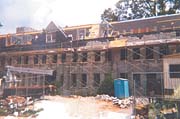
J. Mack Robinson Hall was constructed on a sloping site, and as a result, only 4,500 square feet of the main floor of the building's original footprint was useable space. The rest of the area was a basement with 20-foot ceilings stretching to the roofline. While the main floor was used for classrooms and offices, the lower level was used for storage. To create more useable space, CGLS designed an intermediate elevated slab, adding 3,200 square feet of floor space to the main level for more classrooms and offices as well as creating studio space in the new lower level.Redesigning the roofline also caused some considerable challenges for the architect, because the building was not square. Structurally, the deteriorated timber roof framing system was replaced with a structural steel and a light gauge metal truss system. To achieve the Gothic architectural look, the design added ornate granite parapets, gables, dormers and cast stone accents. Additionally, integral copper gutters and downspouts were hidden behind stone parapets, and authentic copper flashing and details kept the design consistent with the university's Gothic architecture, while providing a modern, high-quality roof.
"The roofing design for this building was extremely complicated," said Les Juneau, president of Juneau Construction Co. "We faced many hurdles, working with the original walls and slab. The [new] slate roof had to match the existing slate roof. It was pretty intense roof detailing - lots of changing in slopes and pitches. With the roofing materials being slate, there was no margin
for error."
According to Don Harris of Absolute Roofing in Lithia Springs, GA, a blend of three slates were implemented in the roof design. The colors, which were all supplied by Southern Roof Center of Atlanta, included a Welch purple, Vermont Evergreen and a gray slate quarried in Virginia. Absolute Roofing installed all of the slate as well as the 22-gauge copper internal gutters. The most difficult aspect of the installation was coordinating with the other trades on the job, said Harris. In total, it took about three to four months to install the slate and copper flashings.
A working tradition
According to Juneau, one of the subcontractors for the job, Clack Granite & Fieldstone of Conyers, GA, has a long history with the campus. "The Clack family did some of the older buildings out there," he said. "This project required us to assemble the best team possible to construct and incorporate all the roofing components that were required." Additionally, it was helpful that Juneau Construction and CGLS had previously worked together on several other projects. "We're good partners," said Juneau.Another challenge faced during the renovation was maintaining the dimensions because of vertical expansion, and maintaining new against old construction, according to Juneau. "The difficulty for us was [working on] a stone building with existing window openings remaining as we expanded vertically," he said. "We were working with materials with hardly any room for error."
As for the granite, Juneau agreed with Sussenbach's diagnosis. To clean the material, the contractors had to sandblast the corrosive material off. "It was difficult because it was attached to the building," he said. "It was touchy because you can't take the finish of the block, and you don't want the mortar blown out."
The original granite was quarried in the Elberton, GA, area, so finding replacement pieces was fairly easy, according to the general contractor, adding that Clack Granite & Fieldstone supplied the new granite pieces. Searching for a matching mortar was more of a challenge. "Back in the day, they had obviously hand mixed the grout with river sand, so matching the mortar was almost impossible," said Juneau. "We did manage to do it well, but it took a lot of experimenting."
In total, it took about six months for the stonework to be completed. There were between 60 and 70 workers, including subcontractors, on the job site, along with 12 stonemasons.
End box
J. Mack Robinson HallOglethorpe University
Atlanta, GA
Restoration Architect: CGLS Architects, Atlanta, GA
General Contractor: Juneau Construction Co., Atlanta, GA
Stone Suppliers: Clack Granite & Fieldstone, Conyers, GA (granite); Southern Roof Center, Atlanta, GA (slate)
Stone Installers: Clack Granite & Fieldstone, Conyers, GA (granite); Absolute Roofing, Lithia Springs, GA (slate)
Looking for a reprint of this article?
From high-res PDFs to custom plaques, order your copy today!