Stone World logo
search
cart
facebook twitter linkedin youtube
  • Sign In
  • Create Account
  • Sign Out
  • My Account
Stone World logo
  • NEWS
  • PRODUCTS
    • Machinery
    • Digital Technology
    • Tooling & Accessories
  • MATERIALS
    • Alternative Surfaces
    • Stone
    • Tile
    • Imports & Exports Data
  • FABRICATORS
    • Fabricator How-to
    • Fabricator Case Studies
    • Fabricator of the Year
  • A&D
    • Installation & Technical Tips
    • Outdoor Design
    • Interior Design
    • Hospitality | Commercial Design
    • Mosaics & Decorative Tile
    • Kitchen & Bath
    • Residential
    • Renovation | Restoration
  • MEDIA
    • Videos
    • Podcasts
    • EBOOK
  • EVENTS
    • STONE INDUSTRY EDUCATION
    • Industry Calendar
  • MORE
    • NEWSLETTERS
    • WOMEN SPOTLIGHT
    • MARKET RESEARCH
    • STONE WORLD STORE
  • DIRECTORY
    • TRADE ASSOCIATIONS
    • Stone Suppliers
    • GET LISTED
  • EMAG
    • eMagazines
    • Archives
    • Contact
    • Advertise
  • SIGN UP!

Re-emerging U.S. Stone Industry: Celebrating 25 years of stone production

By Michael Reis
January 1, 2007
Champlain Stone, Ltd. was founded in 1982 with a leased site for South Bay quartzite near Lake Champlain in Upstate New York. That quarry remains active on a large scale today.


When Michael Morey established Champlain Stone, Ltd. in Upstate New York in January of 1982, the company was essentially a one-man operation, as Morey would extract stone by hand and haul it to the marketplace for sale. Today, the company employs over 175 people and supplies six distinct varieties of stone to markets throughout the U.S. and abroad.

“I started in hotel and restaurant management, and I had an offer to sell stone,” Morey explained. “I researched the stone industry and visited the Building Stone Institute, which was in New York at the time. I took the principles of hospitality to the stone business, because in the end, you’re still in the people business.”

Large splitting rigs from Caterpillar, John Deere and Volvo are used to split large blocks as needed.

Company history and growth

The original operation was financed by Morey’s brother, Mark, who loaned him $5 a day, a vehicle and some basic tools. Also during the first year, Larry Ritchie purchased a 50% interest in the business and became Morey’s longtime friend and mentor.

Initially, the company leased a quarry for South Bay quartzite® near Lake Champlain, which was used for the company’s first major project, the Stratton Mountain Ski Center in Vermont. South Bay quartzite is characterized by a warm tan color, with accents of white, blue, amber and brown.
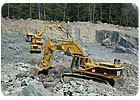
At the Fort Ann quarry site, all four varieties of granite are quarried - Summit, Van Tassell, Corinthian and American.
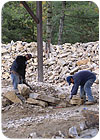
A year later, the company continued to grow and opened a second quarry in Putnam, NY.- Morey’s future wife, Barbara, became instrumental in the company and managed the Putnam operations, where Ticonderoga granite® was extracted by hand from the site’s shallow stone ledges. For years, she headed up the accounting department, which earned industry recognition for its billing and collection efficiencies. Barbara Morey remains as the company’s vice president, but now focuses much of her time raising their children. Several of her long-time employees, however, continue her collection methods within the accounting department. By 1986, the company opened a quarry for Corinthian granite®- which has tones of blue, green, black, pink, brown, burgundy and white - and it added another site for the same material a year later. Mark Morey joined the company on a full-time basis, and Ritchie sold his interest in the company back to the Morey family. Expansion at the time included a line of granite flagging as well as investments in heavy equipment such as forklifts, loaders and excavators.


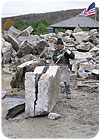
Hand splitting of stone is done in the timeless, but labor-intensive, method of using a hammer and chisel.

Ultimately, Morey began looking to the future of hand-cut stone in the marketplace, visiting dealers to determine their needs in this sector. Noting their requests for roughly squared and rectangular patterns, along with ashlar material, Champlain Stone’s line expanded to include these products.

In 1990, the company introduced Great Meadow limestone®, meeting the demand for stone that provides an aged look for restoration, as well as a “fresh-split” look for new construction. A year later, it opened a quarry for American graniteTM, a brown material which also features an aged appearance as well as a fresh hand-split look.
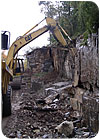
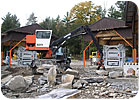
Among the different extraction methods, excavators from Caterpillar pull and dig the large pieces of stone from the ledge.

The company headquarters moved to Warrensburg, NY, in 1995, and three years later, Champlain Stone moved to an historic 19th century home, which was extensively renovated with the company’s stone products.

Today, the company produces four varieties of granite: American, Corinthian, Van Tassell® and Summit™, along with South Bay quartzite and Great Meadow limestone. Van Tassell, a granite with tones of buff, pink, blue/green and brown, was introduced in 2002, while Summit, a dense, dark blue-gray granite, featuring highlights of sage green, white and russet orange, was introduced in 2003.

Champlain Stone also recently expanded the Fort Ann location to include a facility for producing custom sawn and thin veneer products. This plant is run by Michael Morey’s son, Christian, who joined the company full time in 2003.
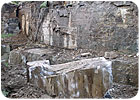
Champlain Stone’s products are sold through an extensive distributor network across the U.S. When supplying stone for architectural projects, the company generally works with architects in conjunction with the dealers. “We support the dealer base whenever possible,” explained Jane Bennett, a member of the corporate media relations department for Champlain Stone. This department also acts as an in-house advertising and graphics company for promotion, including a great deal of marketing to the architectural community. “We promote to architects a lot,” Morey said. “The architects fuel the industry. If you promote to them and learn their vision, they will work with stone.”

Workers use drills, feathers and wedges to split stone blocks.

Quarrying and splitting

During the quarrying process, stone is extracted from the topmost layers of the site by setting charges. Holes are drilled in the ledge, where explosive charges are placed and detonated. This way, stone is “bumped” away from the natural ledge rather than blown into small pieces. “We don’t blast often; only a few times a year,” Morey said, adding that the blasting is done by a subcontractor so they don’t have to keep explosives on the site.
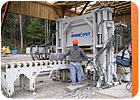
Hydraulic splitters - also referred to as “guillotines” - are also a key component of the process. The stone is loaded onto the conveyor by machine, and it is positioned by hand.
Excavators from Caterpillar also pull and dig the large pieces of stone from the ledge, and many of the excavators are equipped with “thumbs” that allow them to pull stone from the quarry face. Large excavators equipped with hydraulic hammers from Caterpillar, John Deere and Volvo are also used to split large blocks as needed. These larger blocks are then loaded into haulers and moved to the drilling area for further processing.

Splitting equipment includes Hydrasplit splitters from Park Industries as well as splitters from Cee Jay Tool Co. Any further trimming takes place by hand, and the stone is then placed in containers to be taken to the packaging area.
Drilling is a labor-intensive process where large blocks of stone are drilled into thick slabs. Holes are drilled 4 inches into the stone at various distances apart, depending on the length of the block. Then feathers and wedges are used to separate the stone, and a pry bar is used to finish removing the slab from the block.

In January of 2005, Champlain Stone built a new plant at the Fort Ann quarry location for sawn products, including thin veneer as well as architectural work.
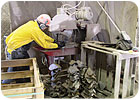
Hydraulic splitters - also referred to as “guillotines” - are also a key component of the process. These are used to break stone pieces into finished products such as ashlar or roughly squared/roughly rectangular veneer stone. The stone is loaded onto the conveyor by machine, and it is positioned by hand to be split using Hydrasplit splitters from Park Industries as well as splitters from Cee Jay Tool Co. Any further trimming takes place by hand, and the stone is then placed in containers to be taken to the packaging area.

The company currently offers thin veneer in its American, Corinthian and Van Tassell granites as well as South Bay quartzite. Due to the skill required to produce corners, some of the workers in the plant specialize in this work.

Material taken from the guillotines that do not meet the ashlar or roughly squared/roughly rectangular specifications are passed on to the splitting bays to be trimmed by hand to meet other specifications.

The hand splitting of stone is done in the timeless, but labor-intensive, method of using a hammer and chisel. A sprinkler system is in place at the splitting bays to keep fugitive dust levels down and provide a cooler environment for the workers. Once material is split to specifications, it is loaded into containers and moved to the packaging area. Products that are split by hand include “mosaic” (irregularly shaped) veneer, flagging and wall stone.
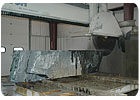
In addition to a series of smaller saws, the plant features a large-scale Predator saw from Park Industries, which can be equipped with blades up to 60 inches in diameter.
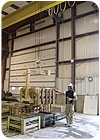
Finished materials are transported from the splitting area to covered bays for sorting and packaging onto pallets, and then weighed, labeled and placed in rows to be shipped to dealers or directly to the jobsite. Due to the volume of work being produced, the shipping area must be extremely well organized, and bar codes are in place on the pallets to record the product, weight, date of packaging, and any special order information. This information is scanned into the inventory system in “real time,” so the company’s salespeople know the exact status of every order. As a backup to the bar code system, which has been in place for about a year, the palettes are still marked by hand with pertinent information.

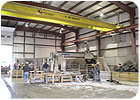
The plant also has a 10-ton Zinter overhead crane, which can maneuver pallets of stone around the space.

Within the quarry sites, the areas for stone extraction can be quite extensive. At the Fort Ann quarry site, where all four varieties of granite are quarried (Summit, Van Tassell, Corinthian and American), extraction sites are connected by a network of roads that were created with the quarry byproducts.

Moreover, the Fort Ann quarry site rises in elevation by 400 feet from the road. “When you consider that the benches of stone are 30 feet high, and you divide 400 by 30, that’s a lot of benches,” Morey said.
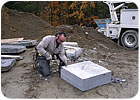
The company also processes stone for architectural projects. Here, Mac Morey processes edgework for a project at Fordham University in New York. After the edge is chipped by hand, it is thermal finished to achieve the desired look.
The quarries operate from March 1 to late December, and a smaller crew remains over the winter to do maintenance work on the equipment, among other tasks such as running the guillotines. Many of the workers are immigrants from Mexico, who live in New York during the quarrying season and return home when the quarries are closed. These workers come to the U.S. with H2B and H2R work visas sponsored by Champlain Stone, and they live in company housing.

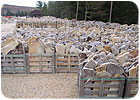
A vast inventory of flagstone products is maintained by the company.
Although Champlain Stone has steadily expanded its quarry operations over the years, it remains cautious in its expansion. “We turn down a lot of [offers to buy] quarries,” Morey said. “We don’t want to introduce a material to the market unless there is a 50- to 100-year supply. Some of our stones have a 500- or 1,000-year supply. It takes three to four years to open a new quarry, so you’re only as good as your prospecting.”

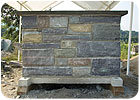
Building stone products include a range of wall veneer materials.

In terms of safety, the company has an in-depth employee safety program in place, and it also works with government agencies to ensure it meets all standards. “We try to be proactive and work with MSHA to get their specifications and share this information with the machinery manufacturers,” Morey said.

The company also strives to be environmentally conscious. “We want to work in harmony with the mountains,” Morey said, adding that the quarry sites are well camouflaged from any nearby roadways. “We’re our own best neighbor.”
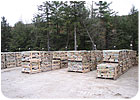
Due to the volume of work being produced, the shipping area must be extremely well organized, and bar codes are in place on the pallets to record the product, weight, date of packaging, and any special order information.

Custom sawing

In January of 2005, Champlain Stone built a new plant at the Fort Ann quarry location for sawn products, including thin veneer as well as architectural work. The company currently offers thin veneer in its American, Corinthian and Van Tassell granites as well as South Bay quartzite. These veneer products weigh 15 pounds or less per square foot, and they do not require a bearing shelf. Products include thin sawn “flats,” which are sold by the square foot, as well as thin sawn corner pieces, which are sold by the lineal foot. Due to the skill required to produce these pieces, some of the workers in the plant specialize in corner work. Additionally, hand select thin veneer is a split product, offering two usable faces.
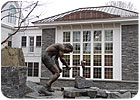
Champlain Stone’s headquarters is located in an historic 19th century building in Warrensburg, NY, which is being extensively renovated with the company’s stone products.

Architectural production includes items such as lintels, sills, mantels, hearths, thresholds, stair treads and other architectural pieces. Finishes include honed, thermal, polished or sandblasted.

In addition to a series of smaller saws, the plant features a large-scale Predator saw from Park Industries, which can be equipped with blades up to 60 inches in diameter. It also has a 10-ton Zinter overhead crane, which can maneuver pallets of stone around the space.
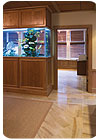
The inside of the office has also been expanded and renovated in a “Key West” theme, using rich woodwork as well as South Bay quartzite flooring.

The new plant is just the latest chapter in 25 years of advancement for Champlain Stone, which is continually reinvesting in itself. “This can be a strange market, with soft spots in the economy,” Morey said. “But if we keep diversified, we can keep ahead of that. One key for us is to always have fun in the business. At the same time, we want to be the best we can possibly be. I’ve always considered us to be a small local company. Obviously, we’re not a small company anymore, but we want to have that mentality. We also put a lot of our resources into further developing the company.”

Share This Story

Looking for a reprint of this article?
From high-res PDFs to custom plaques, order your copy today!

Recommended Content

JOIN TODAY
to unlock your recommendations.

Already have an account? Sign In

  • customer doing research online

    3 Reasons Why Quick Response Time Results in a Successful Fabrication Shop

    Your fabrication shop can have the best website. The best...
    Fabricator How-to
    By: Anthony Milia
  • Silica

    Renewed National Attention Ignites Over Silicosis Epidemic

    A major investigative report published on March 12, 2026...
    Industry Insights
    By: Jason Kamery
  • shipping containers

    U.S. Countertop Material Imports: February 2026

    U.S. countertop material imports collapsed in February...
    Stone
    By: Jason Kamery
Manage My Account
  • eMagazine
  • Newsletters
  • Online Registration
  • Manage My Preferences
  • Subscription Customer Service

More Videos

Popular Stories

cal osha

Cal/OSHA Standards Board to Vote May 21 on Engineered Stone Ban Petition

shipping containers

U.S. Countertop Materials Imports: March 2026

kitchen

Building a Reputation on Strong Craftsmanship and Customer Service

Fabricator Focus

From profiles to roundtable discussions, Q&As to best business practices, we're turning a focus on topics and challenges impacting fabricators.

AI Talk Is Everywhere -- Where Does a Countertop Fabricator Begin?

Fabricators Discuss Pros and Cons of Chip Repair

How to Grow a Countertop Fabrication Shop

Events

June 25, 2026

North Carolina Stone Summit

You’ve probably heard a lot lately about how to calculate the profit for each job you produce. You likely have production benchmarks based on square footage since it’s the most common production metric in the industry. Come learn how focusing on these metrics can hurt your profitability and what to do about it.

July 16, 2026

Washington Stone Summit

Join us for "Taking Your Organization to the Next Level," a session dedicated to transforming your business practices. Discover strategies for setting clear agendas, encouraging participation, and driving actionable outcomes. Learn how to foster collaboration and communication, ensuring that every meeting enhances productivity and contributes to your business goals.

View All Submit An Event

Poll

Tariffs and Quartz Imports

If high tariffs are placed on U.S. quartz imports, how will this affect your business?
View Results Poll Archive

Products

Restoration & Maintenance Technical Module

Restoration & Maintenance Technical Module

See More Products
	
3 Reasons Why Quick Response Time Results in a Successful Fabrication Shop

Related Articles

  • Re-Emerging U.S. Stone Industry: Pennsylvania stone producer continues to expand

    See More
  • RE-EMERGING U.S. STONE INDUSTRY

    See More
  • Re-emerging U.S. Stone Industry: Taking the plunges into CNC technology

    See More
×

Our Newsletters are a rock solid source of industry insights!

Stay in the know on the international stone and tile industry trends.

JOIN TODAY!
  • RESOURCES
    • Advertise
    • Contact Us
    • Directories
    • Store
    • Want More
  • SIGN UP TODAY
    • Create Account
    • eMagazine
    • Newsletter
    • Customer Service
    • Manage Preferences
  • SERVICES
    • Marketing Services
    • Reprints
    • Market Research
    • List Rental
    • Survey/Respondent Access
  • STAY CONNECTED
    • LinkedIn
    • Facebook
    • YouTube
    • X (Twitter)
  • PRIVACY
    • PRIVACY POLICY
    • TERMS & CONDITIONS
    • DO NOT SELL MY PERSONAL INFORMATION
    • PRIVACY REQUEST
    • ACCESSIBILITY

Copyright ©2026. All Rights Reserved BNP Media, Inc. and BNP Media II, LLC.

Design, CMS, Hosting & Web Development :: ePublishing