International collaboration results in colossal stone structure

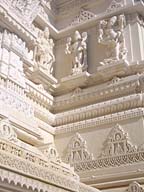
Building the massive limestone and marble mandir for the Bochasanwasi Shree Akshar Purushottam Swaminarayan Sanstha organization (BAPS) was a labor of love, involving more than 40,000 stone pieces, 3,000 craftsmen and countless volunteers. The Hindu temple, located just outside of Chicago, in the suburb of Bartlett, IL, is the largest of its kind to be constructed in the U.S., and sits on 30 acres of land. It was entirely created according to ancient Hindu Shilpashastras -- an Indian architectural science that does not require the use of steel reinforcement. Considering the scope of the project, the mandir was completed relatively quickly. A dedicated team worked around the clock to construct the structure within a 16-month time frame.
“This project was more than just a building,†said Rohit Patel, construction manager. “I am from India, and I knew some key people in the BAPS organization who told me that they were planning to build this massive structure, and asked if I would like to help. I had similar experience building temples. I was honored that they chose me to do this. For all of us, this was a little beyond construction and engineering.â€
Once Patel committed to the project, he received several preliminary drawings from India. “It would be a complete limestone and marble structure, with wood used for the doors,†he said. “There is no structural steel or no nails -- steel can create corrosion. The logic behind the stone structure is that you can build it, and it lasts for 500 to 1,000 years.â€
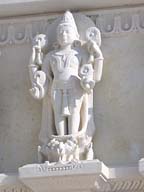
After receiving the plans, Patel then started to recruit design firms. “We worked with the county,†said the construction manager. “This was all new for them. This was a massive project. They went to a special structural committee. We finally got a building permit. [Next], we started to secure stone. The carving process had already started back home in India, where BAPS has a special division. There was in excess of 3,000 carvers. They were such minute carvings. The 40,000 pieces were hand carved in a record time of just under two years.â€
Finding an appropriate stone
The exterior of the approximate 22,000-square-foot mandir consists solely of Turkish limestone, while Carrara marble was used for interior elements such as pillars, ceilings and arches. Additionally, Bansipahadpur (Rajasthan) slabs, a milky white marble from Makrana, were employed inside for applications such as floors. Onur Mermer Tic. San. A.S. of Finike / Antalya, Turkey, supplied the Turkish limestone, while Campolonghi Group of Massa, Italy, and La Facciata Srl of Carrara, Italy, supplied the Carrara marble.“A total of four individuals from our team went to Turkey for the selection of the Turkish stone,†said Patel, explaining that he traveled with Sanjay Parikh, his counterpart in India; Bharat Patel from the U.S.; and Vinubhai Bhattessa and Sagoon Patel from London. “We did an extensive search of what stone we wanted to use. We were looking for a stone that had the least water absorption ratio. In Chicago, snow falls, and water can create ice crystals. We were thinking that we are working on a special project, so let's try for excellence.â€
The design team's search led them to the Finikie region of Turkey. “We took that limestone and ran up to 300 freeze/thaw cycles,†said the construction manager. “We also made sure that the grains of the limestone were consistent. We wanted to make sure there were no cracks in the blocks, because we had some large-sized pieces. We were also looking for consistency in color. The stone looks white, but when you look closer, it is somewhat beige, which makes it even more beautiful.â€
Building the foundation
Due to the extensive amount of stone being used for the project, a solid foundation was needed for a base. “The amount of weight that we put here required a massive foundation system,†said Patel. “We installed 85,000 cubic feet of stone. We had over 200 casings, and some were 30 and 45 feet long.â€Also, the design team did not want any uneven settling in the foundation. “[BAPS] wanted to make sure that anything and everything we did, would not create uneven settling,†said the construction manager. “We couldn't use rebar, and regular concrete could create a lot of cracks -- we wanted to avoid that.â€
In the end, a university professor, Dr. Kumar Mehta, was brought in to assess the situation and offer technical advice, explained Patel. “We used a special mix that had less cement and more flyash,†he said. “It was a real surprise to all of us. It worked so wonderfully.â€
Shree Swaminarayan Mandir, Bartlett, IL
Design Concept/Master Plan: BAPS Planning Cell, Amdavad, IndiaOwner/Developer: BAPS MW Inc.
Construction Manager: Rohit Patel
Stone Suppliers: Onur Mermer Tic. San. A.S., Finike / Antalya, Turkey (Turkish limestone); Campolonghi Group, Massa, Italy (Carrara marble); La Facciata Srl, Carrara, Italy (Carrara marble)
The foundation of the mandir was set in November 2003, and left to settle during the winter months. “We all knew that this thing was not going anywhere,†said Patel. “We wanted the whole thing to sit, and then start the stonework in the springtime. During the winter, our team members went to India to study how the old temples were built.â€
Shipping the stone pieces
With the limestone being quarried in Turkey, fabricated in India and installed in the U.S, a great deal of coordination was needed to keep the lengthy process moving and organized. The limestone blocks were first placed on a small vessel and shipped from the quarry site to Istanbul, where they were transferred to a larger boat and shipped to Bombay, India, according to Patel. Once the limestone blocks arrived in Bombay, they were then placed on a smaller ship and sent to the location where the carving was being done.“The blocks were cut into sizes that they needed for fabrication,†said the construction manager. “The stone would then go to one of 26 locations, depending on the fabrication that needed to be done. They were doing carvings for months and months.â€
All of the finished pieces were shipped to a final location for polishing, and then they were sent to another facility for packing. “Everything was numbered, so we could track the stone at any given time,†said Patel. “[After packaging] the boxes were shipped back to port and stocked there until a container was filled. The container was then shipped to Virginia, where it went through [U.S.] Customs or Homeland Security. From there, the boxes were put on a train to Chicago.â€
It took two months to ship a container, according to the construction manager. “The journey of the stone was unbelievable,†he said. “This building is more than just a building. I had one person in the department whose job was to track the stone. That's all he knew. It took an excess of two years to ship all the stone.â€
The success of the project was largely due to the dedication and hard work of all those involved. More than 1,700 volunteers offered their services throughout the building of the mandir, and in excess of 2.5 million man-hours were logged, according to Patel. “There were two main people besides me,†said the construction manager. “Mr. Sanjay Parikh and Bharat Patel were involved in day-to-day coordination of stonework related matters. I was the overall design/construction person. Below me, I had a huge team of about 35 people -- 80 to 85% of them were volunteers.
“On any given weekend, there would be in excess of 250 people working on this project,†he continued. “During the last two months of the project, the number went as high as 500 people. We would get boxes and boxes and boxes [of stone]. We had a crew just to cut the boxes open and take out the stone. The smallest stone pieces were 15 grams, and the largest weighed up to 5.2 tons. Because of the numbering system we had, we knew what was in each box.â€
Honoring ancient methods
According to Patel, a gantry machine was designed to function as a special hoist system during the installation process. “The machine was constructed to provide approximate clearance of 78 feet tall and 136 feet wide without any obstructions,†he said, adding that the machine ran on railroad tracks, which were supported by a heavy foundation system and steel beams. “This machine allowed all the stones to be lifted and placed exactly in the position with very slow upward and downward movements.â€Installing over 40,000 pieces of stone was similar to assembling a jigsaw puzzle, said Patel. For obvious reasons, the numbering of the stone pieces was crucial during the installation.
The mandir was entirely con-structed according to ancient Hindu Shilpashastras. “It was done the old fashioned way,†said Patel. “One stone is put down, and after that, the surface is made rough on the top and on the bottom of the stone being laid on top of it. After the stone is down, grout is put on the backside, which is basically white cement. Copper clamps are secured in the back and between the stones.†There are two clamps used for each stone, making it four in total.
“The installers came from India,†said the construction manager. “We brought approximately 40 to 50 craftspeople here.†Patel explained that the workers were sent from India to match the carving. They did not do any physical work.
“The design is completely different than any other temple,†said Patel. “It is so pretty. This is the first temple done with a heating/air condition system, elevators and fiber optic lights, and the beauty is that you can't see anything else, just stone.â€
BAPS is a worldwide sociospiritual organization in consultative status with the Economic and Social Council of the United Nations. It is dedicated to community service, peace and harmony. The temple near Chicago is among 9,000 centers worldwide operated by BAPS under the direction of “His Divine Holiness†Pramukh Swami Maharaj.
Looking for a reprint of this article?
From high-res PDFs to custom plaques, order your copy today!