Indian sandstone debuts at Padres new ballpark
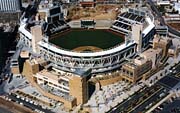

The executive architect for the stadium -- dubbed PETCO Park -- was HOK Sport, and the design architect was Antoine Predock. “The new ballpark for San Diego and the San Diego Padres is a landmark for downtown and the city of San Diego,†said Predock. “[It] serves as a civic meeting place and a focus for the future development of downtown. The ballpark completes the connection between Balboa Park and the bay, acting as a grand terminus on the park-to-bay link.â€
From the very beginning, Predock wanted the ballpark to provide an environment where visitors could enjoy the outdoors at all times. “Taking full advantage of the San Diego climate, the new ballpark is most aptly described as a 'garden' that weaves in and out of every aspect of the design, from the concession stands to outdoor view terraces, from the seating bowl to the main concourse,†said Predock. “Traditionally, ballparks consisted of the seating bowl and a large facade that wrapped the perimeter of the concourse. However, the design of the new ballpark has displaced the programmatic content, such as office space, concessions and lounges, away from the back of the bowl, creating an interstitial exterior space for the concourses to carve through with bridges connecting the two sides. As one circulates horizontally along the concourses, there is a reciprocal movement from a canyon-like space to peel away to open views beyond.â€
“The design of the new San Diego Padres ballpark is a metaphor for the City of San Diego,†stated a project description released by HOK Sport. “San Diego's hills, canyons, and hilltops are brought to life and expressed in the new ballpark. Canyons are created by pulling the concessions and other ballpark facilities away from the seating bowl, and housing these facilities in stone-clad “garden buildings.†The garden buildings have outdoor patios and are terraced, creating a sense of natural hills. The canyons between the seating bowl and garden buildings are crossed by pedestrian bridges, akin to the bridges that criss-cross the city. These 'canyons' allow sunlight to stream into the lower concourses.â€
Choosing the sandstone
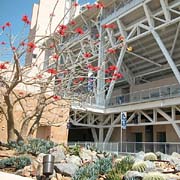
To clad the ballpark's feature elements, the owners and architects selected 150,000 square feet of Indian sandstone, a material that Predock had also used for other projects over the years. But for PETCO Park, the stone selected was a new introduction from India, supplied through Modern Builders Supply of San Marcos, CA, and Stone A.V. USA, Inc., of Plano, TX. “The cliffs of La Jolla are sandstone, and Antoine Predock wanted colors to match that scene,†explained Jim Thompson of Modern Builders Supply. “That was always the desire of everyone involved.†He said that the principals looked at a range of samples, and they liked the texture and color of the Indian sandstone, as well as its hardness. Since the Padres' stadium was the first application of the sandstone, it was appropriately named “Padre Goldâ€[r].To make sure that the stone would meet all of the goals of the project, the owners, architects and contractors traveled to see the stone quarry in person. “We went to India with representatives from the Padres, the architects and the builders,†explained Sharad Muralidhar of Stone A.V. “It was a very remote, new quarry. I remember that Erik Judson [the Padres' Vice President of Development] picked up a piece and said if I could get all 150,000 square feet to look like that one piece, that would be great. Ultimately, we found a range that made everyone happy. It was actually a very tight range with no greens.â€
The texture of the stone was also very specific. “The owners wanted maximum cleft, so there would be shadowing, but the installation needed minimal cleft, so there was a balance.†The bulk of the stone pieces were 60 x 60, 60 x 45 and 60 x 29.5 cm, and there were also some other quantities of other sizes. To install the stone, the individual stone pieces were laminated to a plaster substrate, said Andy Stallings of Hines Development, the development manager for the project.
Overall, it took a year of quarrying to produce the amount of stone needed for the ballpark. It really was amazing,†Muralidhar said. “The quarry was just a hole in the ground at first.â€
Great care was taken by all parties to make sure the stone would endure over the long term. "The Padres, along with Hines and the San Diego Ballpark Builders, tested the stone to assure specification conformance and selected the stone that reflected the appropriate color and texture," said Erik Judson of the Padres. "Aside from the political and financing challenges, the greatest challenge was to restart construction after a sixteen-month delay. Remarkably the team mitigated the risk and overcame the challenges to deliver the project on time and on budget.
Groundbreaking for the ballpark began during the Summer of 2000, and the project had an unyielding deadline of Major League Baseball's Opening Day in April of 2004. Overall, the 42,000-seat ballpark had a total budget of $294.1 million, and updates on the stadium's progress were regularly released to the general public. As time went on, the ballpark became a focal point for local citizens, who eagerly anticipated its completion. Even before construction was completed, San Diego Padres President Dick Freeman declared: “The architecture and ambience of this ballpark will celebrate everything that is special about San Diego -- the sea, the sky, the sun, the spirit. It will be spectacular in every way, with breathtaking views of San Diego and the bay, and state-of-the-art fan amenities. The ballpark will have signature towers and terraces offering panoramic vistas. When the stone and stucco exteriors and landscaping are finished, this will truly be the garden spot of baseball.â€
Speaking on the ballpark's impact on the team and the region, Judson was equally enthusiastic. "Petco Park is undeniably a tremendous success. Attendance has increased over 50% from last year, the team is playing competitive baseball, and the project is receiving architecture acclaim," he said. "Additionally, the ballpark exceeded all expectations as a catalyst for redevelopment, with projects representing over $1 billion in development underway in the district and many more to come."
End box
PETCO ParkSan Diego, CA
Design Architect: Antoine Predock, Albuquerque, NM
Executive Architect: HOK Sport + Venue + Event, Kansas City, MO
Landscape Architect: Andrew Spurlock Martin Poirier, San Diego, CA
Stone Supplier: Modern Builders Supply, San Marcos, CA; Stone A.V. USA Inc., Plano, TX
Stone Installer: Klaser Tile
General Contractor: San Diego Ballpark Builders (A Joint Venture between Clark Construction Group, LLC, Roel Construction and douglas e. barnhard inc.)
Development Manager: Hines of San Diego
Looking for a reprint of this article?
From high-res PDFs to custom plaques, order your copy today!