Stone World logo
search
cart
facebook twitter linkedin youtube
  • Sign In
  • Create Account
  • Sign Out
  • My Account
Stone World logo
  • NEWS
  • PRODUCTS
    • Machinery
    • Digital Technology
    • Tooling & Accessories
  • MATERIALS
    • Alternative Surfaces
    • Stone
    • Tile
    • Imports & Exports Data
  • FABRICATORS
    • Fabricator How-to
    • Fabricator Case Studies
    • Fabricator of the Year
  • A&D
    • Installation & Technical Tips
    • Outdoor Design
    • Interior Design
    • Hospitality | Commercial Design
    • Mosaics & Decorative Tile
    • Kitchen & Bath
    • Residential
    • Renovation | Restoration
  • MEDIA
    • Videos
    • Podcasts
    • EBOOK
  • EVENTS
    • STONE INDUSTRY EDUCATION
    • Industry Calendar
  • MORE
    • NEWSLETTERS
    • WOMEN SPOTLIGHT
    • MARKET RESEARCH
    • STONE WORLD STORE
  • DIRECTORY
    • TRADE ASSOCIATIONS
    • Stone Suppliers
    • GET LISTED
  • EMAG
    • eMagazines
    • Archives
    • Contact
    • Advertise
  • SIGN UP!
Stone & Tile ProductsSustainable Stone & TileIndustry InsightsStone & Tile EventsOutdoor DesignHospitality | Commercial DesignMosaics & Decorative TileKitchen & Bath

European country style achieved with Texas limestone veneer

May 19, 2009
Photos © Paul Finkel / Courtesy of Through the Lens Management

For the design of a private residence in Austin, TX, a variety of local limestone was used to create the look of an old French/English-style farmhouse.


The homeowners of a private residence in Austin, TX, sought a space that exhibited French/English country influences. And to achieve this desired style, they incorporated regional Texas limestone into the home’s design.

“The house picks up on a very rural sensibility found in French/English farmhouses,” said Project Architect David Webber of Webber + Studio, Inc. in Austin, TX. “The front door is almost incidentally located, and the largest most entry-like fronts are large archways that indicate the use being more important than the incidental entry a few steps down the facade.”
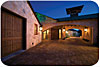
The limestone pieces, which all had a thickness of 4 inches, ranged from 6 inches in size to some that measured 24 x 20 inches and even larger.

The architect went on to explain that in old farmhouses, large doors were used to move livestock in and out of the structures. “They were the most prominent aspect [of a farmhouse],” he said. “Whereas, the farmer’s living quarters were often smaller and more modest - almost incidental to the work of running the farm. The same is true with this home. The main windows and doors reflect the largest and most important rooms, such as the living room and the master [bedroom], but the circulation routes along the back of the house are treated less importantly.”

While the home itself measures approximately 7,500 square feet, an additional 3,500 square feet consists of one attached garage and a three-car garage that is connected to the house by a covered porte-cochere breezeway. According to Webber, his clients required that the residence also contain a living room, a dining room, a kitchen with a breakfast area, a master bedroom with a master bath that included “his” and “hers” water closets and closets, a study/library, two children’s bedrooms - each with a suite bath and closet, a children’s television/play area, two full guest suites and associated sitting area, a laundry/dog kennel room, a pool bath and a powder room.
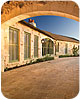
The exterior of the main part of the house consists of a fairly soft, local, whitish, fossilized limestone with cut shellstone quoins. Further texture was added by inserting small ledges into the limestone facade.

“Stone is prominent throughout the design,” said the architect. “The house is large, but we did not want it to feel that way. It also sits on a ridge along the top of a small bluff - offering great views into a valley and natural area. In order to spread the size of the house out, we broke it into two zones - the main house and the kids/guest part of the house.”

Webber explained that by dividing the residence into two zones, it presented the opportunity to differentiate between the two main volumes by utilizing two different stone applications on the exterior. “For the main house, a fairly soft, local, white, chalky, fossilized limestone with cut shellstone quoins was used, while the other [part of the home features] a more slurried application using multi-colored limestones at various levels of weathered appearance, which were locally available,” he said. “Locally, we can get from very white chalky limestone to rusty, brown, tan and even blackish limestones, depending on how much aging they have been exposed to in their creation.”

The other part of the home features a more slurried application for its exterior facade - comprised of multi-colored limestones at various levels of weathered appearance (shown on left).

The mason on the project, Richard Llewellyn, located the stone for the home in a range of stoneyards and supply shops in the Austin region. The homeowners were also very involved in the selection process.

“They had a great awareness for how they wanted it to feel, and the mason was able to do mock-ups to test out their reaction to the possibilities,” said Webber. “But, before we even got to that point, the clients would drive around for weeks before they finally located a stone that they liked and felt comfortable was the right selection.”

In the end, the chosen limestone varieties proved ideal for creating the French/English-style farmhouse. “The chalky limestone and its softness seemed informal enough for the overall look,” said the architect. “By using it with some ledges inserted into [the stone], and with a cut stone version for the quoins, we achieved both informality with a hint to formality that informal architecture often tries to achieve in spite of itself.”
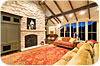
The rough-cut limestone was also carried into the home’s interior, where it was used for applications such as a fireplace.

Webber added that the slurried stone part of the house needed to have an even more informal quality than the main house. “The stone we picked there - with its multi-colors and its very informal application - would do the trick. Slurried walls were often done as a substrate for stucco. The stone was not intended to be finished.”

While the extensive stonework used for the exterior appears thick, it actually is all veneer stone that has a thickness of only 4 inches. The pieces ranged from 6 inches in dimension to some pieces that measured 24 x 20 inches and some even larger.

According to the architect, not much direct supervision was needed during the stone installation. “We certainly were involved with selecting the stone, but the mason was so talented that, in fact, the stone we did select was generated in the form of a mock-up by him matching a few stone walls that we had seen while driving around,” said Webber. “Because the mason was the one that generated those samples, we really did not need to direct him at all.”

Share This Story

Looking for a reprint of this article?
From high-res PDFs to custom plaques, order your copy today!

Recommended Content

JOIN TODAY
to unlock your recommendations.

Already have an account? Sign In

  • customer doing research online

    3 Reasons Why Quick Response Time Results in a Successful Fabrication Shop

    Your fabrication shop can have the best website. The best...
    Fabricator How-to
    By: Anthony Milia
  • Silica

    Renewed National Attention Ignites Over Silicosis Epidemic

    A major investigative report published on March 12, 2026...
    Industry Insights
    By: Jason Kamery
  • shipping containers

    U.S. Countertop Material Imports: February 2026

    U.S. countertop material imports collapsed in February...
    Stone
    By: Jason Kamery
Manage My Account
  • eMagazine
  • Newsletters
  • Online Registration
  • Manage My Preferences
  • Subscription Customer Service

More Videos

Popular Stories

cal osha

Cal/OSHA Standards Board to Vote May 21 on Engineered Stone Ban Petition

shipping containers

U.S. Countertop Materials Imports: March 2026

kitchen

Building a Reputation on Strong Craftsmanship and Customer Service

Fabricator Focus

From profiles to roundtable discussions, Q&As to best business practices, we're turning a focus on topics and challenges impacting fabricators.

AI Talk Is Everywhere -- Where Does a Countertop Fabricator Begin?

Fabricators Discuss Pros and Cons of Chip Repair

How to Grow a Countertop Fabrication Shop

Events

June 25, 2026

North Carolina Stone Summit

You’ve probably heard a lot lately about how to calculate the profit for each job you produce. You likely have production benchmarks based on square footage since it’s the most common production metric in the industry. Come learn how focusing on these metrics can hurt your profitability and what to do about it.

July 16, 2026

Washington Stone Summit

Join us for "Taking Your Organization to the Next Level," a session dedicated to transforming your business practices. Discover strategies for setting clear agendas, encouraging participation, and driving actionable outcomes. Learn how to foster collaboration and communication, ensuring that every meeting enhances productivity and contributes to your business goals.

View All Submit An Event

Poll

Tariffs and Quartz Imports

If high tariffs are placed on U.S. quartz imports, how will this affect your business?
View Results Poll Archive

Products

Restoration & Maintenance Technical Module

Restoration & Maintenance Technical Module

See More Products
	
3 Reasons Why Quick Response Time Results in a Successful Fabrication Shop

Related Articles

  • Texas limestone creates old ranch-style home

    See More
  • Environmentally friendly design achieved with Hakatai tile

    See More
  • Texas limestone attracts upscale buyer

    See More
×

Our Newsletters are a rock solid source of industry insights!

Stay in the know on the international stone and tile industry trends.

JOIN TODAY!
  • RESOURCES
    • Advertise
    • Contact Us
    • Directories
    • Store
    • Want More
  • SIGN UP TODAY
    • Create Account
    • eMagazine
    • Newsletter
    • Customer Service
    • Manage Preferences
  • SERVICES
    • Marketing Services
    • Reprints
    • Market Research
    • List Rental
    • Survey/Respondent Access
  • STAY CONNECTED
    • LinkedIn
    • Facebook
    • YouTube
    • X (Twitter)
  • PRIVACY
    • PRIVACY POLICY
    • TERMS & CONDITIONS
    • DO NOT SELL MY PERSONAL INFORMATION
    • PRIVACY REQUEST
    • ACCESSIBILITY

Copyright ©2026. All Rights Reserved BNP Media, Inc. and BNP Media II, LLC.

Design, CMS, Hosting & Web Development :: ePublishing