Bringing English heritage to North Texas
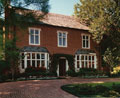
Using a combination of English antiques and
classically detailed stonework, a private residence in University Park, TX, has
the look of an historic English cottage. The architect for the project was
Steve Chambers, AIA, NCARB, Principal of Stephen B. Chambers Architects, Inc.
of Dallas, TX.
For a private residence in University Park, TX, architect Steve Chambers, AIA, NCARB, Principal of Stephen B. Chambers Architects, Inc. incorporated a range of elements, including English antiques as well as classic architectural detailing. Many of these details can be found in the stonework, which was employed in a range of traditional formats.
“One of the controlling factors in the design of this house was that the couple collects English antiques,” Chambers said. “They will get a container full and bring them back. They brought back old English doors, and they have one room with paneling from the 1600s. The idea was to make the house look as authentic as possible, and to do that, we used elements such as cut stone around the windows and entry door.”
The residence is sited on a narrow urban lot within University Park. In addition to incorporating the antiques collected by the couple - who travels extensively in the Cotswold countryside of England - the home needed to provide light, openness, convenience and other amenities of modern design.
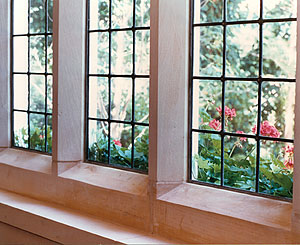
One of the most noteworthy details was the use of
limestone at the windows. “We did a very old-fashioned detail of fixed leaded
glass windows that were set directly into the stone,” Chambers explained. The
Leuders limestone was quarried and processed within Texas, and it was supplied by Mezger
Enterprises of Lampasas, TX.
Once the windows were installed, they quickly contributed to the overall goal of creating a home that looked centuries old. “These are single-glazed windows in a metal frame, so they ‘sweat,’ and when the condensation runs onto the stone, it looks like what you would see on a building that is 200 or 300 years old,” Chambers said. “That is part of the natural effect of what happens with the stone. Some might consider it an imperfection, but we liked the natural effect. The home-owner loves the idea that the house looks old. She didn’t want something that looked shiny and new.”
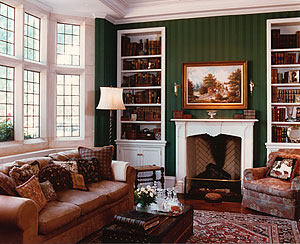
Complementing the limestone windows in the main living
area, the design includes an antique marble fireplace, which was brought in
from England.
Complementing the limestone windows in the main living area, the design includes a traditional stone fireplace. “The fireplace is actually an antique that the owner brought from England,” the architect explained. “It is a marble surround, and it is really a testament to the longevity of stone. Here’s an example of something that was used before, and is now used again. We designed the firebox open to fit the fireplace.”

At the kitchen/dining area, the kitchen countertops
were done in a rust-colored granite that blends with the overall aesthetic of
the space. Additionally, a raised fireplace utilizes Leuders limestone in
several formats.
Natural stone can also be found at the entry foyer, where Pennsylvania Bluestone was specified. “We had a cut pattern with a border around the outside and a diagonal on the inside,” he said. “The front door was brought in from England, and [the homeowner] kept telling me the thickness of the door. It was very thin, and I wasn’t sure how it would work in terms of the hardware, but everything came out great. Sometimes your clients have incredible ideas and imagination. It was wonderful working with them and all these antique pieces.”
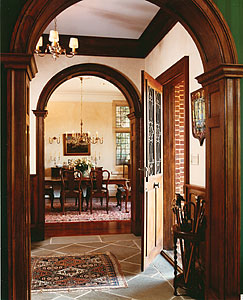
Natural stone can also be found at the entry foyer,
where Pennsylvania Bluestone was specified. “We had a cut pattern with a border
around the outside and a diagonal on the inside,” Chambers said.
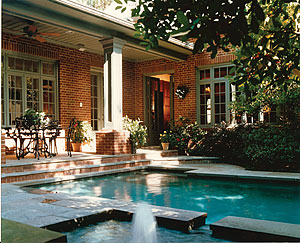
Pennsylvania Bluestone was also used at the pool area,
and in addition to its design value, the stone provided practical benefits as
well - as it can withstand harsh weather conditions.
Speaking on some of the challenges in completing the project, the architect said that utilizing traditional building processes and techniques was something that required an extra level of communication. “We were trying to create something that had an Old World look to it, but to do it like it was done originally,” he said. “So often, people try to imitate the look of something historical. But when trying to build these bay windows, for example, a lot of contractors forget that you can build out of solid masonry.”
For more information, please visit the Chambers Architects' Web site at http://chambersarchitects.com/mcfarlin-english.html
Looking for a reprint of this article?
From high-res PDFs to custom plaques, order your copy today!