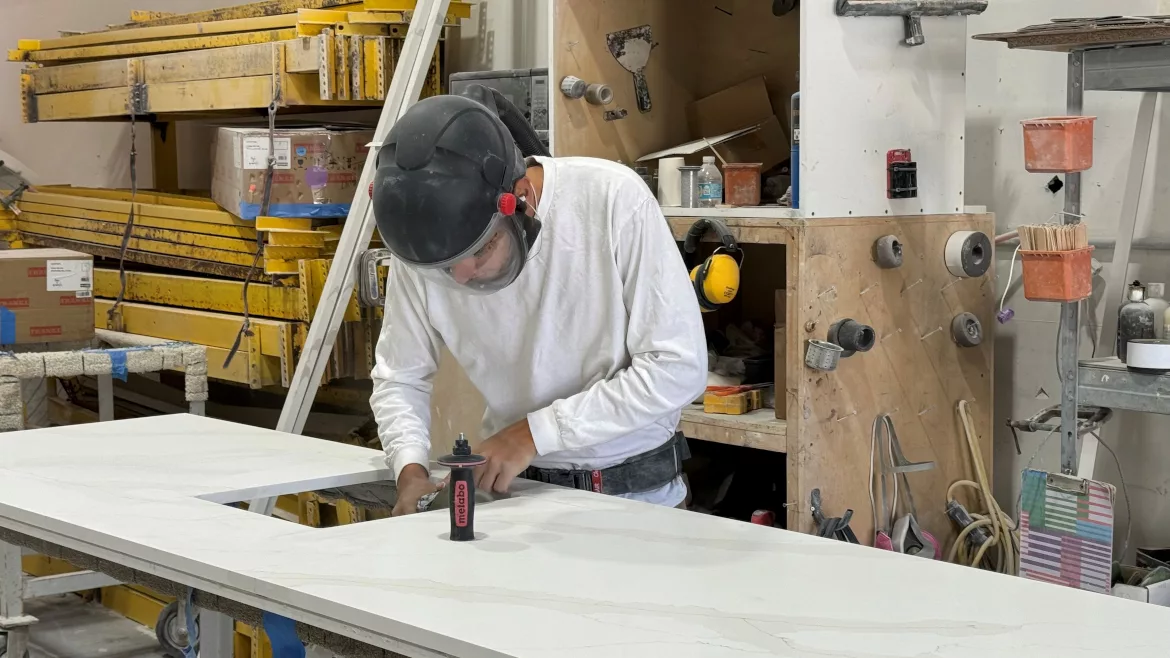
Achieving the optimal seam

More and more in the stone fabrication industry, companies are looking to take extra steps to ensure that the seam is as smooth as possible. Seam polishing is one technique, although many of the seams I polished were to fix someone else’s mistakes. You may also have to seam polish if you have a bowed slab.
However, you can also achieve a smooth, almost “seamless” seam without breaking out the polisher. The following is a technique that I developed, which we teach in our Stone Fabrication seminars:
The most important step in obtaining a smooth tight seam is to make sure you set the countertop properly. This starts with the templating stage. The cabinets need to be as level as possible so that the stone will sit flat. This allows each stone piece that you member up to be as level as possible so you don’t have to shim the seam.
The next most important step is when you cut the stone on your saw. You want a smooth, clean cut with no jagged edges. This is a problem that I see in a lot of installations. If you are getting jagged, spalled edges, then you need to take a look at your blade and the speed at which you are cutting. Nine times out of 10 you will find that you are using the wrong blade, or the blade is worn out or glazed.
When you are ready to install the countertop, take some basic steps to protect the material during transportation. It sounds simple, but make sure your installation crew is careful not to bang the edges. I also protect the edges with some low-contact masking tape.

Setting the stone
After dry setting the stone, place tape under the seam so glue does not drip through. To hide the fine, light-colored line on the seam, take a marker and color the very edge of the stone. Adjust the seam so that your fingernail runs smoothly over the joint. Once you have the seam where you want it, open up the seam and pour in clear flowing grade polyester. Generally, most stones don’t need colored polyester. However, you may want to use some tint for darker stones such as Absolute Black granite.Close the seam with the seam setter, allowing the polyester to flow up onto the top. Determining the proper amount of glue is something that will take a little practice. It is important not to remove or clean the excess glue at this point. Instead, allow the glue to dry. Once the glue is dry, remove the seam setter.
Next, take a razor blade and shave the dried glue. Hold the razor blade straight up and perpendicular to the face of the stone. The way you hold the blade is critical. If the blade is allowed to get under the glue, it could pull it up and out of the seam.
Once the glue is scraped away, you will need to take a pumice stone and rub it across the seam to smooth the joint. A pumice stone is a volcanic stone, and the beauty of it is that it will remove the glue, but will not scratch the granite.
After the entire joint is smoothed, take some denatured alcohol on a rag and rub the joint to bring the color back.
Looking for a reprint of this article?
From high-res PDFs to custom plaques, order your copy today!