Fabricator issues and solutions discussed at Coverings
Is anyone self-importing slabs? It seems like there would be a better margin, and it also would keep our customers out of other slab yards.
Malisani: I wouldn’t do it. It costs just as much in the end. I do not stock 500 slabs. We sell our expertise and more quality than quantity. When a customer wants a particular stone, we can find it for them.
Marcella: We do our own importing, and it works for us. We import exotic and highly exotic materials. When Home Depot moved to MSI and Arizona Tile and Daltile, it opened up the color palette. I import slabs that no one else shows.
We have developed a relationship with the exporters we work with, and we have recourse if we are unsatisfied.
Laliberti: It is tempting, but we don’t import either. There is a lot to it; unloading bundles from containers is dangerous, and you need the proper handling equipment. Most suppliers will bring in a container for you and deliver it in their trucks.
Naquin: We were importing 120 containers per year pre-recession. Now we are importing one or two containers per year — strictly exotics. There are some good companies out there for those who want to import, but for me, the distributors get me what I need.
Marcella: In the last three years, we have developed relationships with suppliers in Italy. When you go to these places, you know what will sell and what your competition doesn’t have. Once you develop these relationships, you can also purchase from these suppliers using the Internet, but you first have to develop that relationship in person.
We have an indoor warehouse, and we move our materials around to shake it up and show new materials.
How much is quartz surfacing and white marble taking away from your granite business?
Laliberti: My market prefers granite. We have been doing about 10 to 15% quartz for the past few years. It is nice to fabricate quartz, with better material handling and no rodding, but the demand isn’t there.
Malisani: Quartz lost a little market share for us, but there has been an upswing in the use of marble.
Marcella: We do a lot of quartz work for outdoor barbecues. We are using marble in our other work, but we jump-started it by importing some more marble.
Naquin: Granite is the highest request that we have. We are using quartz for barbecues, but not so much for walk-ins.
I would say that 25% of our market share has gone to marble. Fabricating marble is much different than fabricating granite. We only sell honed marble, and we explain the issues of etching and patina.
Are you setting a goal for how much square footage you want to process per hour?
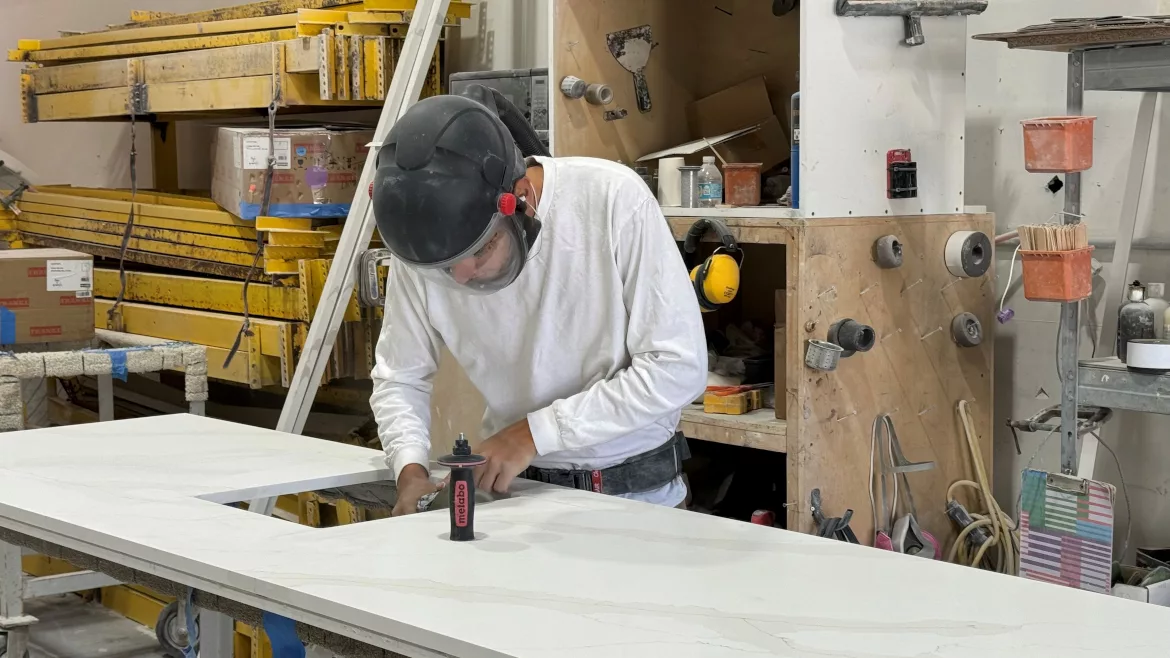
Laliberti: We have been tracking our square footage for the past few years. We have a Park Fusion bridge saw/waterjet, Destiny CNC, Sasso backsplash polisher and five guys, and we can do 150 square feet during an eight-hour day and 200 square feet during a 10-hour day.
We started with wood templates, and then we went digital, but we were still doing our layouts with plastic over the slab. That all changed when we bought the bridge saw/waterjet. All of the layout is done electronically, so we don’t have that bottleneck.
Our emphasis is on loading and unloading the CNC and keeping it going. We are programming it offline in our programming office.
We have two guys that run the saw with other duties — material handling, maintaining the filter press, doing backsplashes. We need to cross-train.
We also have one dedicated CNC operator and two guys hand finishing, in addition to the programmer.
Backsplashes are a pain, actually. They are the piece that breaks the most, and they take the most time when you are on the jobsite.
When you are using the CNC, does it take the workpiece to the very end?
Laliberti: Yes, tooling has come a long way. We use the Terminator tooling [from Continental D.I.A.]. You have to keep an eye on it and make sure Position 1 or 2 — or even the others — don’t have to work too hard. That can even mean re-dressing if necessary. You need to dedicate someone to look at the tools.
It depends on the profile and on what you cut. I’ve gotten 5,000 feet on Position 1, but I would recommend [re-dressing] at 2,000 to 2,500 feet if you are doing a flat polish.
Also, the operator needs to either know how to properly set up the tools, or you should have the supplier visit your shop to show the operator how to set it up.
Marcella: We have three CNCs and a CNC saw, along with a completely automated warehouse with automatic conveyors. In 2008, we were doing 10,000 to 12,000 square feet per month, and now we are doing 5,000 square feet per month, so we are operating below our capacity.
Our work on our CNCs is similar to what Matt is doing. We are using the wheels for Positions 1 through 4, but we finish by hand. We underpolish anyhow, so it makes sense.
We do a flat-polished edge on 60% of our work, because Home Depot gives that for free. The rest is split evenly. We also do things like chiseled edges and a 6-cm laminated edge, but we make them pay for it.
Malisani: We use a gantry saw, a line polisher and a radial arm polisher, but we are not just a countertop, so [tracking square feet] doesn’t really apply. We are doing monuments, 8-inch ogees, columns and architectural work.
What type of incentives are you offering for employees?
Malisani: We try to make it their business as well. Employees have to be sold on working for you, and you need to give them opportunities to have input.
Pay is not all that employees want; they want respect. You also need to place an emphasis on resolving conflicts.
Laliberti: We are a family business. We started with one guy, and he is still there — along with five of his brothers. We have very low turnover.
In terms of pay, the workers in the shop and the installers are paid hourly. We thought of paying by the square foot, but even if our installer took five hours to do a job that should have been less, we want to know that he got it just right.
We keep tabs on productivity, but it is not the only factor.
Marcella: We try to keep the staff involved in our business. We tried doing awards, but it caused infighting — even when it was the staff that voted. It was a challenge for us.
Malisani: Doing awards were also a problem for us. We offer a retirement plan and health insurance, along with paid time off. Retaining employees is the most cost-effective thing you can do.
Naquin: Our business went down by 80%. We went from 75 employees down to 18, and those that remained are very appreciative of us. They stayed with us because they believed in the company; not for the money.
Are shops buying used machines? Where are you buying parts for used equipment?
Laliberti: There are consumable parts for every piece of equipment. Whatever machine you buy — new or used — you need to know where to go for parts and service. Don’t ask the machine supplier; ask someone who uses that particular machine.
Naquin: We bought a used machine that we cannibalize for parts.
What is your sales process?
Laliberti: Follow-up is really the key. We sent a “secret shopper” out to 20 shops —including our own. We only got one follow-up, and it wasn’t us. We have now placed an emphasis on not simply being order-takers.
Our sales used to be fragments. Now we have three dedicated salespeople — two in the showroom and one on the road.
Also, our walk-in philosophy has changed. We try to get people to make appointments. We are on a busy street, so we get a lot of walk-ins. When it is crowded, maybe customers are getting annoyed because they are not getting the help and attention they need.
We have a form on our site that lets people make an appointment. This is distributed to the salespeople, and everything is scheduled. The time of peaks and valleys of customer waves are gone, and our salespeople can dedicate one or two hours to a customer.
Retail is really the bulk of our business — about half — and the rest is kitchen and bath dealers, woodworking shops, architects, etc.
Looking for a reprint of this article?
From high-res PDFs to custom plaques, order your copy today!