Part I- Moving pieces in the shop

Photos by Michael Reis-
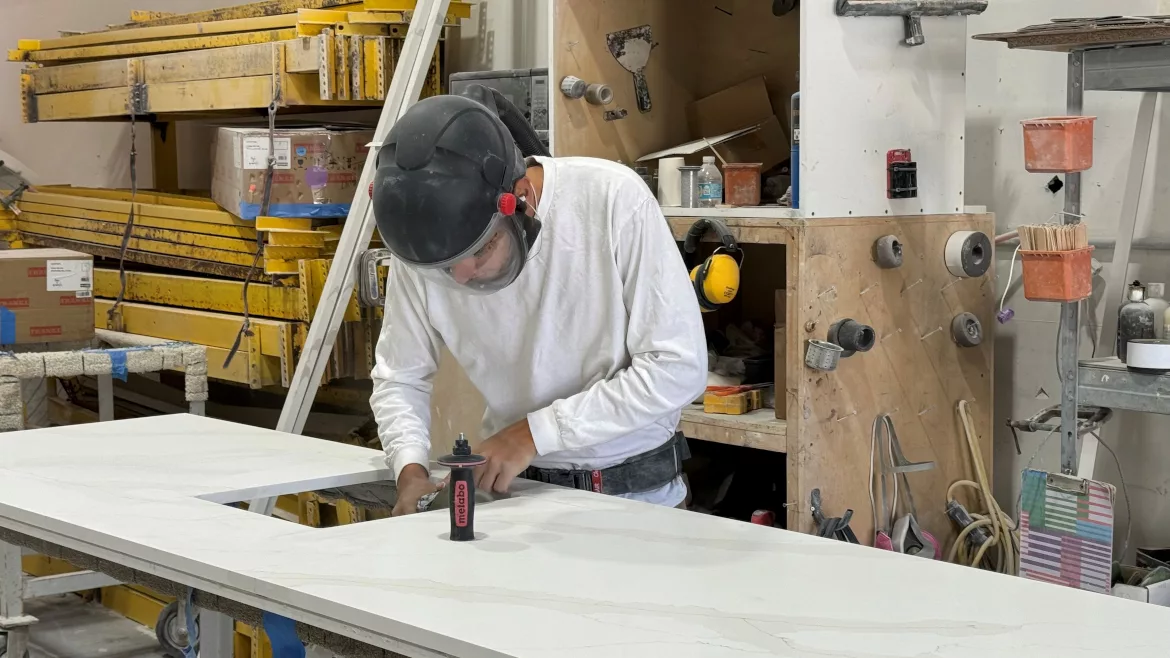
The equipment used by fabricators to move stone around the shop can vary
depending on space configurations and overall size of the operation. For slab
lifting, many fabricators today are using boom cranes that are outfitted with a
vacuum lifter.
Q:How are you maneuvering slabs around your shop? Are you using overhead cranes? Forklifts? Vacuum lifters? Do you have different methods for slabs versus finished job pieces? Also, what is the process for training employees of proper material-handling techniques?
Joshua Hopkins, Albemarle Glass Company Inc., Albemarle, NC: We use an overhead crane with an Abaco lifter to move slabs and finished pieces around. If it is small pieces - weighing 100 pounds or less - we move them manually. The new employees are trained to look for fissures or cracks in granite, and they then determine if they are safe to handle while unloading the trucks.
They are also trained to stay away from the sides of the granite until it is placed on racks and within an arm’s reach of the edges to minimize risk in case of accidents.
Dan Riccolo, Morris Granite Co., Morris, IL: We use jib cranes with vacuum lifters and Abaco clamps. We also use flatbed trucks equipped with knuckle boom cranes. For moving multiple slabs at once, we use a small carry deck crane. Training is mostly by watching, practicing (supervised) and help during procedures by trained employees.
G. Cooper, Moonlight Tile and Stone, Cashmere, WA: We use all the above mentioned methods for in-shop maneuvering of pieces and slabs. Our shop unloads with a forklift into a set of racks, from which the sawyer can pick the slabs from there and place them on the table with an overhead crane. For larger pieces and pieces that are awkward to lift, we like to employ the vacuum lifter. It saves a lot of stress, and it can also save a lot of energy.

Vacuum lifters have proven to be helpful in
loadings slabs onto the bridgesaw without the need to tilt the worktable.
We use the same methods for our slabs. Our overhead crane fits the “clamshell clamp” and the vacuum lifter, so we switch out heads as needed. As for everyday standard pieces, it is really important that everyone have direct-eye contact, clear communication and a nice steady pace. Do not rush, and make sure your lifting partner is 100% with you. We have not had any back injuries or accidents moving pieces in my shop for a long time due to this, along with the inclusion of tools that the industry has created for us to use.
Kris Jorgensen, Natural Stone Interiors, LLC/NSI Solutions, LLC, Mukilteo, WA: We use a 5,000-pound forklift with a boom and Abaco clamp to unload full slabs from our trailer and to load full slabs onto the saw (our saw has a hydraulic tilt table). The pieces are moved off the saw with a jib crane and vacuum lifter.
Our employees are trained hands on. I work with them until they have developed safe slab handling practices. I remind them all the time how serious that part of the job is. I tell them to assume that every time they move a slab, it could fall at any time, so make sure to be out of its way. Also, while moving slabs, there is no horseplay allowed, no answering cell phones, etc.

While some shop configurations are well suited
for an overhead crane, others are more suited for boom cranes.
The vacuum lifters are used in slab and finished work applications. A large “scissor” clamp is used on thick stock material. Occasionally, we pull out the straps/slings to handle the fragile or ornate work.
We hold a training class whenever a new employee arrives, or about once a month for a refresher class.
Mark Mihalik, Counterparts, LLC, Delaware: I think material handling should always be looked at from a safety perspective. Moving around 1,000-pound-plus pieces of stone is serious business. Keep the pieces at arm’s length and stay out of the “kill zone” when moving pieces around. Most guys don’t realize the danger involved until they see a slab break in half or get involved in an accident.
We use a forklift with a jib and an Abaco lifter to move slabs into the building. From there we use a jib crane with a Wood’s Powr-Grip suction cup lifter to load and unload the saw. For light pieces, the guys will move them by hand from the tables to carts. Heavy pieces get moved again by the suction lifter. Once pieces are finished, we load them onto a Weha A-frame in the shop and fork the whole A-frame into the truck for install.

For loading slabs into the shop, many fabricators
utilize a forklift equipped with a boom and a clamp.
Our shop is set up with the wet areas located in the back and the dry areas/loading/storage of finished work near the front loading door. To avoid having to drive the forklift through the shop, we set up the slab A-frame right next to the loading door so that people working in the shop are not near the forklift or slabs as they are being loaded onto this frame. When we move the slab to load the saw table using the overhead crane and vacuum lifter, everyone must stop what they’re doing in the shop so that they can stay out of the way of the slab as we’re moving it. This helps generate proper respect for the dangers inherent to moving stone.
Steel-toed boots are mandatory for everyone and are provided/replaced for free as often as is necessary. The clamp and hoist are inspected daily to make sure all the bolts are tight and that there isn’t any damage to the clamping face. The vacuum lifter is inspected once a week for pad wear, and we have recently replaced the foam rings to help improve suction on the back of the slabs.
We utilize a flipping cart to help us turn over large pieces of stone. Ours is homemade, but there are commercially available models. The stone is simply lowered into the cart with a vacuum lifter, and then the vacuum lifter is transferred to the back of the stone. This is all done in a near vertical position in a cart that looks like a “V.” Using the flip cart has eliminated the need to ever physically pick up a piece of stone until we are ready to install it.
New employees are trained by having them watch a video to understand what’s going on. Then they will assist while a supervisor observes to make sure that they get it right. After a couple of days, most people get it. If there’s a fundamental problem, and it seems like the person can’t show proper respect, then that person is not allowed to move stone.
No amount of money can replace a life, and you’d be hard pressed to put a dollar value on a limb. Accidents involving stone are usually very serious, and it’s the job of every owner and employee to help minimize the risks.
Scott McGourley, SFA, Kasco Stone, Tampa, FL: Material handling is one of the most laborious things we do, yet it is often overlooked. It is important not only to use machinery to “lighten your load,” but also to use a workflow pattern that will minimize handling. For example, we normally underpolish 1.5-inch overhangs shiny side up to avoid flipping a part. Sink runs come off the saw upside down and are rodded and underpolished, and slots for sink anchors are cut before flipping to profile and cut the sink. Also, you must take into consideration that usually you have to disrupt a co-worker in order to help you move a part. Now he has lost his momentum and may forget where he left off. (“Let’s see, was I done with the 800 grit or not?”)
Clamps are also used inside the shop,
particularly for smaller pieces.
As far as training goes, it is on the job. We explain that pretty much the only thing that can kill you in the shop is a slab falling on you. We forbid cell phone conversations while moving slabs and other obvious things like not getting under the load or in a position they cannot escape.
First, they are taught hand-moving techniques and the theory that “if the granite cannot bend, it cannot break.” Then, as they progress, they pick up the vacuum lifter and eventually the forklift.
In each case that I have seen a lift go wrong, it was like a bomb going off. I stress this to my employees. When a slab falls out of the clamp or simply breaks in half, the result is immediate and catastrophic. The only thing they are told to do is get out of the way and not try to “save” the day.
There are many new tools available, such as install carts, bar clamps, hand clamps and suction cups that can make your handling easier. Forkliftable A-frames and trailers will reduce cycles, also. These are the best investments you can make to reduce your risk, and at the same time, increase your efficiency.
Reuben Flax, Sinai Marble & Granite, Baltimore, MD: One of our slab suppliers related a story to me and posed the question of: “Would you try to save a slab that’s falling?”
He was picking up slabs from a local shop to return to their warehouse. While the employees of that shop were loading his truck with slabs using a forklift and slab clamp, the slab broke off -- leaving just a small square of stone in the clamp. The slab was only a couple of inches off the ground and it fell right on i’s edge, standing perfectly balanced. the ground man (second man used when moving slabs to help position and rotate slabs) was standing right there, but he didn’t reach out to grab the slab to balance it. So after almost five seconds, the slab finally leaned over and broke on the ground.
If you were the ground guy in that situation, would you try to save the slab? My supplier said he would have done so if he were in that position.
In our shop, we use a forklift, and it’s important for people to understand what can go wrong and to have an exit strategy in place. After realizing the discrepancy between what I would do and what this guy would do, I immediately instructed everyone in the shop that should they find themselves in a similar situation, they should run and not try to save the slab.
Guy Robertson, SFA, Robertson Manufacturing, Inc., Davenport, IA: I tell my guys that if they hear, feel or sense any danger, GET OUT! Don’t try and save it, because you will be doing so by yourself because I am getting out of the way.
I can buy another slab. I don’t want to have to buy flowers.
Looking for a reprint of this article?
From high-res PDFs to custom plaques, order your copy today!