Indian sandstone harmonizes with desert landscape

The
Musical Instrument Museum (MIM) opened its doors on April 24, 2010 in Phoenix,
AZ. The exterior of the 190,000-square-foot structure features Teak sandstone,
which was quarried and fabricated by Tab India
of Jaipur, India,
and supplied through the company’s U.S.
office, Amsum & Ash in Minneapolis,
MN.
Photo by Bill Timmerman
Teak sandstone from India was a key component of the design for the Musical Instrument Museum (MIM), which held its Grand Opening on April 24, 2010, in Phoenix, AZ. The stone, which was quarried and fabricated by Tab India Inc. and supplied by the company’s U.S. office, Amsum & Ash of Minneapolis, MN, was chosen for its rich tones that reflect the museum’s surrounding desert environment. With approximately 74,000 square feet of sandstone employed in more than 800 different sizes, the success of the project was due to strong teamwork among all those involved.
The design team was led by Richard Varda, FAIA, ASLA, the museum’s Project Lead Design Principal, and included Ted Davis, AIA, IIDA, Design Principal for RSP Architects in Minneapolis, MN, as well as Jeremy Mayberg, AIA, Managing Principal; Tom Sopoci, AIA, Project Manager; Paul Whitenack, AIA, Project Architect; Brian Tucker, AIA, Project Architect; Jeff Walden, Senior Designer; Scott Aspenson, Designer; Alissa Swenson, Interior Designer; and Rafael Olabarrieta, Job Captain - all from RSP Architects.
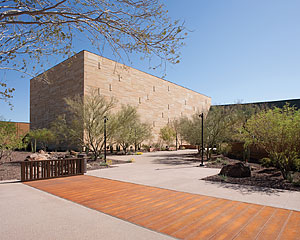
Approximately
74,000 square feet of sandstone - in more than 800 different sizes and five
thicknesses - was employed for the building’s exterior facade as well as some
interior applications.
Photos by Bill Timmerman
In addition to its coloring, the “fluidity” found in the Indian Teak sandstone was a match for the museum’s personality. “We worked with the architect in Minneapolis to get the project specified,” explained Amit Gupta Owner of Tab India, and who also heads Amsum & Ash. “They wanted something dramatic - something that goes with the personality of a music museum - with various genres and artists. They wanted a stone with character and long-lasting impact. We very patiently went through many materials. It was important for Tab India that materials come from its own quarries and its own production. Finally, Teak sandstone was picked due to its unique movement. To even add more drama to the project, there were various thicknesses and finishes on the same wall without appearing too busy.”
The Teak sandstone was extracted from Tab India’s quarry in Khatu, Rajasthan, India, and custom cut at its fabrication facility in Jaipur, India. The stone pieces, which have a honed finish, clad the exterior facade of the 190,000-square-foot MIM. The sandstone was also used for interior walls, including in a 299-seat music theater. “The articulated solid teak [sandstone] wall of the theater contrasts with the landscaping of the performance courtyard,” according to a design statement. “Protruding stone slabs suggest musical notes and the rhythms of music.”
During the selection process, members of the design team visited neighboring buildings that feature the same material to get a feel for the sandstone’s look and texture. “This stone was used on other buildings in Phoenix, so we visited them,” said Varda. “The spec called for a specific veining direction and color continuity.”
With such an extensive amount of stone being used for the MIM, communication was the key for a successful project. According to Gupta, he met often with representatives from the design team to ensure accuracy and address any concerns. Tab India also provided many mock-ups for the design team to view. “Veining was a challenge,” he said.
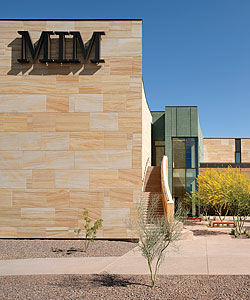
The Indian sandstone was selected for its warm
coloring, which matches MIM’s surrounding desert landscape.
Meeting the challenge
At first, meeting the timeframe and request for the extensive amount of stone in an abundance of sizes seemed almost unobtainable, according to Gupta. But Tab India rose to the occasion, and dedicated many man-hours to performing the task.“Tab India was given a schedule which was very stringent,” he said. “We added significant equipment to the quarry, and thanks to many people at Tab who took this challenge and made it happen. At the end, the project was a success not just because of Tab’s very extensive experience today in cut-to-size and the plants, machinery and infrastructure, but because of Tab’s people for understanding the challenge and burning the midnight oil to deliver.”
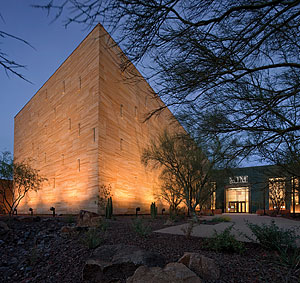
The Teak sandstone pieces were installed by Sun Valley
Masonry of Phoenix, AZ. Each piece was custom cut and numbered on the back. The
installers carefully followed the architect’s drawings to make sure each stone
piece was placed in the right spot.
Photo by Bill Timmerman
Photo by Bill Timmerman
With so many different-sized pieces involved, Tab India had to carefully strategize how it could tackle this project. “Planning sizes with the blocks and trying to optimize them to minimize wastage would have been a nightmare,” said Gupta. “However, computer programs were used that were designed in-house to figure out how to do this, and of course, human capabilities. We had to number these pieces so no pieces were missing. Since almost every piece size was different, if a piece breaks, we would have had to try to match the veining in this otherwise very heavy veined material as we have lost that piece in a middle of a sequence. This was a logistical challenge, but we did it without a single odd piece or complaint.”

During the installation process, 8-foot steel channels
were installed on top of the masonry wall. “Stainless steel clips fastened the
stone pieces to the steel channel,” explained Ralph D’Ippolito. “It was quite a
bit of work involved to prepare the wall.”
Photo by Bill Timmerman
Photo by Bill Timmerman
Installing the sandstone
An experienced installation crew was also necessary with a project of this magnitude. A team from Sun Valley Masonry in Phoenix, AZ, which included Don Voight, Business Development Manager; Danny Aukett, General Superintendent; Ralph D’Ippolito, Project Superintendent; and Tiffany Howard, Project Manager, spent five and a half months working on the installation of the Teak sandstone for the exterior and interior applications.“This project was the only one I saw, and probably the only one in my life like it,” said D’Ippolito. “It was unique. It took a lot of teamwork to get it together.”
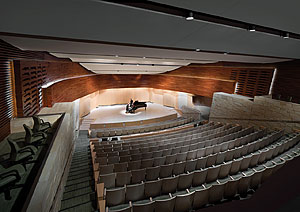
The
Teak sandstone was also used for walls inside the 299-seat music theater.
Photo by Bill Timmerman
The first step was to install 8-foot steel channels on top of the masonry wall. “Stainless steel clips fastened the stone pieces to the steel channel,” explained D’Ippolito. “It was quite a bit of work involved to prepare the wall.”
D’Ippolito went on to say that the architect’s drawings were carefully followed to make sure each stone piece was being set in the correct spot. “Nothing was the same,” he said. “It was a random layout. Each course was different. We created more or less of an assembly line. The pieces were prepped on the ground and then placed on the wall. If one was misplaced for any reason, then we were in trouble.”
Approximately six to eight workers were on scaffolding, three were on the ground prepping all the stone, and another one was on the wall doing the layout. “We had two cranes on site picking up the pieces from the ground to put on the wall,” said D’Ippolito. “The men on the scaffolding were receiving the load.”
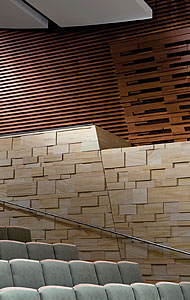
“The articulated solid teak [sandstone] wall of the
theater contrasts with the landscaping of the performance courtyard,” according
to a design statement. “Protruding stone slabs suggest musical notes and the
rhythms of music.”
Interior stonework
In addition to the Indian Teak sandstone, other varieties of stone and tile were used throughout the MIM’s interior spaces. A 450-foot-long central corridor named “El Rio” connects the museum’s two stories and numerous galleries. The corridor is described as “a flowing, river-like form that serves as the spine of the museum - connecting the exterior atrium with the interior spaces.” The floor in this area is made of Italian porcelain tile, which was supplied by RBC Tile and Stone of Minneapolis, MN. The field consists of tiles from Lea Ceramiche’s Tecnoquartz collection in the color Doral. It is complemented by a border from Ceramiche Caesar’s Glam collection in the color Coffee.A focal point of MIM’s interior is the “World Stair” - featuring a stone mosaic map of the world at the base of a grand spiral staircase. The map, which features a variety of stone types, was designed by RSP Architects and waterjet cut by Rock Hard Designs of Phoenix, AZ. Bell Stone Co. of Phoenix performed the installation of the map as well as the majority of the interior stone and tile work.
“We did all of the interior flooring and stair treads,” said Joel Jensen of Bell Stone Co., adding that the stairs were made of Crema Marfil marble, which were fabricated in his shop. Crema Marfil was also used for the floor surround of the map.
Jensen explained that the pieces of the map were preassembled at the shop. “Rock Hard Designs worked with us on it to get it all precise,” he said, adding that the installation took a couple of weeks. “We went down to the shop and helped make the pieces fit.”
In total, Bell Stone Co. had a crew of 15 to 20 workers on site for about six months. The company completed numerous installations throughout MIM, including stone window sills, restroom vanity tops, the serving line in the cafeteria and coffee bar.
The first floor of MIM features the Orientation Gallery, which introduces visitors to the rich diversity of international instruments; the hands-on Experience Gallery that offers the opportunity for guests to touch and play instruments; the Artist Gallery, featuring musical instruments and special items linked to world-renowned musicians and innovators; the Mechanical Music Gallery; and the Target Gallery for special exhibitions.
Additionally, the first floor includes the Guest Service area, the MIM Café and Coffee Shop, a space for group and educational programming; and a state-of-the-art working Conservation Lab.
The second floor is devoted to MIM’s extensive core collections - arranged in Geo-Galleries that focus on five global regions: Africa and the Middle East, Asia and Oceania, Europe, Latin America and the Caribbean, and the U.S. and Canada.
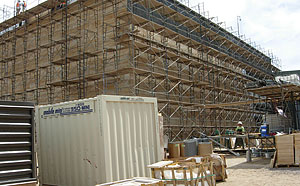
According
to D’Ippolito, approximately six to eight workers were on scaffolding, three
were on the ground prepping all the stone and another one was on the wall doing
the layout. “We had two cranes on site picking up the pieces from the ground to
put on the wall,” he said. “The men on the scaffolding were receiving the
load.”
Photo courtesy of Sun Valley Masonry
Grand Opening
In total, it took 26 months to complete construction of the Musical Instrument Museum. Groundbreaking commenced on February 6, 2008, and the Grand Opening was held on April 24, 2010.“The reviews and reactions to the project have been extremely positive,” said Varda. “It is quite extraordinary to create an institution like this from vision to completion in less than five years. The attendance since opening in April has been solid and increasing as the word gets out.”
Gupta is equally pleased with the success of the project. “Tab India has done numerous prestigious projects - and not just plain office buildings - around the world,” he said. “However, this one is special to me because it’s a museum funded by a Minnesota corporation’s ex-CEO, a Minnesota man himself. And secondly, music is close to our hearts and lifestyles, and now Americans will celebrate this music monument in which we supplied the stone. Almost as if we composed a symphony of stones for the project. Every time visitors go to MIM, they will definitely wonder about the stone.”
Sidebar: Musical Instrument Museum
Architect: Richard Varda, FAIA, ASLA, in collaboration with RSP Architects of Minneapolis, MNGeneral Contractor: Ryan Companies, Minneapolis, MN, and Phoenix, AZ
Stone Quarrier/Fabricator: Tab India, Jaipur, India (Teak sandstone)
Stone Supplier: Amsum & Ash, Minneapolis, MN (Teak sandstone)
Stone Installer: Sun Valley Masonry, Phoenix, AZ (Teak sandstone)
Stone Fabricator/Installer: Bell Stone Co., Phoenix, AZ (interior flooring, stone stair treads, stone countertops, window sills)
Waterjet Fabricator: Rock Hard Designs, Phoenix, AZ (World Map)
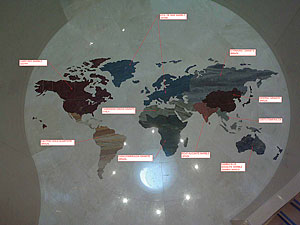
A focal point of MIM’s interior is the “World Stair” -
featuring a stone mosaic map of the world at the base of a grand spiral
staircase. The map, which features a variety of stone types, was designed by
RSP Architects and waterjet cut by Rock Hard Designs of Phoenix, AZ. Bell Stone
Co. of Phoenix performed the installation of the map as well as the majority of
the interior stone and tile work.
Sidebar: The “World Stairâ€
“The map concept [for the ‘World Stair’] was developed by RSP Architects as part of the overall stair design,” said Design Principal Ted Davis, AIA, IIDA, of RSP Architects. “The original ideas focused on how the floor could add to the visitor experience. The circular stair form seemed to suggest a compass or world map. As the design developed, the idea of repeating the gallery world map came forward. This is the same map used throughout the galleries that depicts the various geographic regions used to display the instruments.”The map design was waterjet cut by Rock Hard Designs of Phoenix, AZ. An assortment of stone was chosen for various continents and countries. These included:
• Cairo Red - North America
• Calypso Gold - Central and South Americas
• Azul De Mar - Europe and Greenland
• Tazmanian Green - West Africa
• Onda Esmerelda - South Africa
• Starburst - Russia
• Inferno - China
• Costa Esmerelda - Thailand
• Nambia Blue Sodalite - Australia
“The actual execution of the map dealt with the ‘physics’ of the stone,” explained Davis. “The team had to find stone that would represent the colors used in the museum map, which proved to be an interesting challenge. The team literally looked at over 1,000 stone options. Once stone color options were narrowed down, selection depended on the visual characteristics of the stone and how each cut of stone related to the other stones being used. Some stone were not available in the required thicknesses or had veining that wasn’t acceptable. Once finalized, specific stone slabs were scanned into a computer, so that the team could study which area of the slabs would be ideal for the floor map. For instance, each slab was typically 4 x 8 feet in dimension, but the actual cut-out was much smaller. The size of the map needed was moved around the slab until an ideal piece was found. This final piece was then cut with a waterjet. Some stone was not physically conducive for small cuts, and shapes had to be smoothed out to enable pieces to fit together. These factors led to the ‘artistic interpretation’ of the map.”
Once the stone pieces were cut, they were brought to the jobsite, and installed by Bell Stone Co. of Phoenix, AZ. “The pieces were fit together over a level bed of mortar,” said Davis. “Much like putting a puzzle together, the pieces were laid out following a full size template. The final result not only shows the creativity and craftsmanship of the building team, but emphasizes the importance of the world perspective for the museum.”
Looking for a reprint of this article?
From high-res PDFs to custom plaques, order your copy today!