Fabricator issues and solutions discussed at SFA Workshop
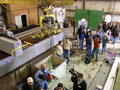
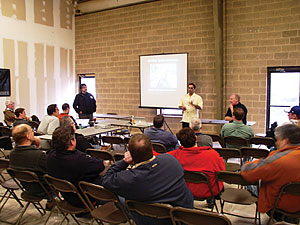
A recent Stone Fabricators Alliance (SFA) Workshop at
Crowe Custom Countertops in Acworth, GA, drew nearly 200 attendees.
Over the last few years, the Stone Fabricators Alliance (SFA) has been conducting Workshops among its members, and these events have included hands-on demonstrations as well as classroom education and open fabricator forums. Taking place at fabrication shops across North America, one of the most recent SFA Workshops was held at Crowe Custom Countertops in Acworth, GA, a volume production shop outside of Atlanta.
Founded in 2006, the SFA now has close to 600 members, and its Workshop attendance has grown from a total of 12 at the first session to nearly 200 at the current one.

The event included machinery demonstrations, and there
were also displays of hand tools and accessories as well as laser templating
equipment. Also, a number of SFA sponsors were on hand with tabletop displays
in a covered pavilion. These sponsors represented suppliers of large-scale
machinery as well as tooling, equipment, templating and stone care,
installation and maintenance products.
In addition to an in-depth presentation on using CNC and digital technology for both high-volume and small-shop production - published in the May 2010 issue of Stone World on page 64 - a variety of sessions focused on the issues and solutions facing fabricators today. The following is an overview of the various discussions that took place during the event.
“Ultimately, we knew that we couldn’t go on forever
without addressing [OSHA compliance,]” said Miles Crowe. “It would either be
voluntary, or OSHA would show up at our door one day. We set a budget, and we
got it done.”
Sidebar one: Session Summary: OSHA Compliance
by Miles Crowe, Crowe Custom Countertops, Acworth, GA, and Wayne Estes, Risk Management ConsultantOver the past decade, the stone industry has grown to the point that fabrication shops of all sizes have drawn the attention of OSHA. And while this development has been a concern of many shop owners, some have taken a very proactive shop and found it to be a useful step in many ways. Crowe decided to take this approach with his operation, and he spoke of another shop in the Atlanta area where OSHA proposed fines of nearly $135,000 earlier this year. (The official OSHA report on this situation can be found online by visiting www.osha.gov and searching “Atlanta Intown Granite.”)
“This process is manageable and doable,” Crowe said. “It really wasn’t painful at all. Ultimately, we knew that we couldn’t go on forever without addressing [OSHA compliance.] It would either be voluntary, or OSHA would show up at our door one day. We set a budget, and we got it done. It is an ongoing process, and we have developed procedures and task hazard analyses. We also remove anything in our shop that is not being used, so there’s nothing sitting around.”
According to Estes, the process of preparing for OSHA compliance is a matter of taking several specific steps, including the following:
Assess - “You need to start by investigating your plant and identifying the specific problem areas, and then you need to figure out what it will cost - also understanding that it will save your business money in the long term.”
Control -- “Figure out what you need to do to address the problems.”
Monitor - “How are the risks changing in your shop? Adding a piece of new equipment or new processes adds new risks, and you have to consider these new risks.”
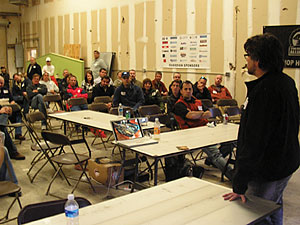
“To sell service, you have to be face to face, not
sending quotes on a spreadsheet over e-mail,” said Mark Lauzon. “That simply
says, ‘Here is the price.’ “
Sidebar two: Session Summary: Sales Techniques for Fabricators
by Mark Lauzon, Denali Stone Slab Studio, Woodinville, WAGiven the difficult recession that continues to plague many stone fabricators, the SFA called upon Mark Lauzon, a veteran stone fabricator, to offer a version of his presentation on sales techniques, which has been well received at past SFA events as well as trade shows such as StonExpo. In his presentation, Lauzon stressed the following main principles:
Selling is a process
“The days of simply taking orders are over,” Lauzon said. “You always hear about slogans or books called, ‘The Art of Selling,’ but selling is a process, not an art. Facts and data do not tell the whole story, and one unknown piece of information can change the story.”
Face-to-face meetings are key
Lauzon explained that at a time when customers already have leverage in terms of price, it is critical to make a shop stand out among increased competition. “At the end of the day, you need to be selling service,” he said. “If you are simply selling granite, then your only metric is price, and that only works if you are the low-cost provider.”
In order to position a fabricator as a provider of service, however, Lauzon stressed the need for personal contact. “To sell service, you have to be face to face, not sending quotes on a spreadsheet over e-mail,” he said. “That simply says, ‘Here is the price.’ “
The value of referrals
According to Lauzon, one of the greatest ways to draw business is via referral. “They are truly one of the biggest ways to draw business, probably more than advertising or prospecting,” he said. “You generate these by doing follow-ups with the customer at various intervals after the sale. You want to ‘touch’ the customer three times with follow-ups. You want to continually make sure they are happy, and they will remember you and refer you. If you just install the countertops and leave, they likely won’t. Of course, you need to do good work for them to refer you. If the countertop looks like you polished the edge with a chocolate bar, then it won’t work for you.”
One way to “touch” a past customer is to send follow-up surveys after the installation is completed to ensure they are satisfied. “You can even put a survey on your sales brochure,” he said. “It shows people that you care what they think.”
No selling on the phone
Speaking on direct sales efforts, Lauzon joked that the “Three Golden Rules of Phone Sales” are all the same: “Don’t sell over the phone.”
“If you’re talking to a potential customer on the phone, you cannot see that ‘a-ha’ moment when they become interested in something, and you cannot gauge their response or concerns,” he said. “If they won’t come out to your showroom, then you need to go to them and show them that you are willing to do more than your competitors. Once you are sitting down with them, you want to identify their two core needs, whether it is their budget, timing, taste or something else. If you have more than two factors, then you still haven’t identified their core needs. Once you have those core needs identified, then the closing process can begin.”
Of course, before making an appointment to visit the customer, Lauzon stressed the need to qualify the prospect - and this can happen over the phone. “What you are doing during that first call is establishing a rapport,” he said. “You want to identify the lead source and learn the purpose of the call. If they are a quality prospect that is legitimately looking to invest in granite countertops, then you go ahead and make the appointment.”
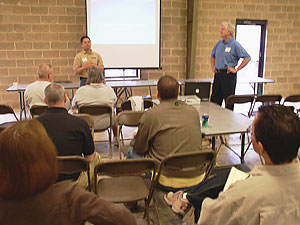
The session “Business Planning” was presented in a
“Town Hall” format, where the speakers interacted with the audience members,
and it included (from left): Mark Lauzon of Denali Stone Slab Studio in
Woodinville, WA; Prem Gnanarajah of Venetian Stoneworks in Woodinville, WA; and
Ron Hannah of Cadenza Granite & Marble, Inc. in Concord, NC.
Sidebar three: Session Summary: Business Planning
by Mark Lauzon, Denali Stone Slab Studio, Woodinville, WA; Ron Hannah, Cadenza Granite & Marble, Inc., Concord, NC; and Prem Gnanarajah, Venetian Stoneworks, Woodinville, WAIn this session, three industry professionals from varied backgrounds offered their insight on the need to create a long-term business planning strategy - not in a tough economy, but also when business is booming. The session was presented in a “Town Hall” format, where the speakers interacted with the audience members, and the following is a summary of the points that were raised.
When is it necessary to form a business plan?
Lauzon: A lot of times, when business is going well, people don’t think of forming a business plan. When I was working in fabrication, we went from doing three or four kitchens per week to three or four kitchens per day, and we did not plan for the recession.
What about diversifying your business?
Gnanarajah: We were able to do $2.2 million in business our first year, and one of the things we did was open up to other materials - not just quartz, but even Corian. Compared to stone, Corian is actually very easy to fabricate. You can do a full bullnose edge in one hour.
Miles Crowe (from the audience): I’ve heard people say, “I don’t bring in exotics because I don’t sell exotics.” But how can they know this if they aren’t offering exotics to their customers?
Hannah: It was not even two years ago that we were all purists. Now we will fabricate anything, or we will at least find someone who will and then offer a quote. We saw a significant overhaul at our shop over the past year. We shut down production between Christmas and New Year’s Day, and we reinvented the entire company. We looked inside ourselves, and we changed everything - the ways that we buy, our management style, selling, fabrication, etc. The economy forced us to change our way of thinking. We don’t have to be the low-cost provider, but we are at least in that area. [During the second half of 2009,] our business plan was simply to stay in business. We wanted to keep the shop busy, and we even started doing big-box work.
What are some of the elements of a business plan?
Lauzon: A structured business plan should help you deal with the pitfalls. You need to start with a vision of where you want to go and who is going to go with you. At this point, you need to determine if you have the right players in place to get there. Just because your company may be a few years old, that doesn’t mean you have a viable business plan in place. A business plan is a fluid document that is always changing as your company and market conditions change.
Hannah: Knowing your financials is also key. You need to have a firm idea of where you are financially in order for a business plan to work. We did a market analysis, and we know what our competitors are doing as well. We also know our real prices and costs.
Gnanarajah: It is also important that you do not base your financial status on cash flow. This is not long-term.
Hannah: Strategic partnerships are also important. Being a member of the SFA, we are able to utilize other waterjets in the region. When people ask if I have a waterjet, I say, “Yes, I do. It just happens to be in Acworth, GA, at Crowe Custom Countertops.” If you have made these partnerships, you never have to say no to a job, because someone will help you get it done.
Lauzon: This also includes partnerships outside the industry. My facility is in the wine country, and we supplied some granite at one of the local wineries. We have our business cards there, and it has resulted in some calls.
What about a leadership strategy?
Lauzon: Communication is key, and to do this right, you have to create “sub-leaders.” In the U.S. Army, people do not manage more than four or five people - at the most. If you have 30 or 40 people working in your shop, you really need to consider having the right sub-leaders in place.
Hannah: We have very definitive policies and procedures and enforcement in place. For example, cell phones are forbidden on the shop floor, and our employees know exactly what the penalties are for breaking this rule - when they will be suspended, and when they will be looking for another job.
Looking for a reprint of this article?
From high-res PDFs to custom plaques, order your copy today!