A revival of church architecture in the U.S.
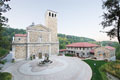
Considered one of the first major Catholic churches
built in a classical manner in the U.S. in over 50 years, the recent construction of
the Church of the Shrine of Our Lady of Guadalupe in La Crosse, WI,
proves churches of great grandeur are alive and well. The building utilizes a
broad range of lavish stone throughout the exterior and interior, with each
selection specifically chosen to provide special meaning to the area it
occupies.
Considered one of the first major Catholic churches built in a classical manner in the U.S. in over 50 years, the recent construction of the Church of the Shrine of Our Lady of Guadalupe in La Crosse, WI, proves that churches of great grandeur are alive and well. The building utilizes a broad range of lavish stone throughout the interior and exterior, with each selection specifically chosen to provide special meaning to the area it occupies.
Built to be a “pilgrimage church” honoring the Virgin Mary’s reported appearances before a simple Mexican peasant in the 16th century, the design process for the project was rigorous. Taking close to five years, much of it involved going to Mexico and studying older, ancient buildings and historical chapels dedicated to Guadalupe.
“The clients did not ask for a Mexican/Spanish building,” said Duncan Stroik of Duncan G. Stroik Architect LLC in South Bend, IN, which served as the Design Architect and Architect of the Interior for the project, also working in collaboration with Mike Swinghamer of River Architects in La Crosse, WI, which served as the Architect of Record and Architect of the Exterior. “We wanted to do something that reflected the story, but was not specifically Mexican.”
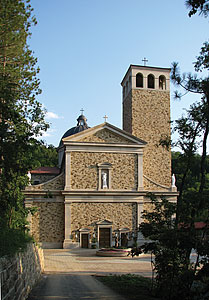
A mix of yellow, red and gray fieldstone comprises
much of the exterior, which was supplied by County Material Corp. in La Crosse,
WI. “My colleague, [Mike Swinghamer of River Architects in Lacrosse, WI, which
served as the Architect of Record and Architect of Exterior], came up with this
mix that he felt was the nicest blend,” said Duncan Stroik of Duncan G. Stroik
Architect LLC in South Bend, IN, which served as the Design Architect and
Architect of Interior. “For all the architectural elements, anything that had
to be more precise, we went with limestone. [The warm fieldstone is] a nice
contrast to the cool limestone detailing.” The exterior limestone came from
Becker & Becker Stone Company, Inc. of Dubuque, IA.
After several trips to Pietrasanta, Italy, a concept was born. “We interviewed a lot of stone companies and talked about the project with them,” said Stroik. “There hasn’t been a new church in America with this quality and classic style in a couple of generations. So they were excited. It’s a story of stained glass, plaster, paintings and marble sculptures.”
Stroik went on to explain the importance of having Archbishop Raymond L. Burke in his company throughout his travels. “It was great for the Bishop to have a say over colors, marbles, etc. and take the time for these trips, since he’s a very busy man,” he said. “He was very supportive and also very involved in all of the stone decisions, which was very exciting for myself and Mike Swinghamer, along with Joe Becker, the American installer.”
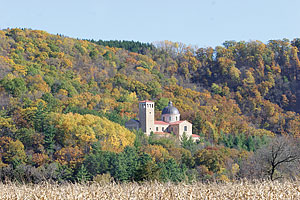
The exterior was intended with its rugged stone, tower
and dome to appear as if it grew out of the rock laden bluff.
"Beautiful and lastingâ€
According to Burke, a continuing goal for the planning and construction of the Church of the Shrine of Our Lady of Guadalupe was to use only materials which are truly beautiful and lasting. Since the shrine would be stationed on a rocky hill, a mix of yellow, red and gray fieldstone comprises much of the exterior, which was supplied by County Material Corp. in La Crosse, WI. The design sought to create an effect for patrons and passersby where it would appear that the stone was coming out of the hill.“Our choice for the exterior stone comes from the part of the country in which the Shrine of Our Lady of Guadalupe is located and which is most beautiful and enduring,” said Burke.
Stroik explained that Swinghamer, his partner for the project, came up with the mix of fieldstone that he felt was the nicest blend. “For all the architectural elements, anything that had to be more precise, we went with limestone,” he said. “[The warm fieldstone is] a nice contrast to the cool limestone detailing. Mike Swinghamer spent a lot of time on getting the mix of stones just right.”
“The lintels and other frames of windows, doors, etc. on the exterior were done in the classical limestone used in the building of churches, down the centuries,” added Burke. The exterior limestone came from Becker & Becker Stone Company, Inc. of Dubuque, IA.

While the exterior is considered simple and rugged,
the interior is intended to be more refined, elegant and glorious, providing a
nice contrast between the two. “In the interior, in accord with the long
tradition in the building of churches, beautiful marbles of various colors were
chosen,” said Archbishop Raymond Burke, who was active in the stone selection
process. “The coordination of the marbles is meant to draw attention to the
sacred reality of the Church of the Shrine of Our Lady of Guadalupe. The marbles were chosen in Pietrasanta, Italy,
a very old and much esteemed center for marble work, especially in the building
of churches.”
Crossing a threshold
While the exterior is considered simple and rugged, the interior is intended to be more refined, elegant and glorious, providing a nice contrast between the two spaces. “The exterior stonework serves to draw pilgrims to the Church of the Shrine of Our Lady of Guadalupe,” said Burke. “Its natural beauty attracts the attention of the pilgrim and invites the pilgrim to enter the church. The stonework in the interior of the church coordinates with the function of each space in the church.“In the interior, in accord with the long tradition in the building of churches, beautiful marbles of various colors were chosen,” Burke continued. “The coordination of the marbles is meant to draw attention to the sacred reality of the Church of the Shrine of Our Lady of Guadalupe. The marbles were chosen in Pietrasanta, Italy, a very old and much esteemed center for marble work, especially in the building of churches.”
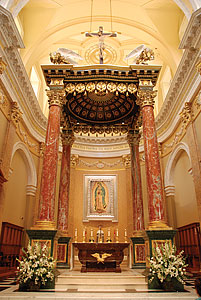
Rouge du Roi, which in French means the “king’s red”
was chosen for the altar area. Additionally, Giallo Sienna was selected for the
crown of the altar, and all of the baldacchino columns are made of Rosso
Francia. “It’s a piece of marble with a lot of movement and vein ing,” Stroik
said of the Rosso Francia, adding that the colors used for the baldacchino and
the altar are classic, but expensive. “It was the right spot to spend the money
on, though.”
The nave leads up to the sanctuary, which has a floor with a slightly different decorative pattern, including Noir St. Laurent, Statuario, Botticino Classico, Rosso Levanto, Tinos Green and Rosso Portogallo.
Located on the sanctuary, the altar is set aside to be the most important area of the shrine. As a result, it utilizes the most expensive materials. “The most beautiful marble work is found in the sanctuary, in the altar, which is the point of focus of the whole church,” said Burke.
“With the multi-colored floor [in the nave], we then wanted the sanctuary to be ultra-white to stand out,” Stroik added. “The biggest thing was how to put this all together. We had a mosaic and a tabernacle, but needed to see the altar. As in classic Italian form, we put the baldacchino, which is like a canopy on four columns. I like to think of it as an exclamation point; you want everyone to see what’s underneath.
“We wanted to have all of the sanctuary elements harmonize together while allowing each to stand on its own,” he continued. “Early on, we said the altar would be red. Our supplier, Pocai, helped us define the altar marble, which ended up being a Rouge du Roi.”
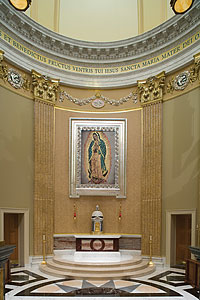
Stone continues into other spaces, including the
tabernacle, which features White Carrara “Bianco P” for the roof, architrave
and cornice. Statuario is utilized for its pedestal, while Belgium Black makes
up the tabernacle’s column capitals and bases. The column shafts features
Sodalite, and the tabernacle base is Venetian Gold.
The altar additionally features Giallo Siena for the crown, and the four baldacchino column shafts are monolithic and made of Rosso Francia. “It’s a piece of marble with a lot of movement and veining,” Stroik said of the Rosso Francia, adding that the colors used for the baldacchino and the altar are classic, but expensive. “It was the right spot to spend the money on, though.”
The wall of the major shrine is Arabescato Orobico, while all of the bases and the base at the shrine are Verde Issorie. The treads and risers at the shrine feature Botticino Classico.
Moreover, White Carrara “C” marble can be found for all the donor plaques and pilaster bases in the sanctuary, as well as the minor shrine altar tops.
Stone continues into other spaces, including the tabernacle, which features White Carrara “Bianco P” for the roof, architrave and cornice. Statuario is utilized for its pedestal along with the sanctuary communion rail, while Belgium Black makes up the tabernacle’s column capitals and bases. The column shafts use Sodalite, and the base of the tabernacle is Venetian Gold.
Additionally, the tabernacle frieze was done in a French Rouge Antique. “We used a couple of French marbles that were brought to my attention by the supplier because he owned a quarry in France,” said Stroik. “Because of this, he allowed us to use them in lieu of Italian marbles, which was very nice of him since they’re more expensive otherwise.”
For exiting and entering the church, the floor of the narthex is comprised of different granites, including Santa Cecilia, Carmen Red and Venetian Gold. “The Italians were aghast that we designed the narthex with a granite floor,” said Stroik. “But we really felt that due to the cold winters in Wisconsin, and the salt that would be dragged in with the snow, we had to consider that seriously. Marble would be eaten by the salt, and would quickly lose its shine.”
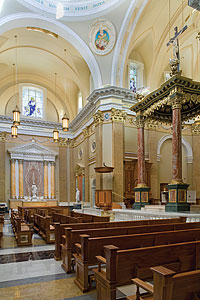
“It’s a story of stained glass, plaster, paintings and
marble sculptures,” said Stroik of the design concept behind the interior work.
Project challenges
Aside from the challenges of choosing the right materials and blending them accordingly, the design team was faced with difficulty from the start because of the site’s topography. The shrine sits atop a hill, and construction had limitations set by the county.“The county would only let us build on certain areas of the hill,” said Stroik. “We couldn’t make it as long or wide as we might want because of site limitations. Also, with steep topography it was quite difficult to get machinery up it, get a level ground to build on and bring the stone up.
“The fabrication by Pocai and their carvers and sculptors was excellent,” he continued. “And the installation by Twin Cities Tile and Marble of St. Paul, MN, was top notch. They were good at matching and installing the marbles precisely. When there was a problem, they fixed it immediately. They took care of things well and were great to work with.”
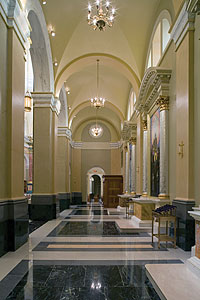
“The beauty of the stonework is a significant part of
what draws pilgrims to the shrine and makes their visit to the shrine so
memorable,” said Archbishop Burke.
Opportune connections
Although the original design did not call for a Mexican inspiration, Stroik was pleased to discover the end project had a few links. “There were a number of nice connections,” he said. “Much to my happiness, the ancient buildings dedicated to Guadalupe in Mexico City that we studied had very similar dimensions to what we built, which was a surprise. I felt it was like a sister or daughter of the Mexican churches.”
Pointing out another connection, Stroik remarked that the base in the narthex is a Gray Tapeaca from Mexico. “It fit in well with the rest of the colors and we wanted to use some elements from Mexico,” he said.
Construction of the 35,000-square-foot, $30 million project took a little more than three years to complete, with Stroik very proud of the final product. “I hope that this building demonstrates that it is possible to build churches like this again,” he said.
“The overall response of those who have been blessed to visit the Shrine of Our Lady of Guadalupe is one of awe at the beauty and of inspiration to prayer and to greater trust in God’s providential love,” Burke added. “The shrine has become well known throughout the U.S. and beyond. The beauty of the stonework is a significant part of what draws pilgrims to the Shrine and makes their visit to the shrine so memorable.”
Sidebar: Church of the Shrine of Our Lady of Guadalupe
La Crosse, WIOwner: Shrine of Our Lady of Guadalupe, Inc.
Contractor: Fowler and Hammer, La Crosse, WI
Architect of Record/Architect of Exterior: River Architects, La Crosse, WI
Design Architect/Architect of Interior: Duncan G. Stroik Architect LLC, South Bend, IN
Exterior Stone Supplier: County Material Corp., La Crosse, WI (fieldstone); Becker & Becker Stone Company, Inc., Dubuque, IA (limestone)
Interior Stone Supplier: Italmarble Pocai Srl, Italy
Interior Stone Installer: Twin Cities Tile and Marble, St. Paul, MN
Stone Statuary Supplier: Stone Consulting Sas, Italy
Looking for a reprint of this article?
From high-res PDFs to custom plaques, order your copy today!