Waterjet-cut stone anchors commercial design
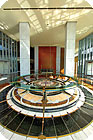
A
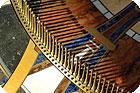
floor medallion made of stone became the “special setting” for the Foucault
Pendulum - a feature that demonstrates the rotation of the Earth - in the main
lobby of the Hunt Oil Co. Headquarters in Dallas, TX. Artists Michaela Mahady
and John Pietras of Pegasus Studio, Inc. of Stillwater, MN,
designed the medallion, in addition to the entire pendulum. Photos by Ron
DeAngelo/Courtesy of Waterjet Works!
In conceiving designs for the Hunt Oil Co. headquarters in Dallas, TX, Ray Hunt - who owns the privately held independent energy company - sought to adorn the main lobby with a focal point that would draw the attention of visitors with more than just an artistic appeal. After many rough sketches of ideas, Hunt finally decided to move forward with the design team of artists Michaela Mahady and John Pietras of Pegasus Studio, Inc. in Stillwater, MN, in an attempt to create a Foucault Pendulum - a feature that demonstrates the rotation of the Earth - to be placed in the center of the room.
“Ray Hunt had admired the sculpture we did for the EDS headquarters building in Plano, TX, and wanted to talk about his new building,” said Mahady. “Ray had decided he wanted to have a Foucault Pendulum in the lobby. It was our task to design the visual setting for the pendulum, which would surround it at the floor and the ceiling.”
The pendulum, made with a heavy bronze orb and weighing 265 pounds, needed a special place to swing, according to Mahady. “That’s where we used the stone,” she said.
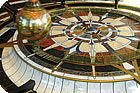
The
floor medallion features seven different types of stone, including Starry
Night, Nero Marquina, Rossa Radica, Tan Diano Reale, Bianco Carrara, Black
Absolute and Tan marble. And in total, 25 slabs were purchased in order to pick
the correct areas of the stone, according to Phillip Einsohn of Waterjet Works!
in Dallas, TX, which fabricated the stone pieces for
this project.
The artists, who often work with glass, felt that stone would be the most suitable option for this particular project. “John and I have traveled a lot through the years, especially in Italy,” said Mahady. “I’ve been visually drinking in Italian stonework for years. When Ray Hunt said he was interested in doing a pendulum, I immediately went to that imagery of very lushly colored stone pieces. The color, texture and capabilities made it the most appropriate material.”
The floor medallion features seven different types of stone, including Starry Night, Nero Marquina, Rossa Radica, Tan Diano Reale, Bianco Carrara, Black Absolute and Tan marble.
“The Tan Diano Reale had a really beautiful grain,” said Mahady. “We used Starry Night sparingly, picking the most intense pieces. And Rossa Radica is a very dramatic Italian rust color with very directional organic stripes. It was a challenge, since we only had two slabs of it, and it has a very visible grain that we had to follow. It didn’t end up chipping, though, so the two slabs were enough.”
In total, 25 slabs were purchased in order to pick the correct areas of the stone, according to Phillip Einsohn of Waterjet Works! in Dallas, TX, which fabricated the stone pieces for this project. “It’s like a paint job,” he said. “You have to pick the correct palettes, and in this case, stone.”
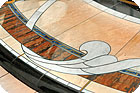
Even
after the slabs were chosen and then cut, they again had to be reviewed for approval.
“Each slab was color checked by circling acceptable areas prior to cutting,”
said Einsohn. “Machine artists had to position the cutting heads to maximize
the amount of acceptable stone. After cutting, they were laid on a table and
reviewed again for acceptability. All pieces were double checked for size and
clean edges.”
Many steps were then taken prior to the fabrication of the pieces. “The technical drawing provided by Waterjet Works! and approved by the artist had to be adhered to as if this was a space ship,” Einsohn explained. “If not, the pieces would not align properly.”
Additionally, as with selecting the slabs, color and directionality was still a concern. “The slabs were photographed and then brought into AutoCAD and overlaid onto the cut files,” said Einsohn. “This would allow the operator to see exactly how to lay the slab on the machine and what was to be cut from the slab. Our goal was to cut with a certain grain direction in mind. Each piece had to appear to be bursting forth from the center, as if to exemplify the beginning of time or the rings on a tree, nature’s clock. You don’t necessarily pick up on that unless you’re keyed in on the minute details of the stone.”
Dee
Brown, Inc. of Dallas, TX, installed the final stone medallion
ensemble for the Foucault Pendulum. Other areas of the finished product include
“knockdown pegs” to demonstrate the motion of the pendulum itself.
Even after the slabs were chosen and then cut, they again had to be reviewed for approval. “Each slab was color checked by circling acceptable areas prior to cutting,” said Einsohn. “Machine artists had to position the cutting heads to maximize the amount of acceptable stone. After cutting, they were laid on a table and reviewed again for acceptability. All pieces were double checked for size and clean edges.”
The approved pieces were then dry laid in Waterjet Works! facility to allow Hunt and his associates, along with the artists, architects, interior designers, general contractor and installation team - to visually understand the true scope of the project prior to the assembly of the 2,600 pieces, which would form the entire floor medallion.
Additionally, there are terraced marble steps that surround the perimeter of the medallion, which were custom manufactured in Carrara, Italy.
Einsohn explained that challenges came with the extremely small pieces. “Even with the waterjet machines, it doesn’t take a lot for it to be off,” he said. “With thousands of pieces, if one is off, it has a tremendous ripple effect and nothing fits.”

With
the finished project, Mahady explained, “You can sit in the lobby and it’s kind
of like watching a fire or the ocean - people are drawn to it. Then when you
approach it, you discover the stonework and metalwork.” Photo by Ron
DeAngelo/Courtesy of Pegasus Studio, Inc.
Dee Brown, Inc. of Dallas, TX, installed the final stone medallion ensemble for the Foucault Pendulum. Other areas of the finished product include a metal ceiling medallion and “knockdown pegs” to demonstrate the motion of the pendulum itself - all of which were designed by Pegasus Studio, Inc.
“There were a lot of players in this,” said Mahady. “There were a lot of different pieces to be brought together. John had the major role of bringing all those people and trades together, and making sure they coordinated properly. He was there for the installation - living and breathing the pendulum - while I, and my associate, Maury Stenerson had the task of doing the intense drawing.”
After the completion of the building and the pendulum, the Hunt Oil headquarters held an open house, in which the pendulum engaged the interest of many visitors. “It’s really interesting in that it’s constantly moving,” said Mahady. “You find it very calming and reassuring. You can sit in the lobby and it’s kind of like watching a fire or the ocean - people are drawn to it. Then when you approach it, you discover the stonework and metalwork.”
Additionally, Mahady noted the pleasure of working with Ray Hunt. “He was just a wondrous client to work with - there throughout the process and extremely appreciative in the end,” she said, adding that this was very complicated project with a tight time frame where each of the many people involved excelled.
Hunt Oil Co. Headquarters
Floor Medallion for the Foucault Pendulum
Dallas, TX
Owner: Ray Hunt
Artist: Pegasus Studio, Inc., Stillwater, MN
Fabricator: Waterjet Works!, Dallas, TX (floor medallion)
Installer: Dee Brown, Inc., Dallas, TX
Looking for a reprint of this article?
From high-res PDFs to custom plaques, order your copy today!